The World Humanoid Robot Games medal table for 2026 exists in three versions, and they have three different winners. AgiBot says it won 18 gold, 16 silver and 12 bronze medals and “ranked first on both the gold medal table and the overall medal table”. X-Humanoid, the Beijing Humanoid Robot Innovation Center, says its robots won 15 gold, 12 silver and 18 bronze and came first on the medal table. A per-team table published by the Beijing Daily’s news app puts neither company’s name at the top, but a single team, Tiangong, run by X-Humanoid itself. The organisers have not published a medal table of their own, so each of the three is a way of adding up the same result sheets.
Who topped the World Humanoid Robot Games medal table?
The organisers post results on the Games’ official site, whrgoc.com. When we read its announcements on 27 September they held 84 notices: result sheets for finals and preliminary rounds, corrected sheets, notices cancelling results and administrative notices. None of them is a medal table, and a few finals, football among them, have no result sheet there at all. The sheets that do exist name the team that finished in each place and, for athletics, the organisation behind it. They do not name robot models.
The closest thing to an official table is the one the Beijing Daily’s app published on 27 August under the heading “Final version!”, carrying the Games’ logo. It ranks teams, sorted by golds, then silvers, then bronzes. First is Tiangong, X-Humanoid’s own team, with 5 gold, 0 silver and 4 bronze. Second is the Shanghai AgiBot team with 4 gold, 4 silver and 1 bronze. Several of the next places also go to teams linked to one of the two companies.
The company counts are a different kind of table. AgiBot’s announcement of 26 August claims 46 medals and first place on both golds and total medals. X-Humanoid’s post claims 45 medals and first place too. On their own figures AgiBot has more golds, 18 against 15, and one more medal in total, 46 against 45; X-Humanoid has more bronzes, 18 against 12. Company tables compiled by Chinese news sites follow the same figures, with AgiBot first, X-Humanoid second and Unitree third. Both companies cannot be first on the same table, which is the clearest sign that they are not counting the same teams.
How do AgiBot and X-Humanoid count their World Humanoid Robot Games medals?
X-Humanoid says how it counts. In a post of 8 September, it writes that it formed “secondary development joint teams” with dozens of universities and industry partners, and that together they produced “the Tiangong family’s 15 gold, 12 silver and 18 bronze, first on the medal table”. The same post counts 49 joint teams using its Tiangong robots, drawn from 31 universities and from industry companies including UBTech and BrainCo. The quotations are our translation of the Chinese. X-Humanoid’s total is a count by robot brand: any team that ran a Tiangong robot adds to it.
AgiBot’s announcement does not say how it counted. It names a lineup including the OmniHand dexterous hand and the G2, A3 and X2 robots, and says they are “robots already in mass production or deployed in real-world applications, rather than models developed specifically for competition”. On the result sheets, teams whose names carry Zhiyuan, AgiBot’s Chinese name, were entered from Shanghai, Shenzhen, Ningxia, Chengdu, Wuxi and Beijing, and the athletics sheets list several of them under AgiBot companies. Other winners are joint teams, such as the Wuhan University and AgiBot team that won the powder weighing event. Neither company publishes the list of teams behind its total.
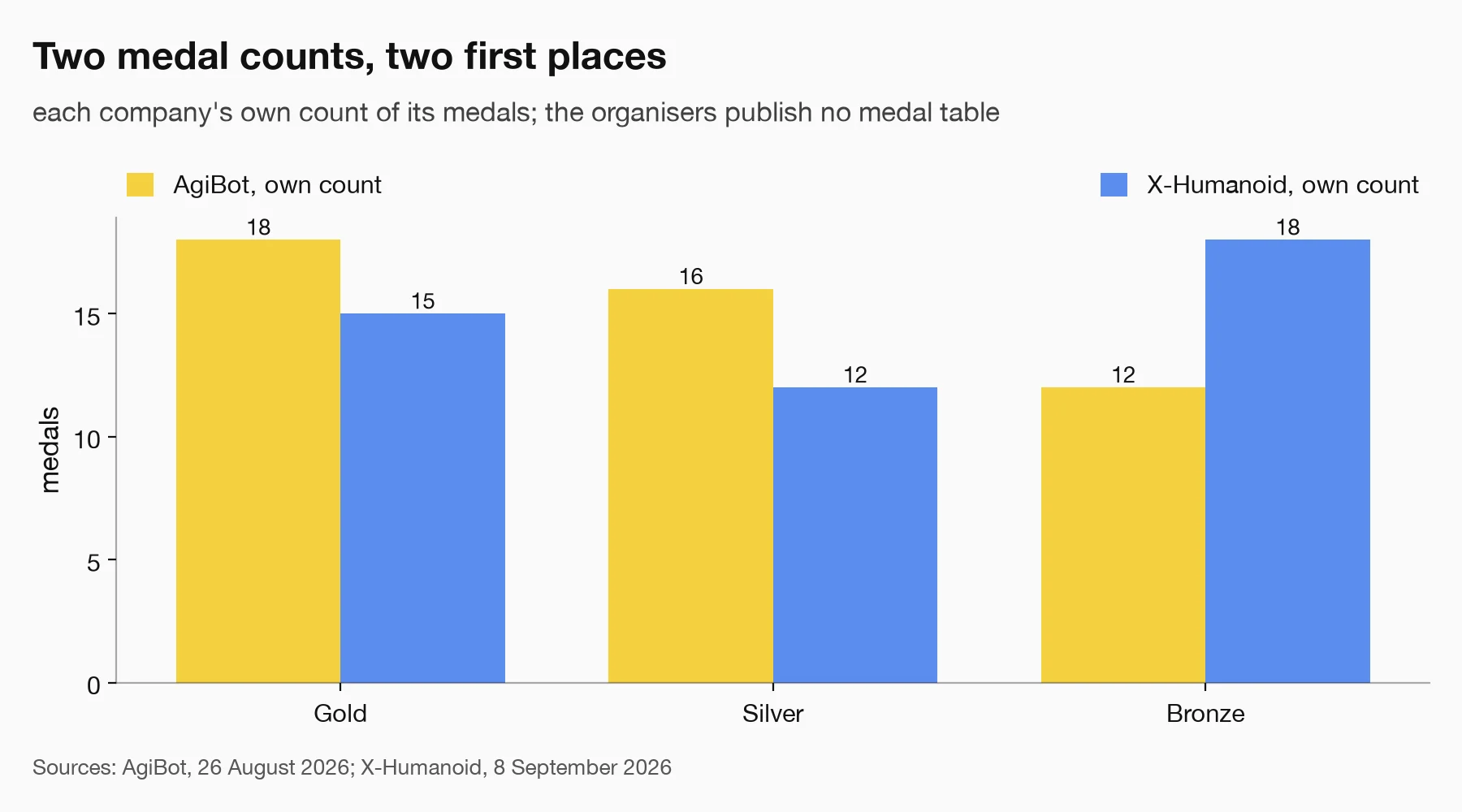
AgiBot has more golds and more medals on its own count, X-Humanoid more bronzes. Both count several teams under one brand.
So there are three questions, and each table answers one. Which team won the most? Tiangong. Which company’s robots won the most golds? AgiBot, on its own count. Which company’s robots won the most medals? Both say they did. Neither company table can be rebuilt from the official sheets, because the sheets do not say which robot each team used.
How do AgiBot’s World Humanoid Robot Games medal claims compare with the result sheets?
Some of AgiBot’s claims can be checked against the sheets, and most hold. AgiBot says OmniHand “reached the finals in all eight events and won seven gold medals” in the dexterous hand competition. The eight final sheets show teams carrying AgiBot’s name first in seven of them; the eighth, power tool assembly, went to a team called Lingxin Qiaoshou. AgiBot says its X2 won the 100 metres obstacle race, and the sheet agrees that an AgiBot team, from Shenzhen, won in 1 minute 28.32 seconds, though it does not name the robot. The release adds that X2 “competed in its mass-produced configuration without hardware modifications specifically for the Games”, a claim the sheets cannot test.
Two claims do not match the sheets. AgiBot says X2 took “silver and bronze medals in the 400m obstacle race”. The official 400 metres obstacle sheet gives silver to the Shanghai AgiBot team and bronze to X-Humanoid’s own team, Tiangong. AgiBot also lists hotel services among the tasks in which it won gold. The organisers’ corrected hotel result puts a team named for UniX AI first and two AgiBot teams second and third, and the first version of that sheet had no AgiBot team ahead of UniX AI’s either. We set out the corrections, and link the organisers’ result sheets, in our piece on the scenario events.
The rest of the announcement is about production, not sport. It says the G2 used at the Games “has already been deployed at factories operated by companies including Longcheer and SAIC”, and that in June 2026 AgiBot’s 15,000th robot rolled off its production line. Those are company statements, not results, and they are the numbers AgiBot most wants attached to its medals. How the makers’ shipment claims compare with their filings is the subject of our piece on how many humanoid robots shipped.
Where did Unitree finish at the World Humanoid Robot Games 2026?
It depends on the table. Unitree’s own team appears on the podium twice in the organisers’ sheets, with silver in Tai Chi, behind the Shanghai AgiBot team, and silver in the 40 kilogram free combat, behind a team from North China Electric Power University. It is not in the top three of any athletics final. The media company tables put Unitree third, and one of them credits it with 10 medals, a total that can only come from counting other teams that used its robots.
That gap between tables cuts both ways. It is why no one can check a company’s medal total against the published sheets, and it is why AgiBot, X-Humanoid and the news sites each produced their own. Buyers comparing makers on price face the same kind of work with list prices, as we found in our piece on what a humanoid robot costs.
The fix is small and belongs to the organisers. A result sheet with one more column, the robot model, would let anyone count medals by team, by company or by robot, and would make the next claim of first place checkable on the night it is made. With the third Games set for Beijing in August 2027, as we note in our results piece, there is a year to add it.