For most of the history of robotics, the price of a humanoid robot was a sales conversation. In September 2026 it is a shopping cart. Unitree lists its R1 from $4,900, its G1 from $13,500 and its H2 at $29,900 on its humanoid store page, and 1X takes orders for its NEO home robot at $20,000 or $499 a month. Those numbers, plus the $4,290 Unitree asks for its smaller R1-D, are the whole public answer to what a humanoid robot costs this year. The makers who publish no price at all say nearly as much as the ones who do. For buyers, a table below sets each price beside the maker’s load figure, availability and rental terms.
What does a humanoid robot cost from Unitree?
Unitree’s store shows six humanoid products. Three carry a price a buyer can act on: the R1 from $4,900, the G1 from $13,500 and the H2 at $29,900. A fourth, the R1-D, starts at $4,290. The word “From” matters on the R1 and the G1. It is the price of the base configuration, and the store sells other editions of the same robots above it.
The remaining two listings need reading with care. The H1 shows $90,000 beside the words “Contact us for the real price”, so the store itself tells you not to take that number at face value. The H2 Plus is listed at exactly $100,000.00, the same round figure the store shows against four other products, including its B2 quadruped. We leave both out of the comparison below. One is flagged by Unitree as not the real price, and the other matches a figure the store repeats across unrelated models.
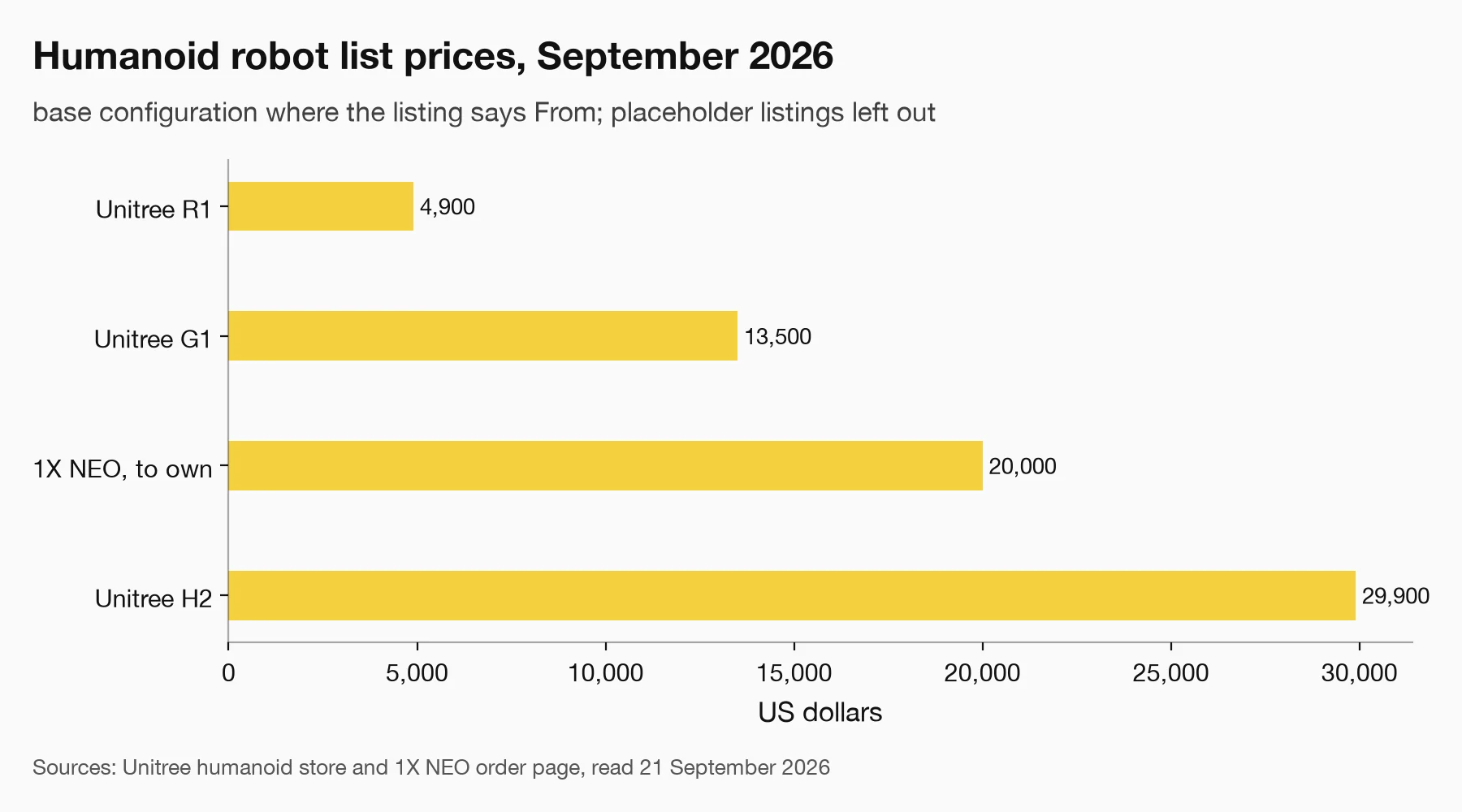
Every humanoid robot with a usable public price in September 2026. Unitree listings that say From are base configurations; the H1 and H2 Plus listings are left out as placeholders.
What the usable numbers show is a spread of about six times between the cheapest humanoid on sale and the most expensive one with a real price: the R1 costs less than a sixth of the H2. Every one of them is below $30,000.
Those list prices sit on top of a falling average. Unitree’s prospectus for its Shanghai listing gives its average humanoid selling price as 593,400 yuan in 2023, 260,400 yuan in 2024 and 166,400 yuan in 2025, a fall of about 36% in the last year (260,400 minus 166,400, divided by 260,400).
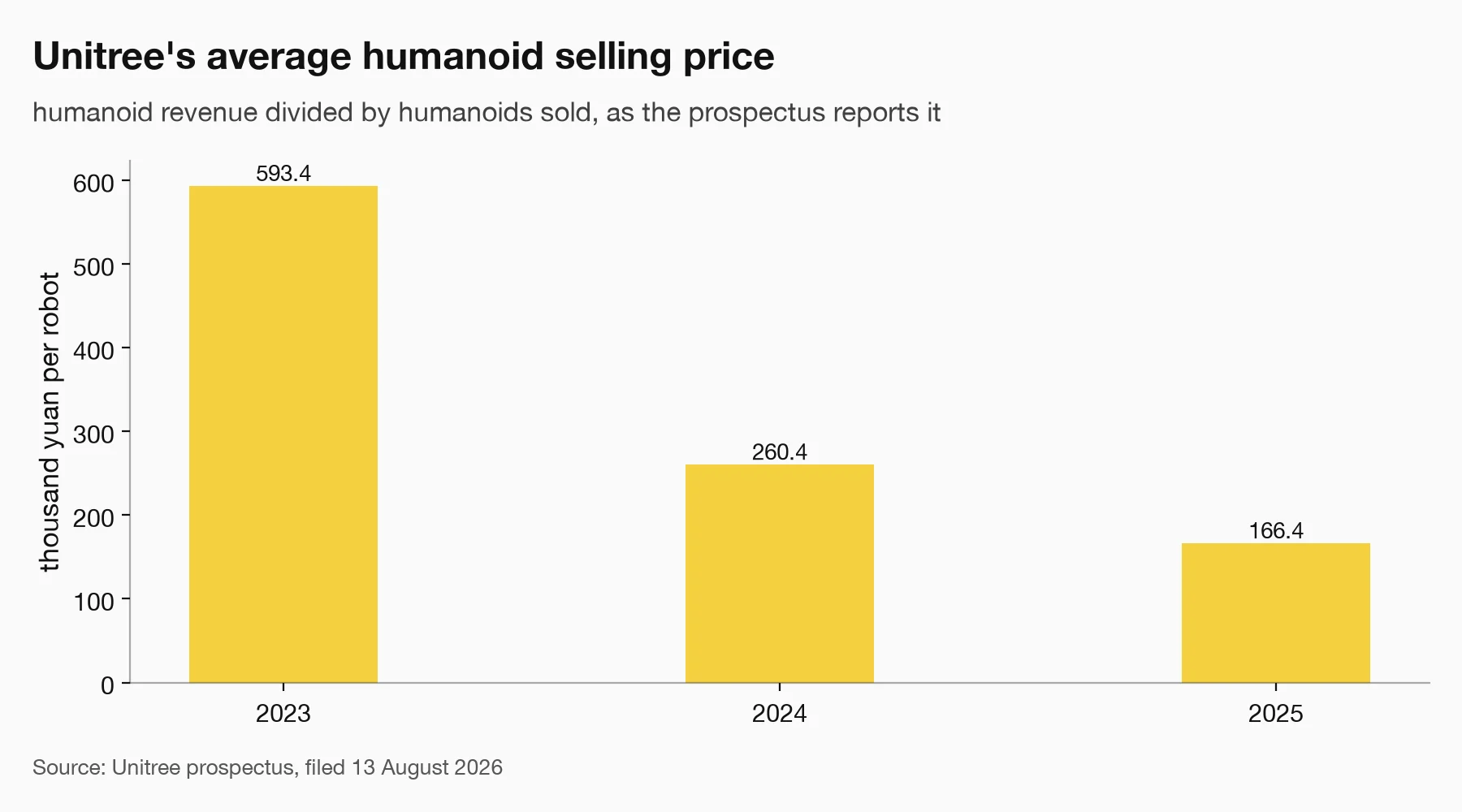
Unitree’s average humanoid price fell by almost three quarters in two years as sales went from 5 robots to 5,215.
What does 1X NEO cost to buy or to rent?
1X sells NEO two ways on its order page. Ownership costs $20,000 and comes with a three-year warranty, under the heading Early Access. The subscription costs $499 a month and includes what 1X calls a “Starter Productivity Package”. Either route starts with a $200 deposit, which the page’s FAQ says is fully refundable up to the point the robot is ready for delivery, and the page says US deliveries start in 2026.
The FAQ on the same page describes the subscription in two sentences: “You pay monthly for having and using a NEO at home. At the end of your subscription, you may extend it or return NEO.” It states no minimum term.
Two more details on the page narrow who these prices apply to. Deliveries are listed for the US only, so a buyer anywhere else has no NEO price at all. And the FAQ says NEO is manufactured in California. The $200 deposit is a reservation rather than a purchase, since it is refundable until the robot is ready to ship.
The page also gives the only running cost any humanoid maker publishes: on standard retail electricity rates, 1X says it expects NEO to “run for under $1 a day”. The specification page lists 842 Wh of battery, a run time of 4 hours and a quick charge of 6 minutes per hour of runtime. NEO weighs 66 lbs, about 30 kg, and stands 5 ft 6 in.
The arithmetic decides between buying and renting. Forty months of subscription comes to $19,960, and the forty-first payment takes the total to $20,459, past the purchase price. Anyone who expects to keep NEO for more than three years and five months pays less by buying it. Anyone who wants to stop after a year pays $5,988 and hands it back. It is the same trade we set out for AI models in our piece on ownership versus cognitive rental, with a body attached.
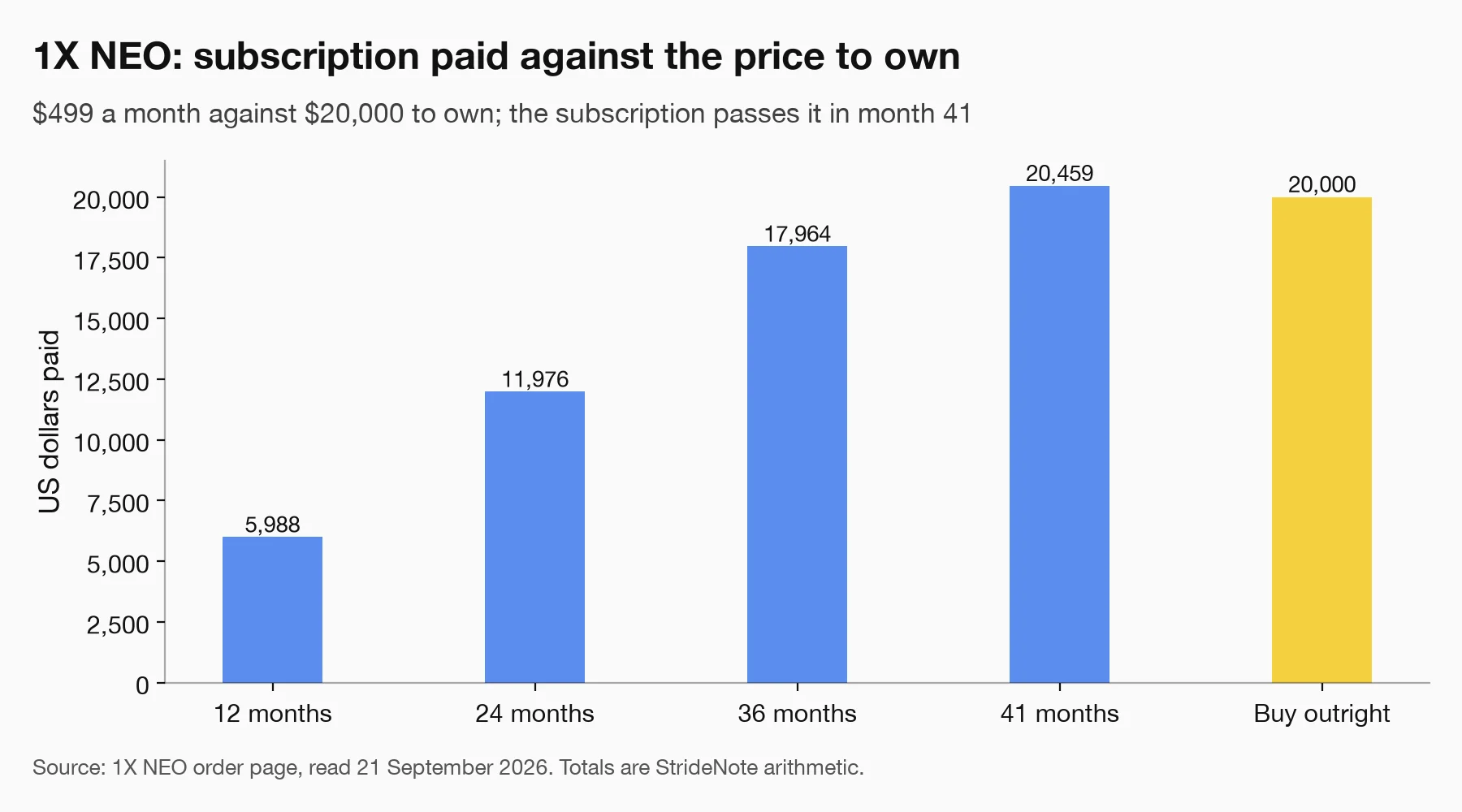
The subscription passes the purchase price in month 41. Totals are our arithmetic from the prices on 1X’s order page.
Buying NEO also buys into how it handles data, which is a question the price does not answer. We read what 1X has written about that in our piece on 1X NEO privacy, and the answer is in a less binding place than a buyer might expect.
Why do Figure, Boston Dynamics and Tesla publish no humanoid robot price?
None of these companies explains why it publishes no price, so we will not guess. What the record does show is who the robots go to. The robots with list prices are sold to anyone with a card: households in the case of NEO, and whoever checks out on Unitree’s store. The robots without prices are going, where their makers say at all, to industrial customers, research partners or the maker’s own factories.
Boston Dynamics Atlas: 2026 is sold, outside customers from early 2027
Boston Dynamics launched the production version of Atlas on 5 January 2026 with an announcement saying all Atlas deployments for 2026 “are already fully committed”, with fleets scheduled to ship to Hyundai’s Robotics Metaplant Application Center and Google DeepMind. “The company plans to add additional customers in early 2027.”
The announcement describes Hyundai Motor Group as “Boston Dynamics’ majority shareholder” and says Hyundai “is preparing to deploy tens of thousands of Boston Dynamics’ robots into its own manufacturing facilities.” It mentions Hyundai’s $26 billion investment in US operations, including a new robotics factory “capable of producing 30,000 robots per year”. That is the capacity of an announced factory, for robots in general rather than Atlas alone. There is no price and no count of Atlas units built or shipped.
Figure 03: over 350 delivered, none offered for sale
Figure’s product page for Figure 03 lists the robot at 5 ft 8 in, 61 kg, a 20 kg payload, five hours of runtime and a speed of 1.2 metres a second, and no price. Its production update of 29 April 2026 reported “delivering over 350 of our third generation humanoid robots” and raising the production rate “from 1 Figure 03 per day to 1 per hour”, a 24 times improvement in under 120 days. It also gave an end-of-line first pass yield of over 80 per cent, a battery line that has “shipped over 500 battery packs” at a 99.3 per cent first-pass yield, and “over 9,000 actuators across more than 10 distinct SKUs”.
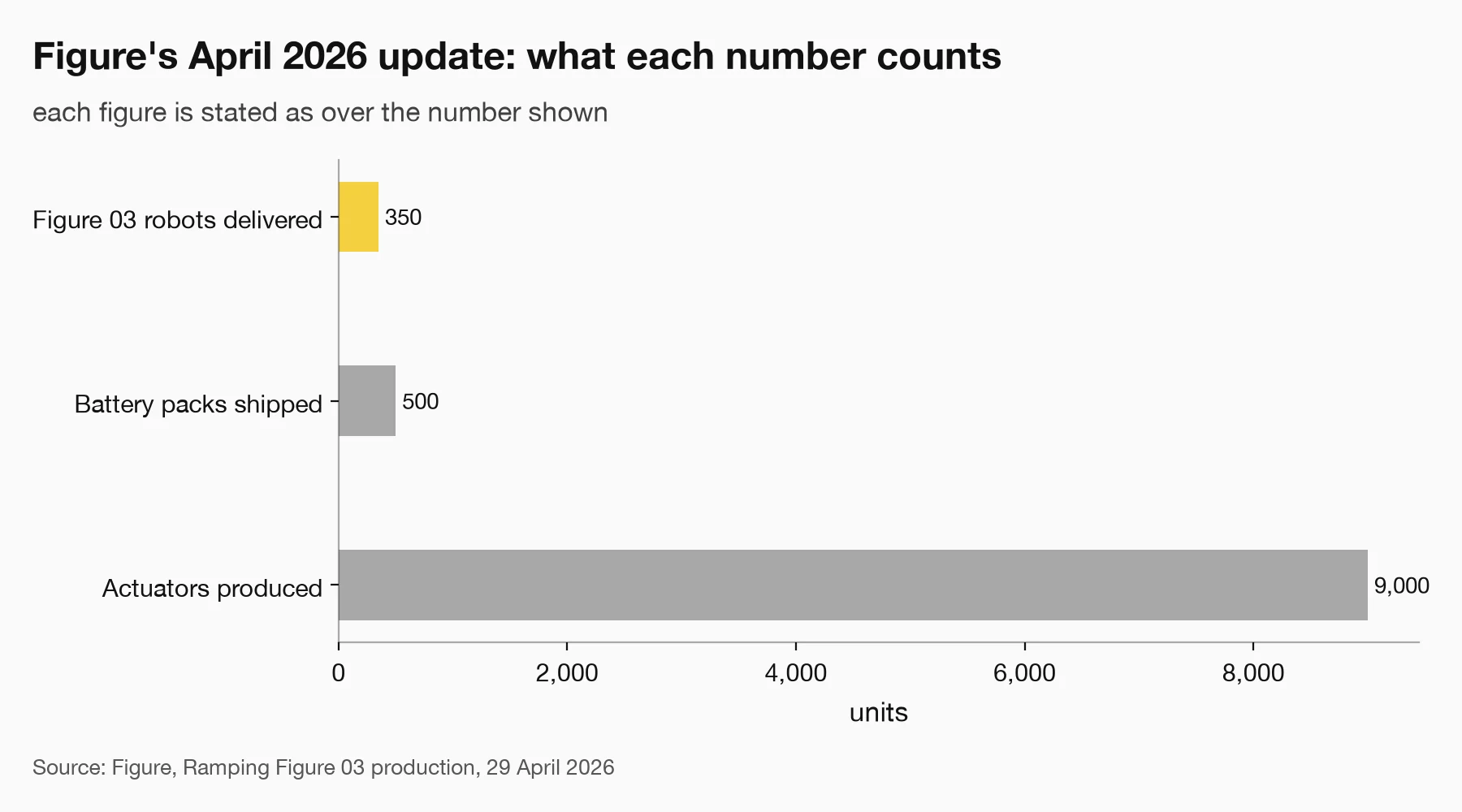
Figure’s own numbers from 29 April 2026. Only the yellow bar counts robots; the grey bars count parts.
Only the first number counts robots. The update says where they went: “Robots shipped from BotQ are allocated to internal research and development groups, data collection, efforts for robots to perform end-to-end housework, and commercial use-case development.” It names no customer and does not say whether any of the 350 were sold.
Agility Digit 5: early access in the first half of 2027
Agility Robotics is the only one of the three industrial makers to publish a general availability date. Its Digit 5 announcement of 15 September 2026 says early access “is expected to begin in the first half of 2027, with general availability for manufacturing, warehouse and distribution operators expected by the end of 2027.” The release names no price. Its RoboFab plant, at full capacity, “is designed to produce up to 10,000 Digit robots per year and employ more than 500 people”. Spread across a year that is about 27 robots a day, slightly above the rate Figure reported reaching in April, and it is a design figure, not robots built.
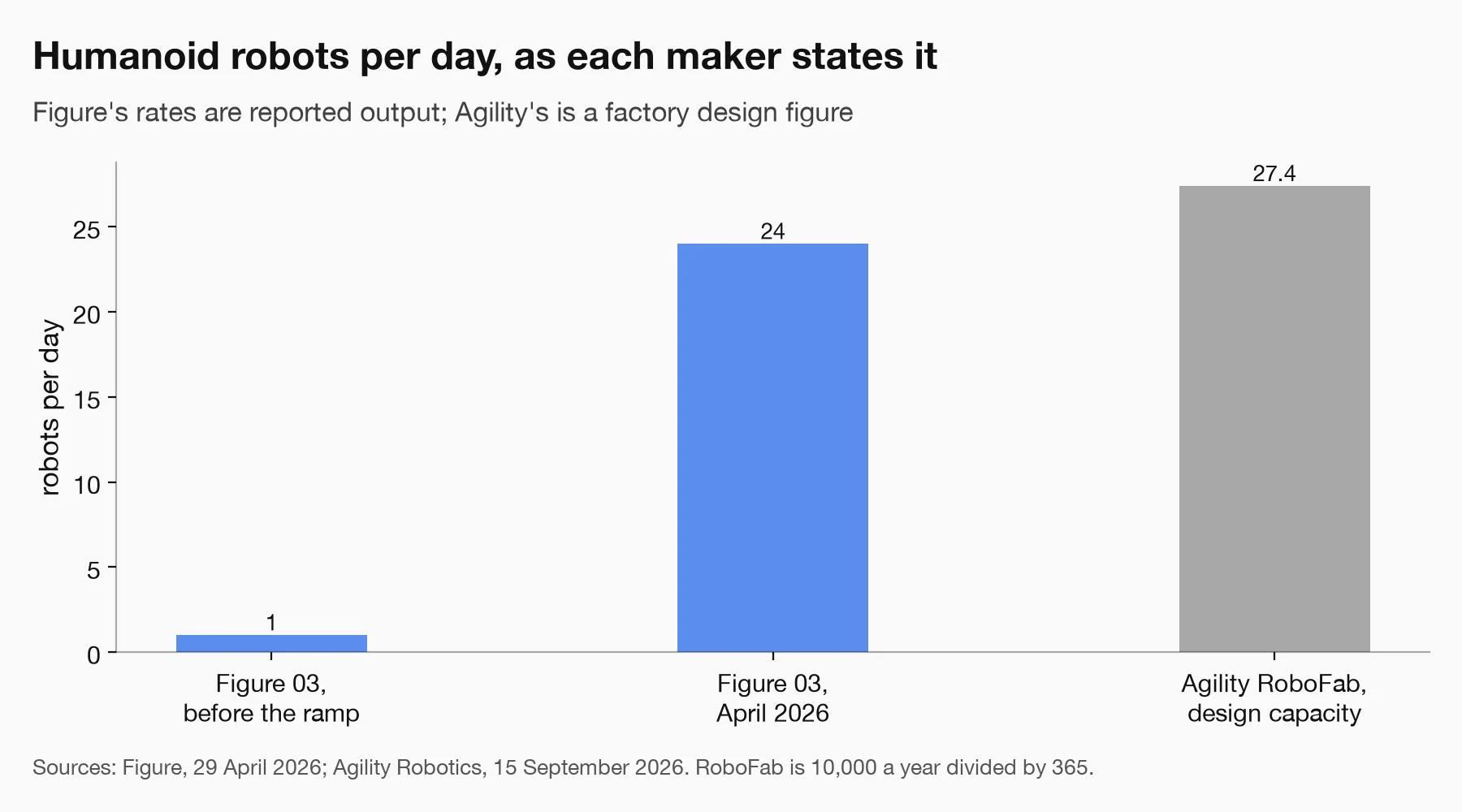
Figure’s two rates are reported output. Agility’s is a design capacity, 10,000 a year divided by 365, not robots built.
Tesla Optimus: a status, not a number
Tesla’s Form 8-K dated 22 July 2026 lists two lines under Robotics in its manufacturing table, California Optimus and Texas Optimus. Both carry the status “Construction”, and the capacity column shows a dash for both. Tesla writes that it has decommissioned the Model S and Model X lines at Fremont and is installing the first-generation Optimus lines, where it expects “to start production soon”. “The initial Optimus builds will be used in our Optimus Academy for training data collection and further functionality development.” In the same document Model 3 and Model Y production for the quarter is counted exactly, at 442,936 units. Unitree’s prospectus, describing its competitors, says Tesla has announced small-batch trial production of Optimus Gen-3, in our translation, which is the more generous of the two accounts.
That is why the published prices are not a fair comparison with the unpublished ones. A $13,500 G1 and an Atlas working in a Hyundai plant are not two points on one price curve. They are different products sold on different terms to different buyers, and one of those terms is whether the price is public at all. The machines most often shown lifting boxes in factories are the ones whose prices are not on the record.
How many humanoid robots have the makers with prices actually sold?
Unitree is one of two humanoid makers, with UBTech, whose sales figures are in stock exchange filings this year, so its list prices sit on top of a sales record rather than a promise.
Unitree filed its final prospectus on 14 August 2026, five days before its shares began trading in Shanghai. It gives humanoid robots sold as 5 in 2023, 412 in 2024 and 5,215 in 2025. A separate line says 2025 shipments exceeded 5,500, counting pure humanoids and excluding wheeled dual-arm robots. The production table puts shipments at 5,511, and the prospectus says the gap to 5,215 sold is robots delivered but not yet signed off by the customer. Quadrupeds still sold in far larger numbers, 23,037 in 2025. Humanoids went from 1.88 per cent of main-business revenue to 51.78 per cent over the three years.
The prospectus also carries reviewed first quarter 2026 accounts: revenue of 422.8 million yuan, up 68.49 per cent, against growth of 332.64 per cent the year before, and profit after non-recurring items down 52.55 per cent. Unitree’s own reasons, in our translation, are a much larger revenue base, industry heat “gradually easing”, and competition “intensifying”. A risk section adds that if short-term demand such as robot rental cools, the effect could pass upstream into price competition.
UBTech’s interim results, published on 28 August 2026, say its full-size humanoid business “achieved sales volume of 921 units, representing a year-on-year increase of 1,946.7%”. By that rate the first half of 2025 came to about 45 robots. Revenue from full-size humanoid products and services rose 1,445.0 per cent to 590.3 million yuan, from 38.2 million, and its share of group revenue went from 6.1 per cent to 46.5 per cent. Group revenue doubled to 1,269.1 million yuan. The category includes the Cruzr Y1, which UBTech describes as a wheeled humanoid for manufacturing and warehousing, so not every one of those robots walks. Revenue divided by units gives about 641,000 yuan per robot, services included, which is not a price to budget from. The filing also names an “annual production target of 10,000 units”, as a target.
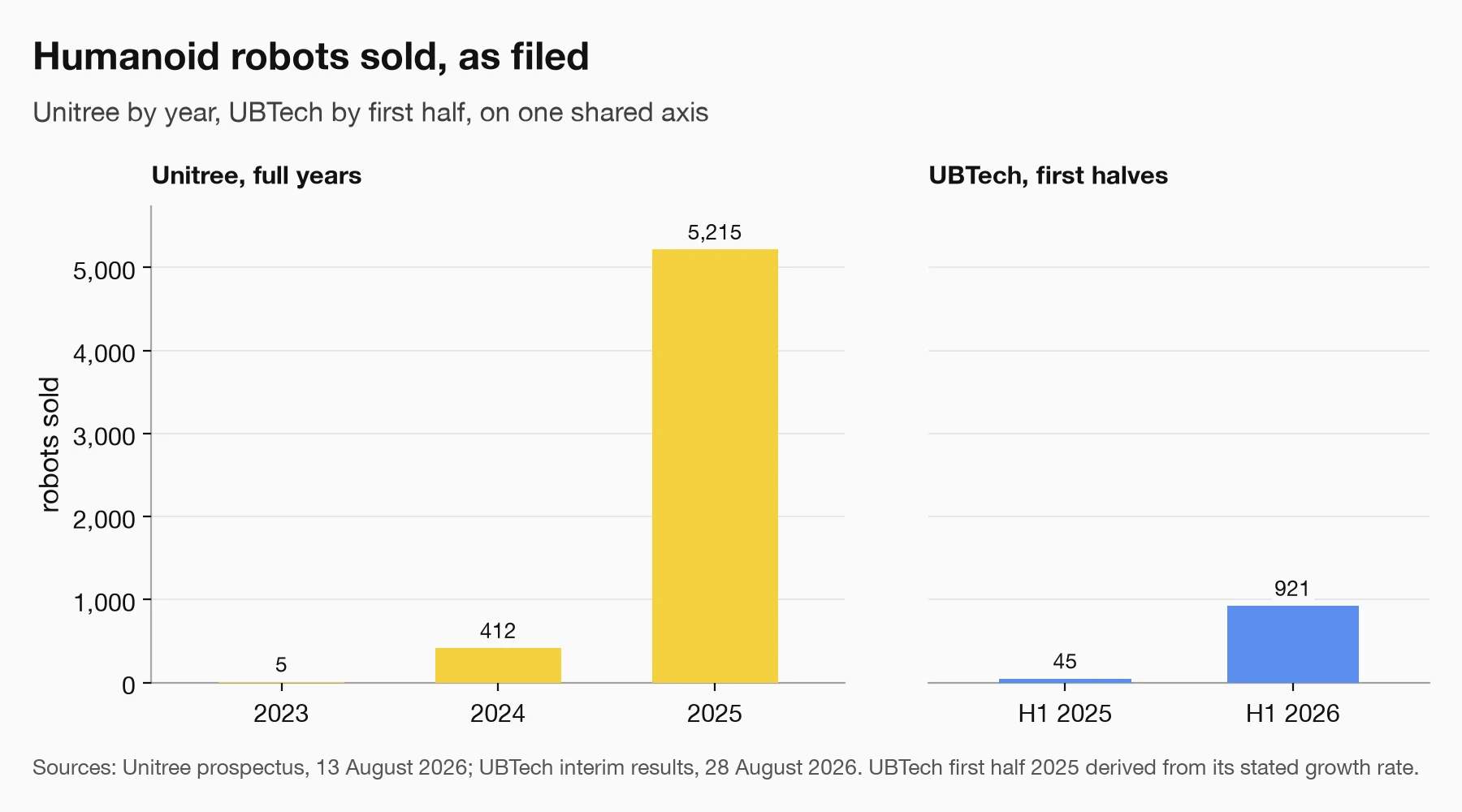
The only humanoid sales counts in stock exchange filings this year. UBTech’s first half of 2025 is our arithmetic from the growth rate it reports.
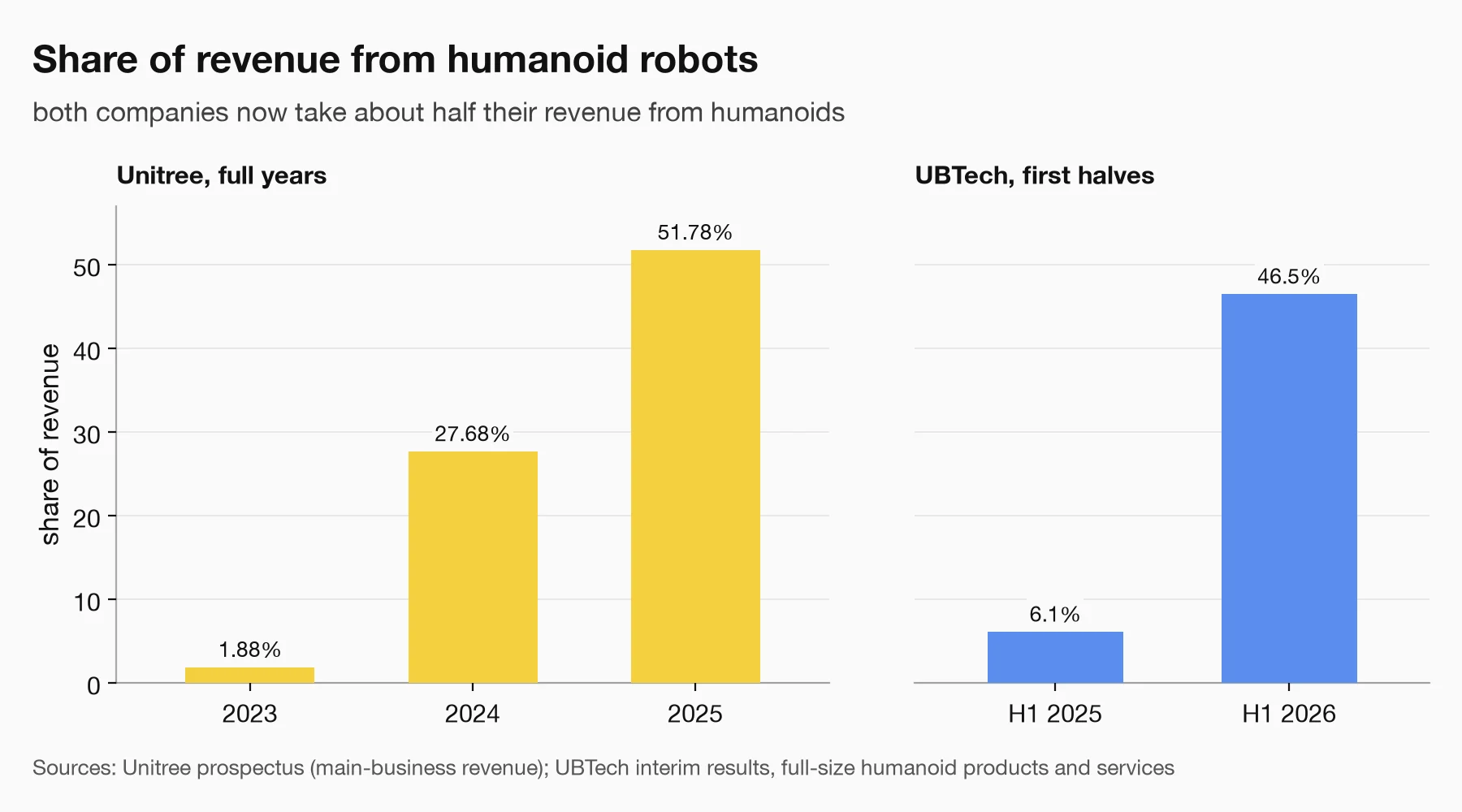
By 2026 both filing companies depend on humanoids for about half their revenue.
The category is real and still small. The International Federation of Robotics published World Robotics 2026 on 24 September, and its industrial count is the first outside check on these filed figures.
How much can a humanoid robot lift, and why do the specs not compare?
Three makers give seven answers. Boston Dynamics’ Atlas spec sheet, dated 23 December 2025, splits weight capacity three ways: 50 kg (110 lbs) instant, 30 kg (66 lbs) sustained and 20 kg (44 lbs) one-handed. Atlas weighs 90 kg, stands 1.9 m, has 56 degrees of freedom and reaches 2.3 m. The sheet does not define its terms, but on the ordinary reading sustained is what the robot can hold, 40 per cent below the instant peak. Battery life is 4 hours, or 2 hours with heavy lifting. Atlas swaps its own battery in 3 minutes, and the pack it removes needs 1.5 hours on the charger.
1X lists a lift of 154 lbs, a carry of 55 lbs and an arm payload of 18 lbs for NEO, about 70 kg, 25 kg and 8 kg. The lift figure is more than twice the robot’s own weight, and 1X does not say how any of the three was measured.
Agility Robotics says Digit 5’s new leg design lets it “repeatedly lift up to 50 lb. (22.7 kg) loads”. Repeatedly is a statement about a work cycle, which is what a warehouse buyer pays for. Digit 5 weighs 129 kg, stands 1.81 m and reaches up to 2.2 m. Its battery runs for 90 minutes and charges in 9, a 10:1 run-to-charge ratio, up from 2:1 on Digit 4, which Agility Robotics says enables more than 20 hours of productive work in a 24-hour day.
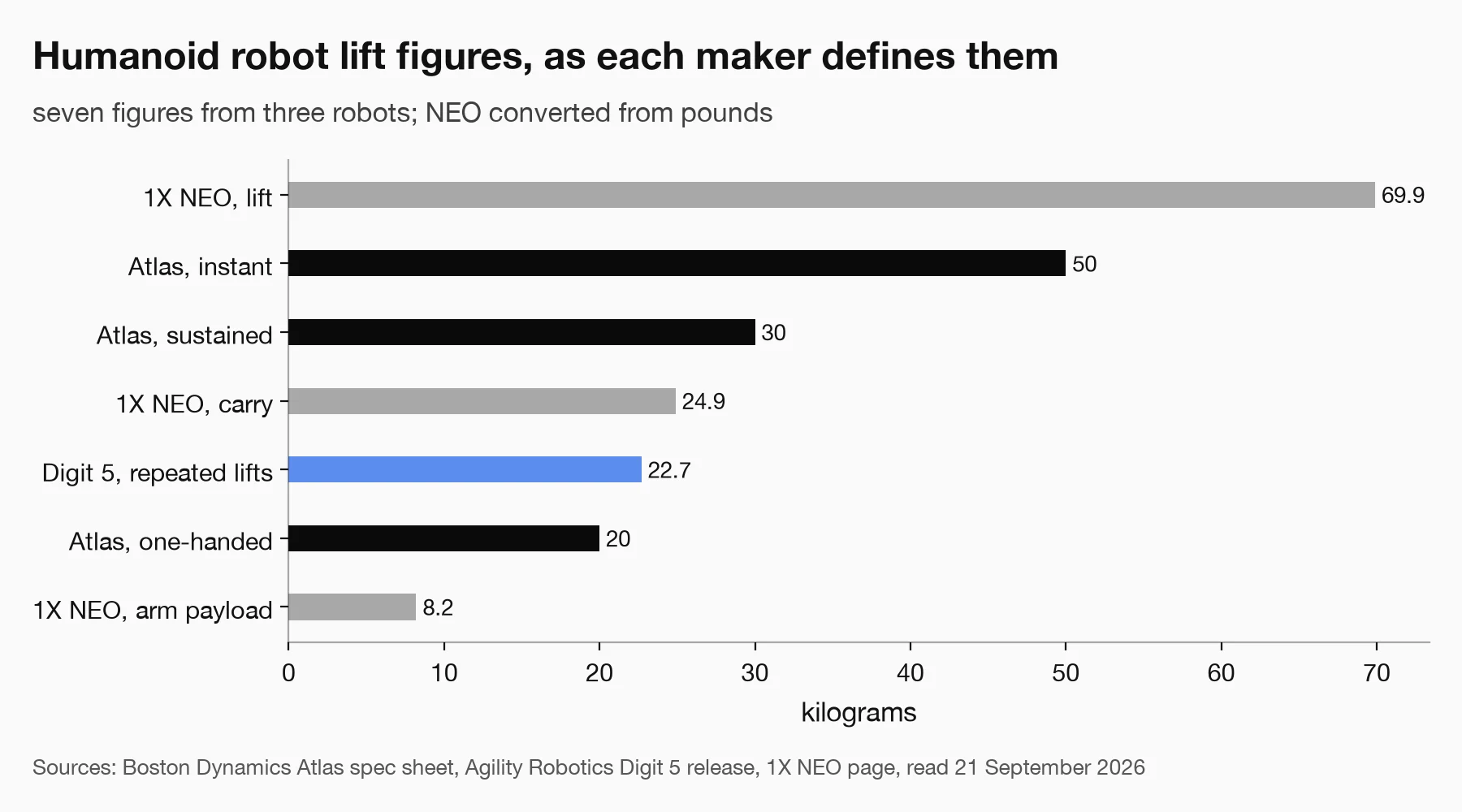
Seven lift figures from three robots. Black is Atlas, blue is Digit 5, grey is 1X NEO, converted from pounds. Only Digit 5’s figure says it holds across repeated lifts.
On one axis the largest number belongs to the lightest robot, measured in a way its maker does not define. Divide each working load by the robot’s weight and the order changes again: Atlas’s sustained 30 kg is a third of its 90 kg, Digit 5’s repeated 22.7 kg is less than a fifth of its 129 kg, and NEO’s 55 lb carry is more than four fifths of its 66 lb.
Runtime has the same trouble. Atlas and NEO both list 4 hours, but only the Atlas sheet halves that under heavy lifting. Charging is where the two newer machines agree: Digit 5 charges 9 minutes per 90 of work, which is 6 minutes per hour of runtime, the same ratio 1X states for NEO. Atlas takes 22.5 minutes on the charger per hour of runtime, but it swaps rather than waits.
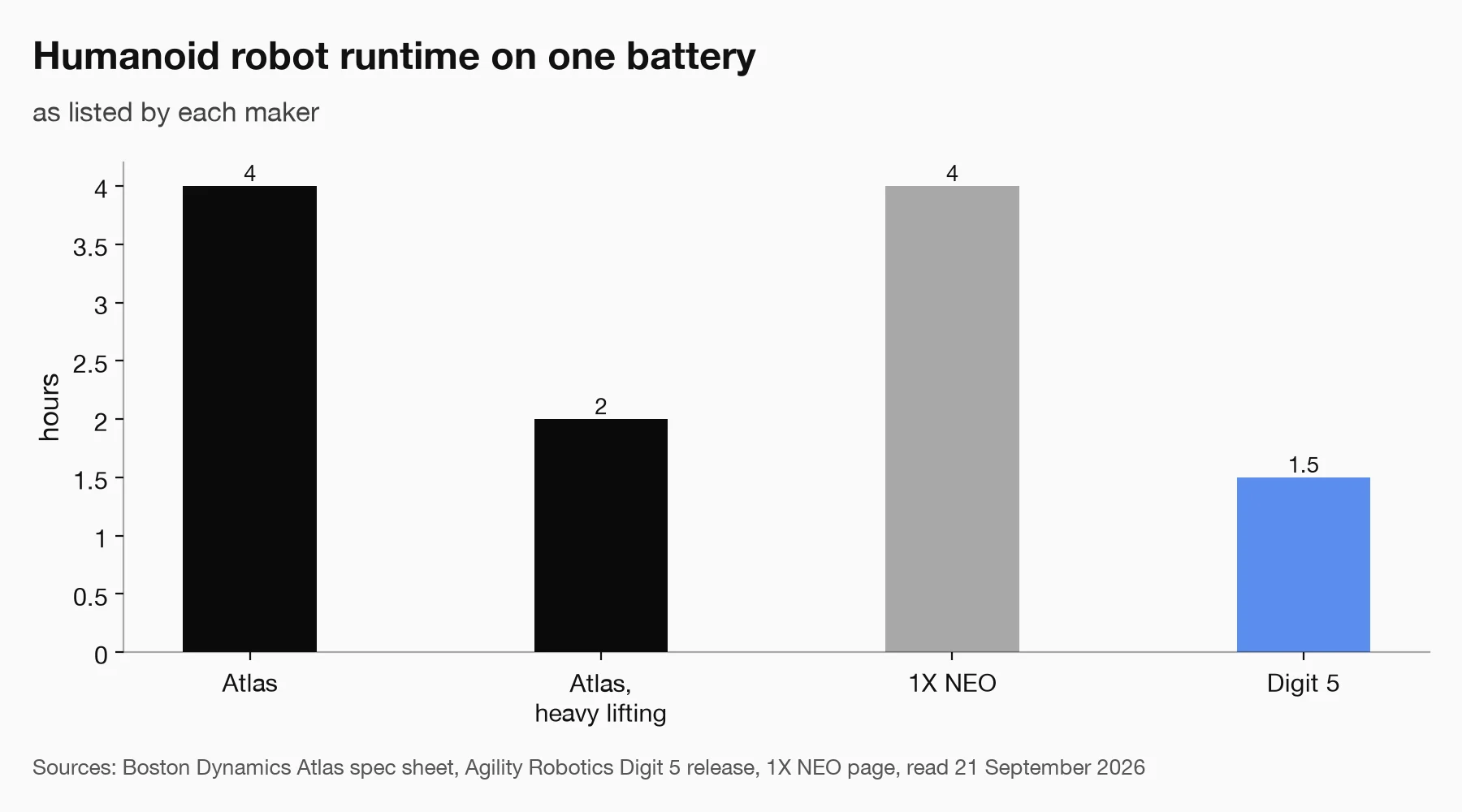
Runtime as each maker lists it. Only the Atlas spec sheet states what heavy lifting does to the battery.
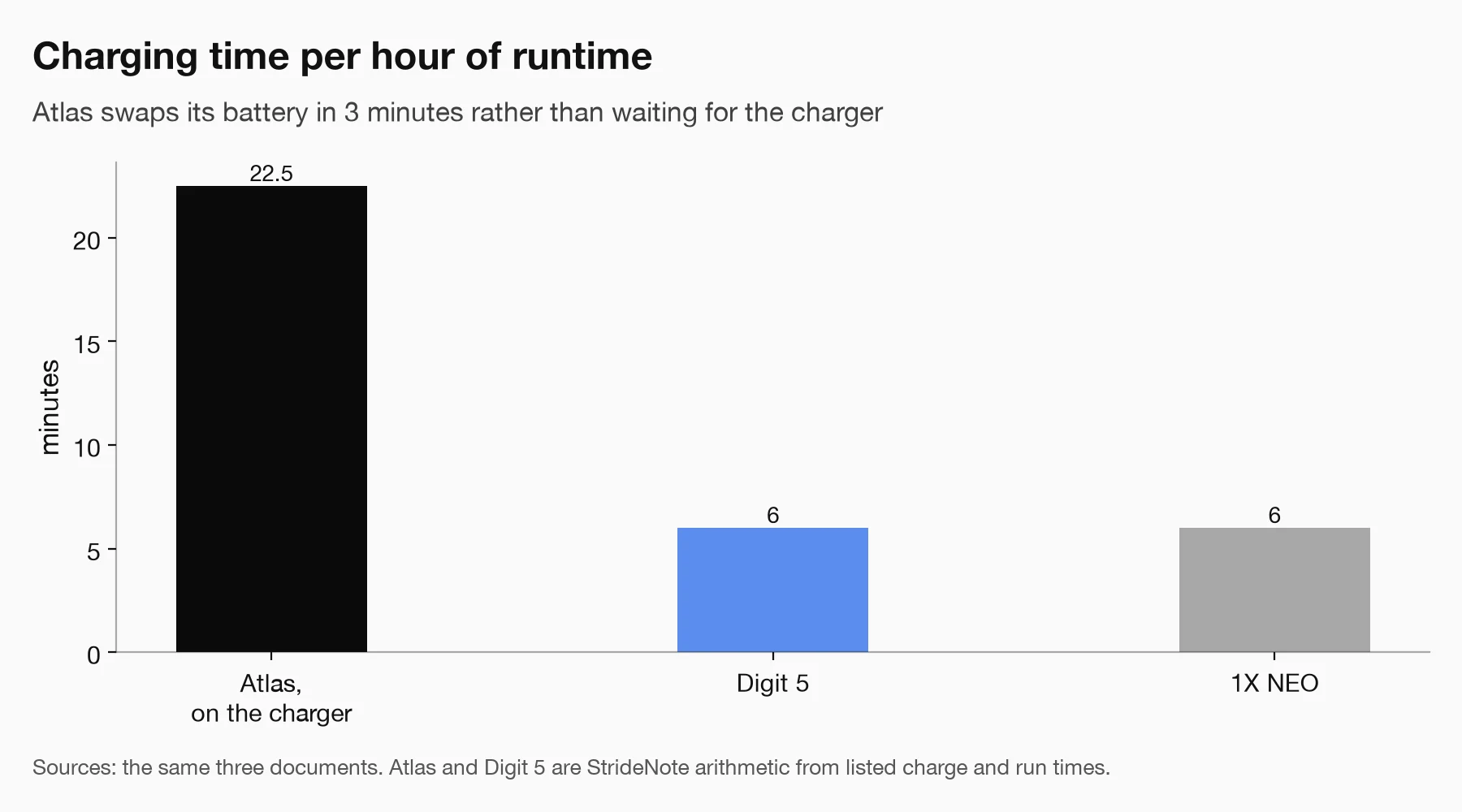
Digit 5 and NEO both come to six minutes of charging per hour of work. Atlas takes longer on the charger but swaps its battery in three minutes.
Over an eight-hour shift of heavy lifting, Atlas at 2 hours a battery needs three swaps at 3 minutes each, about 9 minutes off task. Digit 5 runs a 99-minute cycle, so 480 minutes hold four full cycles and about 36 minutes of charging (4 times 9). These are paper figures from each maker’s own page. Neither covers walking between the charger and the work, and we have tested neither robot.
Humanoid robot cost for a buyer: price, load, availability, rent or buy
The table puts each maker’s price beside its own load figure, its availability and any rental terms. Every figure is the maker’s. We have not tested these robots, so the table ranks nothing, and the load column mixes definitions the makers do not share.
| Robot | Price, per maker | Load figure, per maker | Availability | Rent option |
|---|---|---|---|---|
| Unitree R1 | From $4,900 | Arm about 2 kg | Listed on Unitree’s store | None listed |
| Unitree G1 | From $13,500 | Arm about 2 kg; about 3 kg on the G1 EDU | Listed on Unitree’s store | None listed |
| Unitree H2 | $29,900 | Arm payload about 15 kg peak, about 7 kg rated | Listed on Unitree’s store | None listed |
| 1X NEO | $20,000 with a three-year warranty | Lift 154 lb, carry 55 lb, arm payload 18 lb | US deliveries start 2026; $200 refundable deposit | $499 a month, no minimum term stated |
| Figure 03 | Not published | 20 kg payload | Not on public sale | None published |
| Agility Digit 5 | Not published | Repeated lifts up to 22.7 kg | Early access first half of 2027, general availability by end of 2027 | None published |
| Boston Dynamics Atlas | Not published | 50 kg instant, 30 kg sustained | 2026 deployments fully committed; more customers in early 2027 | None published |
Sources: Unitree’s store and its G1, R1 and H2 product pages, and 1X’s order page, read 17 October 2026. NEO, Atlas and Digit 5 load figures and availability from 1X’s specification page, the Atlas spec sheet, and the Boston Dynamics and Agility Robotics announcements cited above; Figure 03 from its product page.
Unitree’s arm figures carry the maker’s own warning that the maximum arm load “varies greatly under different arm extension postures”, and its R1 product page lists the R1 AIR at $4,900 and the standard R1 at $5,900, which is why the store says from.
On rent against buy, NEO is the only robot with both options published, and the arithmetic above decides it: the subscription passes the purchase price in month 41. For a business the subscription buys something the price does not show, a published way out, since the FAQ says a subscriber may return NEO at the end. None of the other six lists a rental route, so for them the decision is buy at a list price or wait for a sales conversation.
For warehouse or factory work, the dates set the plan. A business outside Hyundai and Google DeepMind cannot order Atlas before early 2027, Digit 5 opens to early access in the first half of 2027, and Figure has published no route for outside buyers. An industrial humanoid in a 2027 budget is therefore an early access place, and a business that wants one should ask the maker now what an early access agreement requires and what it costs. What a business can buy this year is a development robot: a Unitree, or a NEO on a $200 deposit. A team can use one to learn what its own site would need, from floor space and charging points to safety zones and the first tasks worth handing over.
The questions to put to any supplier follow from what each maker counted. Ask how many units have gone to customers outside the maker itself, and what the lead time is from contract to delivery. Ask for the load the robot can lift repeatedly, the lifts per hour it can keep up at that load, and the battery left at the end of a shift, because the spec sheets do not define payload the same way. A filed sales count, such as Unitree’s 5,215, is a record a buyer can check; a production line with the status “Construction” is not. With Unitree’s average price down about 36% in a year and its own prospectus warning of price competition, a buyer with no urgent need has a reason to wait or negotiate, and a buyer who needs robots now can ask for a price review clause in any multi-unit order.
A price is a figure a company can be held to. In September 2026 five humanoid robots have one, and the most talked-about robots in the category still do not.