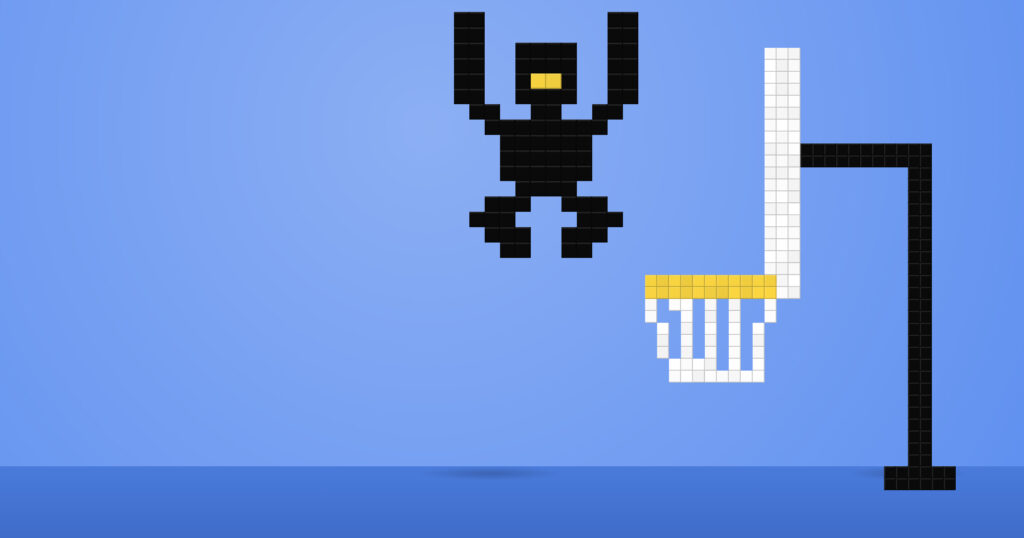
A basketball hoop hangs 3.05 metres above the floor. On 25 August a humanoid robot in Beijing jumped from a standing start high enough that the lowest part of its body cleared 3.40 metres, the winning mark in the standing high jump at the World Humanoid Robot Games 2026. How high can a humanoid robot jump? By the organisers’ own rule, that high. By the rules a human jumper is measured under, the question has not yet been asked, because the robot event is scored in a way no human event is.
How high can a humanoid robot jump in 2026?
The robot standing high jump final was won with 3.40 metres by the Tianzhuo team, a joint laboratory of Huazhong University of Science and Technology and X-Humanoid, the Beijing Humanoid Robot Innovation Center. Two more teams linked to X-Humanoid took second and third with 3.29 and 3.26 metres. Unitree’s own team finished sixth with 2.17 metres. Those are the figures on the organisers’ result sheet, posted with every other final on the announcements page of the Games’ official site.
A year earlier the same event was won with 0.96 metres. The winning height has gone up more than three and a half times in twelve months.
X-Humanoid’s widely reported 2.88 metres came earlier and in a different setting. The company’s own post of 23 August and China News Service both describe it as an opening-ceremony demonstration on 22 August, though a later X-Humanoid poster calls it a competition, as we set out in our investigation of the robots’ world record claims. The organisers’ result sheets contain no 2.88 metre jump. The 3.40 metres from the final is the best competition mark on the record.
How is a humanoid robot jump measured?
The organisers’ athletics regulations define three jumps, and each is measured differently. In the standing high jump, a robot takes off from both feet inside a 3 metre square, with run-ups and extra steps banned, and must land steadily back inside it. The score is “the vertical distance from the lowest point of any part of the robot’s body to the ground when the robot reaches the highest point of its jump”. There is no bar. A 3.40 metre result means every part of the robot was at least 3.40 metres off the floor at the top of the jump.
A human high jump is scored on a bar, cleared after a run-up. The record World Athletics lists is Javier Sotomayor’s 2.45 metres from 1993, and the jumper’s body arches over the bar rather than rising wholly above it. The two numbers measure different things, and neither says whether a robot could clear a 2.45 metre bar.
The standing long jump is the robot jump measured most like a human one. The robot takes off from both feet at a line, and the result is the distance from that line to “the part of the robot nearest the take-off line on landing, such as the heel, hip or hand”. Before take-off a robot may swing its arms, as a human standing jumper does, but its feet may not leave the ground or shift. In every jump each robot gets three attempts, the best one counts, and a tie is broken on the second-best.
The running long jump allows a run-up of 12 to 30 metres along a runway 2.1 metres wide, bans flips during the run or the jump, and lands on a hard floor dusted with magnesium powder rather than in sand. Its rules describe how a robot must leave the landing area but never name the point the jump is measured to. The quotations are our translation of the Chinese.
How far can a humanoid robot jump?
Further than any human from a standing start. The standing long jump final on 26 August was won by the Tianzhuo team with 4.83 metres, ahead of two more X-Humanoid joint teams with 4.75 and 4.64. Guinness World Records lists the farthest human standing jump forwards as 3.71 metres, by Arne Tvervaag of Norway in 1968. Measured the same way, from a line to the nearest mark, the winning robot jumped 1.12 metres further.
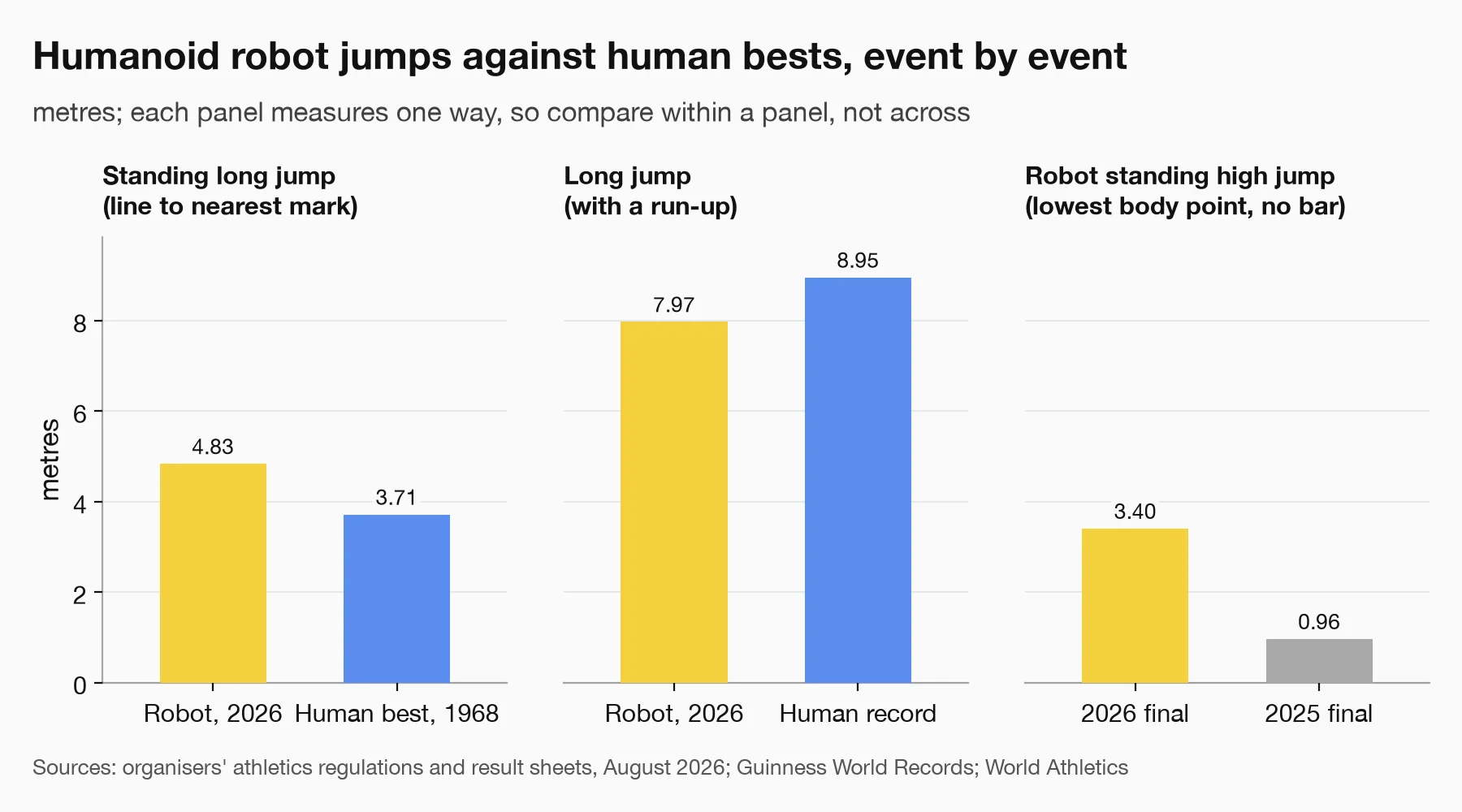
Robots now jump further than any human from a standing start, and not yet as far with a run-up. The robot high jump has no human equivalent, because no bar is involved. Source: World Humanoid Robot Games 2026 result sheets, World Athletics and Guinness World Records.
With a run-up, humans still lead. The robot long jump final on 23 August was won by the Tianjiao team, a joint laboratory of Peking University and X-Humanoid, with 7.97 metres. The human world record World Athletics lists is 8.95 metres. The robot jumped onto a powdered hard floor rather than into sand, so the two marks are close in kind but not identical.
Unitree’s own team placed fifth in both long jumps, with 3.37 metres standing and 4.07 metres running. The same X-Humanoid joint laboratories that led the sprints, set out in our piece on the 2026 results, also led the jumps.
What do humanoid robot makers claim about jumping?
Few makers publish a jump figure at all, and those that do publish it in posts, not spec sheets. Unitree wrote on its official account in October 2024 that its G1 “can perform a standing long jump of up to 1.4 meters”. On 17 August 2026 it previewed a new robot it calls Superman with a claimed “standing high jump 2 m”, without saying how the height was measured. We found no jump figure on the current product pages of Tesla, Figure, Agility Robotics, 1X, UBTech, EngineAI, Booster or LimX, and no Guinness World Records entry for a humanoid robot jump.
That leaves the Games as the one place we found where humanoid robot jumps are measured under written rules, by referees, and published. It is also why a spec sheet comparison is impossible, the same problem we found with lift figures in our piece on humanoid robot spec sheets and with speeds in our piece on how fast a humanoid robot can run.
The robot high jump will only be comparable with a human one when the organisers put up a bar. Until then, the fairest answer to how high a humanoid robot can jump is the one the rulebook gives: 3.40 metres off the floor at the top of a standing jump, and 4.83 metres forward from a standing start, which no human has matched.