Our Local AI Telemetry Report asked what seven pieces of software on a Mac send back to the companies that make them. A humanoid robot in the home asks the same question with stereo cameras, a mobile connection and hands. 1X, which takes $200 deposits for its NEO robot, answers it in the FAQ on its order page. It does not answer it in its privacy policy, which never mentions the robot. For anyone weighing 1X NEO privacy before paying, the FAQ is the whole written record.
Does 1X NEO send data to 1X?
Yes, in two ways, by 1X’s own account. The FAQ says “NEO works without the need for data sharing”, and then describes what is shared anyway: “In autonomous mode, limited sensor data may be sent to our servers to fulfill a request; it isn’t stored.” That is the first path. It runs when NEO is doing something you asked for, and 1X says the data is not kept. Autonomous mode is not an edge case either: another FAQ answer says “NEO works autonomously by default”, so the mode that sends request data is the one NEO is normally in.
The second path is for improvement. “Data collected from real world tasks refines NEO’s base intelligence and performance,” the FAQ says, and owners “can always opt out”. The wording matters. An opt-out means the sharing is on until the owner turns it off, the same default we examined in our telemetry investigations. 1X adds two commitments in the same answer: “We do not use this data to build a profile of you, nor do we sell this data.”
The FAQ also says NEO “comes equipped with 5G connectivity”, with home Wi-Fi recommended. That detail changes how an owner could check any of the above. A device on home Wi-Fi can be watched and blocked at the router. A device with its own mobile connection does not have to pass through the router at all.
Can a 1X Expert see through NEO’s cameras?
The order page lists NEO’s cameras as “Dual 8.85MP 90Hz Stereo Fisheye”, and it describes a way for 1X staff to use them. “For complex tasks NEO doesn’t know, an Expert from 1X can remotely supervise its actions at scheduled times to help it learn new abilities and get the job done.” The FAQ says the Experts are “1X employees physically present in the USA”.
1X sets out the controls in its answer to whether an Expert can enter NEO at any time. The answer is no. Owners “have to actively schedule a time” for an Expert and “accept them into their robot using voice or mobile”. NEO’s “emotive ear rings will change color while a 1X Expert Operator is active”, and “Owners have full control over each session.”
The owner has a remote view too. The order page invites owners to “Pilot your NEO from anywhere in the world through your Mobile App & VR device”. Whatever route that connection takes, it means the robot’s view of the home can be reached from outside it, by design, whenever the owner chooses.
The Expert controls are real if they work as described: an appointment, an explicit acceptance and a visible signal. The same sentence also says why the sessions exist. They help NEO “learn new abilities”, which makes an Expert session a source of training data as well as a service to the owner.
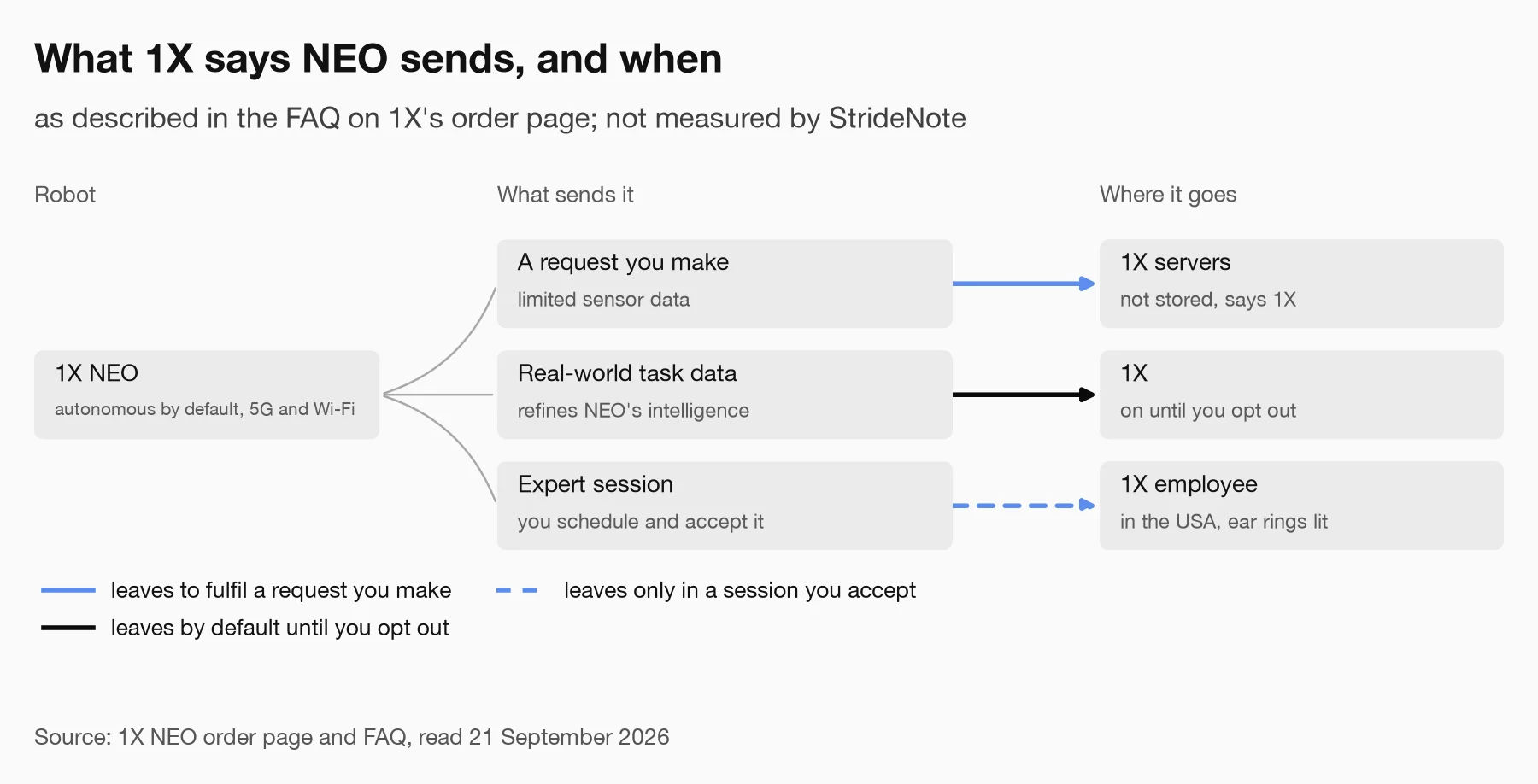
The three paths 1X describes in its FAQ. This is 1X’s account, drawn as stated; we have not tested a NEO.
Remote human operation is not unique to 1X. Boston Dynamics lists “VR teleoperated” among the operating modes on its Atlas spec sheet. The difference is the room. Atlas is built for a factory floor. NEO is built for a kitchen, at the prices we set out in our piece on what a humanoid robot costs.
Where 1X NEO privacy terms are, and are not, written down
Everything above comes from the FAQ on the order page. We looked for the same commitments in 1X’s legal documents and did not find them.
The privacy policy linked from the order page was last updated on 27 October 2025. It opens by thanking the reader “for visiting the website of 1X”, and it covers the website. The policy text does not contain the words robot, camera, video, audio or sensor. The other legal link on the order page, labelled Terms of Use, returned a 404 page when we checked it on 21 September 2026.
There may be an ordinary reason. 1X says US deliveries start in 2026, and product terms may arrive with the product. But the deposit is taken now, and on 21 September the only document a buyer can read about what NEO sends is an FAQ, rather than a policy or a set of terms.
What we would check on a NEO before trusting the FAQ
We have not tested a NEO, and deliveries have not started, so we have no verdict on it. What we can set out is what we would test, because it is the method behind the telemetry report: read what the maker says, then watch what actually leaves. Our piece on how AI companies hide tracking code covers the code side of the same question.
Four checks would settle most of the FAQ. Capture NEO’s traffic in autonomous mode with improvement sharing switched off, and see what still leaves. Check whether anything leaves over 5G while home Wi-Fi is available. Confirm that the ear rings change colour on every remote session, with no exceptions. And ask 1X to put the FAQ answers into its privacy policy, where they would carry the weight of a published policy rather than a sales page.
The first three need a robot. The fourth needs only a request, and it costs 1X nothing.
Software that phones home can be caught at a firewall. A robot with its own mobile connection and cameras in the kitchen depends on its maker writing the rules down first, and as of September 2026 1X has written them in its FAQ, not its policy.