Some of the first medals of the World Humanoid Robot Games 2026 were decided in a school library, days before the opening ceremony. The library final ran from 16 to 18 August at Beijing No. 80 Middle School, where robots sorted books, while the hotel and firefighting finals ran on 16 and 17 August in real buildings across the city. These were the World Humanoid Robot Games scenario events, 21 of them, and they are the part of the Games the organisers built to look like work. By our count of the 21 final result sheets, a robot running on its own won 13 of them. A remote-controlled robot, scored at half points, won the other eight.
What were the World Humanoid Robot Games scenario events?
The organisers’ scenario regulations, published on 2 July, divide the 21 events into three groups. Twelve are work posts, each modelled on a job. In retail, a robot picks goods for a customer; in catering it takes an order and heats food. Two industrial posts cover assembly and loading, and packing and warehousing, where the robot packs finished medicine boxes into cartons. Two emergency posts cover firefighting and rescue, and general emergency response. The rest are office services, housekeeping, hotel guest services, library book sorting, park management and charging electric cars.
Eight more are dexterous hand events, each a single manual task: assembling with a power tool, weighing powder, building with blocks, driving nails, opening bottles, unpacking boxes, picking up beans with tweezers and connecting cables. The last event is a combined five-task run on a 100 metre out-and-back course, with a handover, a heavy carry and a cart to push along the way.
Four work posts were held away from the arena. Housekeeping was held in a show home, firefighting at a Beijing fire service logistics centre, hotel service in a working hotel and book sorting in the school library. Park management and car charging were held outside the National Speed Skating Oval itself.
Xinhua described the choice of jobs as “designed around jobs that can be repetitive, physically demanding, dirty, dangerous or difficult”. In the hotel event, it reported, “more than 10 robot teams were given 30 minutes to tackle three tasks: moving luggage of different sizes, replenishing guest-room supplies and making beds.”
How were the World Humanoid Robot Games scenario events scored?
Each work post is a sequence of stages completed in order inside a time limit, 20 minutes for posts such as retail, catering, assembly and packing. A team may not skip or abandon a stage. The regulations add that “if any task item does not meet the success requirement, that item scores 0; there are no negative scores”. The dexterous events are shorter: most count how many valid completions a robot makes in five minutes, while powder weighing and block building are timed. The combined event is scored on finishing time plus penalties.
Over the work posts and the dexterous events sits one multiplier. Task points are the sum of stage scores, minus deductions, times a weighting: 1 for a robot running on its own and 0.5 for one under remote control. The organisers’ own tie-break puts an autonomous robot ahead of a remote-controlled one on equal points. How that rule was written, and how the organisers checked it, is the subject of our piece on remote control at the Games.
The weighting changes results. In the emergency response final, a remote-controlled robot scored the full 300 points on the tasks and finished with 150. A robot that ran itself scored 250 and took the gold.
Who won the World Humanoid Robot Games scenario events?
The organisers post the scenario finals on the announcements page of the official site, and we read all 21 scenario sheets, using the corrected versions where one was issued. Split by group, a robot running on its own won nine of the 12 work posts and four of the eight dexterous hand events. Remote-controlled robots won the other three work posts and the other four dexterous events. The combined five-task event went to a robot scored at the remote-control weighting, and every entry on that sheet carries the same 0.5, though four of the 17 withdrew and two did not finish.
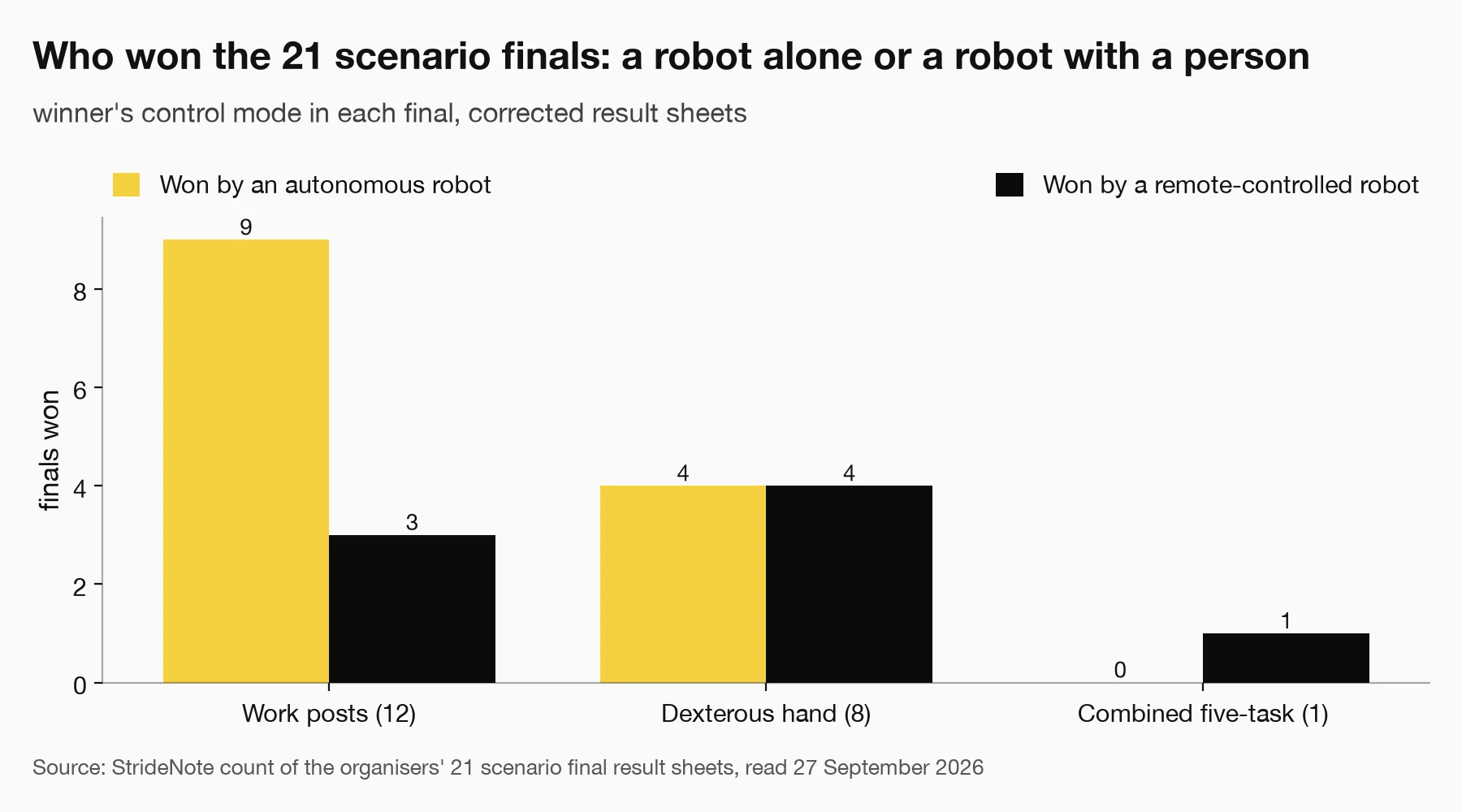
By our count of the corrected sheets, autonomous robots won 13 of the 21 scenario finals and remote-controlled robots won eight.
Teams carrying AgiBot’s Chinese name, Zhiyuan, won seven of the eight dexterous hand finals and five work posts: firefighting, emergency response, packing, assembly and library sorting, the last as a joint team with Tsinghua University and Shanghai Jiao Tong University. Teams linked to X-Humanoid, the Beijing Humanoid Robot Innovation Center, won park management, car charging and the combined event. A team carrying the Chinese name of UniX AI won the hotel post, a team named after Spirit AI won office services, and a team called Beijing Yinhe Xingshu won both housekeeping and catering. The sheets name teams, not robot models.
Four of those results were decided after the event. The organisers’ notices cancelled the leading team’s result in the hotel, firefighting, housekeeping and assembly finals, two for missing a post-event review and two for failing to reproduce their runs on site. In hotel service and firefighting, the gold passed to a remote-controlled robot scored at half points. AgiBot’s own count of its medals lists hotel services among its golds, a claim the corrected sheet does not support, as we set out in our piece on the medal table.
What the World Humanoid Robot Games scenario events mean for buyers
The work posts are the closest thing the Games have to a product test, and they are harder than a spec sheet because the task order is fixed and a failed stage scores nothing. A robot that packs medicine boxes into a carton, boxes blister packs and folds flat cartons, all in 20 minutes without help, has done something a buyer can picture in a warehouse. No robot managed that on its own this year: the three packing medallists all scored the full 300 under remote control, and the best robot running itself scored 54. The same robot finishing under remote control has shown what a person and a robot can do together, which is a different product. Spec sheets describe the same abilities one at a time, as we found when we compared humanoid robot lift figures, and a timed sequence of stages tests them together.
That is the question to carry from Beijing into any sales conversation. AgiBot says the G2 it used at the Games already works in factories run by Longcheer and SAIC. What the scenario sheets add is the mode each run was scored in. Our piece on when you can buy a humanoid robot reads the delivery dates the makers have promised. A buyer can put the referees’ question to each of them: which parts of the job does the robot do on its own?
The organisers expect the third Games, in Beijing in August 2027, to give scenario events a larger share of the programme, as the host broadcaster reported and as we note in our results piece. This year, eight of 21 scenario golds went to robots operated by a person. The count to watch next August is whether that number falls.