A humanoid robot can be driven like a remote-control car or left to run itself. At the World Humanoid Robot Games 2026 the choice was not the team’s to make freely, and the answer changed from one event to the next. The Beijing government’s English preview says every competitive event except two obstacle races had to be run autonomously. Their own rulebooks say more than that. Read closely, the rules on World Humanoid Robot Games remote control sort events into three groups: those where a robot must run itself, those where a human may drive it, and those where a human may help at the price of half the points.
World Humanoid Robot Games remote control: which events allow it?
Most competitive events do not. By our count of the rulebooks and the result notices, 23 of the 30 competitive events required the robot to run itself, while all 21 scenario events allowed remote control at a price, which the next section explains. The Beijing government’s English preview, which we quote in our piece on the 2026 results, says: “Except for the 100m and 400m hurdle races, all track events and other competitive events require robots to complete them fully autonomously.” The athletics rulebook bears it out. The 100, 400 and 1,500 metres, the relay and the jumps are listed as fully autonomous, and only the two obstacle races may be run by remote control, as we set out in our investigation of the record claims. The rulebooks for football, martial arts, gymnastics, tug of war, pitch-pot, table tennis and the dance events also require full autonomy.
Two rulebooks say something different, and the summary leaves both out. The kickboxing regulations state: “The robot’s control mode may be manual remote control (including semi-automatic), full-body teleoperation or fully autonomous.” The rulebook does not define full-body teleoperation; the term usually describes a robot copying the movements of a person. The only conditions are that the link is wireless and the operator stands in a designated area. Kickboxing, which ran in three weight classes, is the one discipline at the Games where a person may drive a robot through a fight.
The weightlifting regulations split the difference. A robot may be driven by remote control, but “after reaching the competition area, the whole competition process must be completed autonomously by the robot”. A person can steer the robot to the platform. The lift itself has to be the robot’s own. Both weightlifting classes, 40 kilograms and under and above 40 up to 80, run under that rule. The quotations are our translation of the Chinese. How much a humanoid robot can lift outside a competition, and how makers define it, is the subject of our piece on humanoid robot lift figures.
So the one-line summary is accurate for the track and for most of the arena, and it is not accurate for kickboxing, where a human may take full control, or for weightlifting, where a human may take partial control.
How do the World Humanoid Robot Games score a remote-controlled robot?
The 21 scenario events, built around jobs such as hotel service and factory packing, treat remote control differently again. They allow it and discount it. The scenario regulations define the two modes. Manual remote control, “including semi-automatic”, must be wireless, with the operator in a designated area. Full autonomy means “the whole run must be completed by the robot autonomously, except for sending the start command from the designated area”.
Then comes the formula: “Task points = (sum of stage task scores minus deductions) × weighting coefficient. Fully autonomous mode: coefficient 1; remote-control mode: coefficient 0.5.” A team chooses its mode at check-in and may not switch during the run. When two teams finish level on points, the first tie-break is control mode, and the autonomous robot ranks ahead.
The effect shows on the result sheets. In the emergency response final, a remote-controlled robot scored the full 300 points on the tasks and was credited with 150. A robot that ran itself scored 250 and won. By our count of the 21 scenario finals, 13 were won by robots running on their own and eight by remote-controlled robots, all of which we set out in our piece on the scenario events.
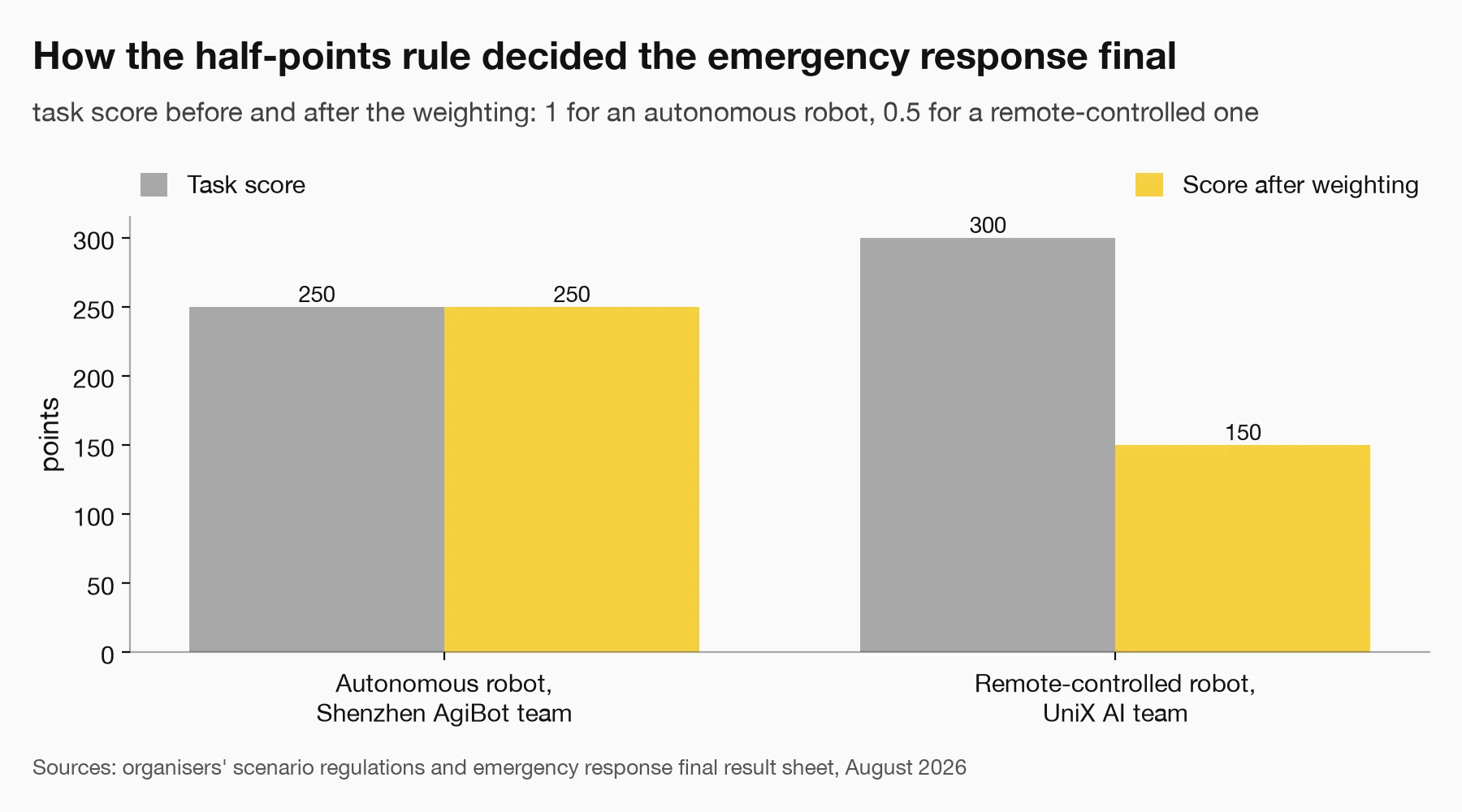
The remote-controlled robot completed more of the tasks and still lost, because its score was halved.
The halving works as a price on human help. A team that trusts its robot can take the full score. A team that does not can still compete and still win, if the autonomous teams fail enough tasks or do not enter. In the combined five-task event, every entry on the result sheet, including all 11 robots that were ranked, carries the 0.5 weighting used for remote control.
How did the organisers check that robots ran on their own?
A rule that pays double for autonomy invites teams to declare it. The scenario regulations anticipate that. Teams “must declare control mode truthfully”, and the organising committee may inspect “run data, control command records, operation logs, video” before, during and after the event. The same clause states that if a team declared autonomous mode but in fact used remote control or “hidden intervention”, the committee may cancel its result.
The committee did cancel results, though under a separate notice on fair competition for autonomous teams, which its announcements cite but which it has not published. Its notices, issued between 20 and 26 August by a fair-competition technical review centre, cancelled four results. Two teams, in the hotel and firefighting events, did not attend the post-event review in time. Two more, in the household and assembly events, were asked to reproduce their runs on site and did not reach the required task completion rate. None of the notices says a team was caught steering its robot. Two teams did not attend the review, and two could not repeat their runs to the required completion rate.
In all four events the cancelled team had been ahead of the eventual winner. In two of them, hotel and firefighting, the new winner was a remote-controlled robot scored at half points. In effect, a checked half score beat an unchecked higher one.
Why remote control matters for humanoid robots outside the arena
The same question follows humanoid robots out of the stadium. Robots sold for the home now come with a remote human option: 1X says an expert can supervise its NEO robot from afar, and owners can pilot it themselves, as we found in our piece on what the 1X NEO sends. A buyer watching a robot fold laundry in a video has the same problem the referees had in Beijing: without a rule and an audit, there is no way to know whose hands did the work.
The Games’ answer is a rulebook, a coefficient and a review centre. It is more precise than anything on the product pages we have read. The organisers have said the third Games, in Beijing in August 2027, will carry more scenario events, as we note in our results piece. The share of those events won at full points, by robots the review centre has checked, will be the best single measure of whether the robots are doing more of the work themselves.