Usain Bolt’s 100 metres record has stood since a summer night in Berlin in 2009. On the last night of the World Humanoid Robot Games 2026 in Beijing, five robots beat it in a single race. The organisers’ result sheet for the final gives the winner 8.64 seconds and the robot in fifth place 8.87, all inside Bolt’s 9.58. That race ended a second Games with more than twice the teams of the first, and one that scored robots on hotel work, library shelving and firefighting as well as on the track.
How big were the World Humanoid Robot Games 2026?
The main competition of the second Games ran from 22 to 26 August at the National Speed Skating Oval in Beijing, and five of the working events held their finals in the week before. The Beijing municipal government’s official preview sets the two editions side by side. The number of events rose from 26 to 51, split into 30 competitive events and 21 scenario-based events. Matches rose from 487 to 1,301. A total of 666 teams and 2,056 robots registered, against 280 teams at the first Games, and the officiating team grew to 223 referees.
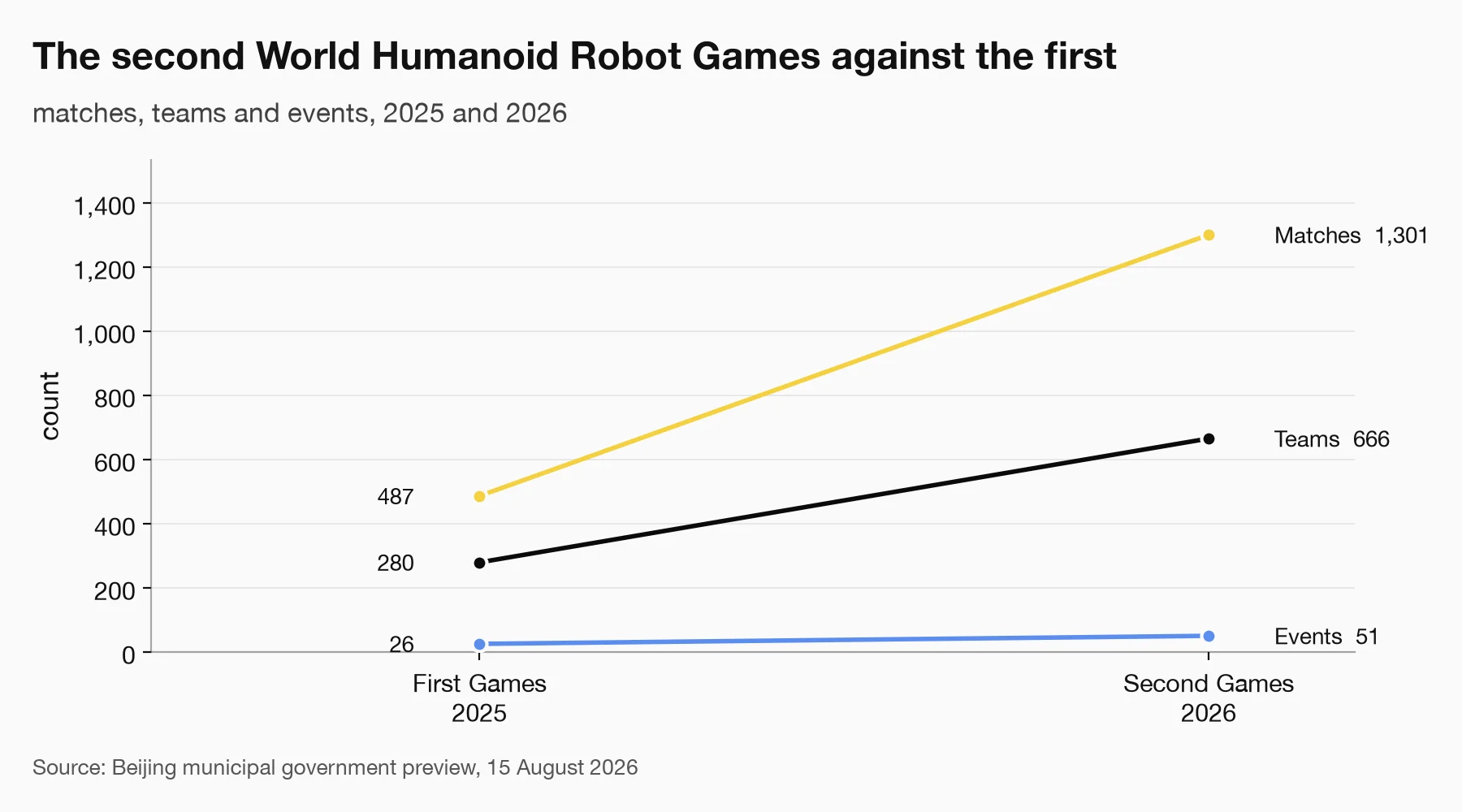
Teams, events and matches all rose between the first and second Games.
Growth on that scale in twelve months says as much about the organisers as about the robots. The Games are a Beijing government event, co-hosted with China Media Group and two international robotics bodies, and we set out who runs them in our explainer on the World Humanoid Robot Games.
The rules moved as well. The same preview lists tighter time limits: one minute for the 100 metres instead of three, five minutes for the 400 metres instead of 15, and 15 minutes for the 1,500 metres instead of 40. It also lists stricter autonomy: “Except for the 100m and 400m hurdle races, all track events and other competitive events require robots to complete them fully autonomously.” That summary leaves out kickboxing, where the rulebook lets a human steer a robot throughout, and weightlifting, where a human may steer it only as far as the platform, both of which we cover in our piece on remote control at the Games.
How fast did humanoid robots run at the World Humanoid Robot Games 2026?
The sprint is where the change is plainest. The official sheet for the final of the class for taller robots lists five finishers. The Tianjiao team won in 8.64 seconds and the Tianxiao team was second in 8.65. Two teams entered by Honor companies came third and fourth in 8.83 and 8.85, and the Jinghong Dongli team was fifth in 8.87. Tianjiao and Tianxiao are joint laboratories that X-Humanoid, the Beijing Humanoid Robot Innovation Center, runs with Peking University and Hebei University of Technology.
The sheet names teams and the organisations behind them, not robot models. Its wind and reaction-time columns are empty. The robot model comes from the teams and the press, and X-Humanoid names it as its Tiangong Ultra. The 100 metres is not a hurdle race, so on the rules as published each of those five times was run by a robot with no one steering it.
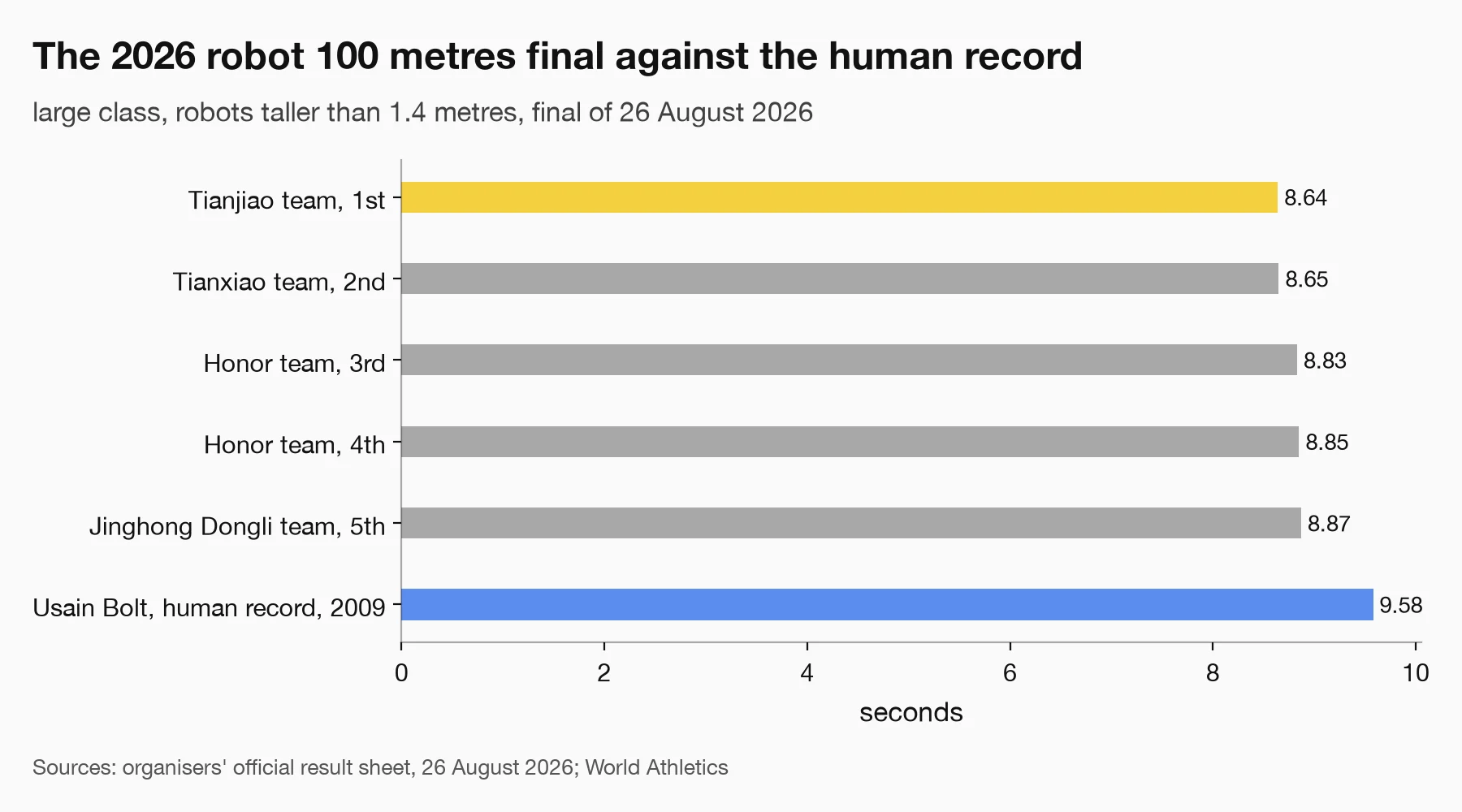
All five finishers in the large-class final ran inside Usain Bolt’s 9.58 seconds. The result sheet names teams, not robot models.
Put the final beside the human record and the gap is plain. The winner was 0.94 seconds inside Bolt’s time, and the slowest of the five was 0.71 seconds inside it. What that comparison means, and where it breaks down, is the subject of our investigation of the human world record claims.
The other track and field marks moved by more. CGTN, the channel of China Media Group, one of the Games’ hosts, gives the comparison with 2025: “The large-size robot 400m record fell from 1:28.03 last year to 38.15 seconds, while the best 1,500m time improved from 6:34.40 to 2:21.64. The standing high jump record also rose from 0.95641 meters to 3.40 meters.”
Those three marks cannot all be read the same way. The 400 and 1,500 metres are times over a set distance, and in 2026 they were run under rules that required the robot to run itself. The standing high jump is measured from the robot’s lowest point to the ground at the top of its jump, with no bar to clear. That is why the 3.40 metres cannot be set against a human high jump, as we show in our investigation of the record claims.
Who won the most medals at the World Humanoid Robot Games 2026?
The organisers publish result sheets for most finals and no medal table. Their announcements page carried 84 notices when we checked it on 27 September, and none of them is a medal count. The tables in circulation come from elsewhere. A per-team table in the Beijing Daily’s news app puts X-Humanoid’s own team, Tiangong, first with five golds. AgiBot says it won 18 gold, 16 silver and 12 bronze and topped both tables. X-Humanoid says its robots won 15 gold, 12 silver and 18 bronze and came first on total medals.
Both company totals gather several teams under one name, which is how both can claim first. AgiBot’s robots were entered by several teams, including ones registered to AgiBot companies in Shanghai, Shenzhen and Ningxia. X-Humanoid counts 49 joint teams using its robots. We set out how each count is built, and where the company claims and the official sheets disagree, in our piece on the medal table. Both companies also sell robots, and AgiBot’s shipments sit alongside the other makers’ in our piece on how many humanoid robots shipped.
What jobs did robots do at the World Humanoid Robot Games 2026?
The 21 scenario-based events are the part of the Games built to look like work. Robots served hotel guests, sorted library books, packed medicine boxes, charged electric cars and worked a firefighting and rescue post. Four of those events were held away from the arena, in a working hotel, a school library, a fire service centre and a show home. A remote-controlled run scored half the points of a run the robot completed on its own. By our count of the 21 final result sheets, a robot running on its own won 13 of those events and a remote-controlled robot won the other eight. The events, the scoring and the results that were cancelled after checks on autonomy are in our piece on the scenario events.
At the closing ceremony, according to CGTN, organisers “released a dataset containing more than 2,500 hours of real-world operational data gathered from training and competition”, covering 12 application scenarios, more than 100 skills and over 10,000 tasks. When we looked a month later we could not find it anywhere to download, as we set out in our piece on the Games dataset. The same report says the third Games will be held in Beijing in August 2027, “with scenario-based events expected to make up a larger part of the next program”.
The track times are the numbers that travel. The number worth watching in 2027 is the other one: how many of the working events a robot wins on its own, now that the organisers have said those events will grow. For buyers, that is the figure closest to the question we asked in our piece on when you can buy a humanoid robot.