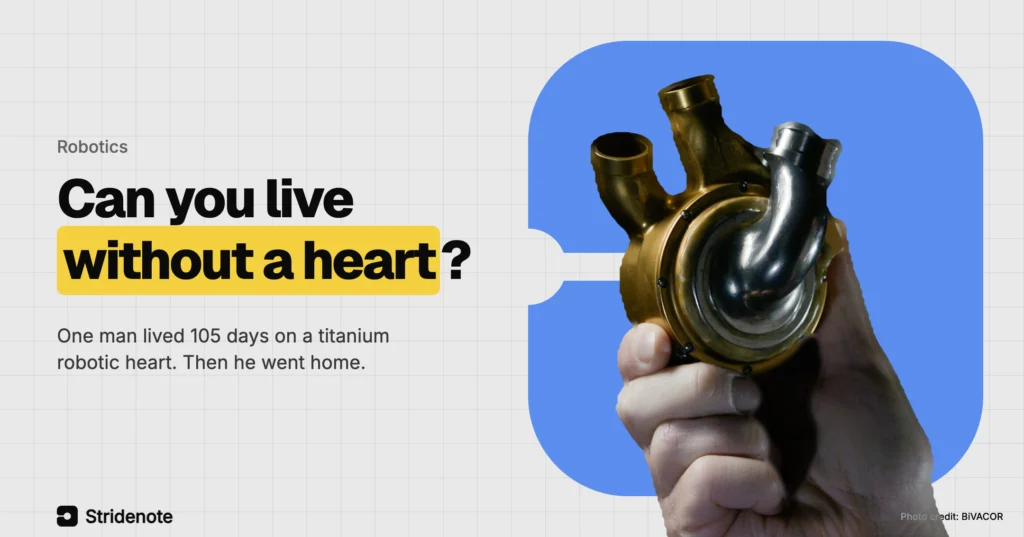
How long can a person live without a heart? In Sydney, one man lived 105 days without a heartbeat. In his chest, where his heart had been, a titanium rotor floated in a magnetic field and spun his blood around his body. Then he went home.
Science fiction imagined it the other way round. In Alita: Battle Angel, the 2019 film, a doctor finds a broken cyborg with an intact human brain and gives that mind a new machine body: a human inside a machine. In 2024, medicine put an artificial heart inside a human, and kept him alive with no heartbeat of his own.
The device was BiVACOR’s total artificial heart, implanted at St Vincent’s Hospital in Sydney on 22 November 2024. According to BiVACOR’s release of 12 March 2025, the patient became the first in the world to be discharged home with the device, lived on it for 105 days, and received a donor heart on 6 March 2025. This is the early phase of a race that may end with a machine someone can wear for years without complications. It is not that machine yet.
Around it, other machines have moved into work we used to call human. Brain implants now turn thought into cursor movement. An AI system earned a share of a Nobel Prize. So we have to ask the question plainly: are we headed for a future where the line between humans and machines blurs, and what would be left of us if it did?
What lets a person live without a heart?
A human heart squeezes. The BiVACOR heart spins. The same release describes it as a titanium pump with one moving part, a magnetically levitated rotor, and no valves. The rotor floats in a magnetic field as it pushes blood around the body. That is what makes it a robotic heart rather than a simple pump: according to the ACS Bulletin, electromagnets hold the rotor in place in response to high-frequency sensor feedback, so the machine senses its own position and corrects it as it runs.
For now the device is studied only as a bridge to transplant. It keeps a patient alive until a donor heart is found, and then it comes out. An artificial heart that someone wears for years is an ambition, and the 105 days in Sydney are a long way short of it. They are also the first time anyone went home with this pump, which is how a longer run has to start.
The record also holds loss. Two later patients in Australia died of intracranial hemorrhage several weeks after implantation, according to the American College of Surgeons Bulletin’s March 2026 cover story. An independent review found the events were not device-related. It pointed instead to the management of blood pressure and anticoagulation. The same Bulletin reports that the first patient in the United States lived 8 days on the device before a transplant.
Those outcomes sit side by side in the record, and they say something the headline alone does not. A pump that needs no heartbeat still depends on the drugs, the monitoring and the people around it. The machine is one part of the treatment, and the other parts are as human as medicine gets.
How artificial intelligence reached work we called human
The heart is the most physical example. The one that won a Nobel Prize happened in software.
The Nobel Prize in Chemistry 2024, announced on 9 October 2024, went half to David Baker “for computational protein design” and half jointly to Demis Hassabis and John Jumper of Google DeepMind “for protein structure prediction”, according to the Nobel press release. The work behind the second half is AlphaFold, a system that predicts the shape a protein will fold into.
Reasoning about the shape of a molecule is the kind of thinking we tend to credit to a scientist, and the committee rewarded a system that does it. Two of the people who built AlphaFold share the prize. The prediction itself is machine work.
The brain is the third example, and the most personal. Neuralink says the first person received its implant in January 2024. Two years later, in its post Two Years of Telepathy, dated 28 January 2026, the company describes “a growing crew of 21 Neuralnauts enrolled in trials worldwide”, up from three participants in 2024. In Neuralink’s words, the implant lets people with paralysis control computers and phones with their thoughts.
Put the three side by side. A pump keeps blood moving without a heartbeat. A model reasons about proteins. An implant turns an intention into a cursor on a screen. Each one reaches into something we had filed under being human, and all three reached those milestones in 2024.
Are humans and machines already merging?
Sam Altman argued in his essay “The Merge”, published on his blog on 7 December 2017, that the answer is yes. “Although the merge has already begun, it’s going to get a lot weirder,” he wrote. He put the Silicon Valley guesses for when humans and machines merge at between 2025 and 2075. “We will be the first species ever to design our own descendants,” he wrote.
The movement that welcomes this has a name, transhumanism: the view that people should use technology to go past the limits of the body. Read the essay next to the 2024 record and one thing stands out. None of the three machines above merges with anyone. The artificial heart is a bridge that comes out at transplant. The implant carries signals from a brain to a computer. AlphaFold predicts structures that scientists then test. What has changed is how close the machines now sit to the body, and how quickly they got there.
That, to us, is the weird part. The machines are strange, but they were always going to be. What surprises is the pace. Our robotics coverage keeps running into the same pattern outside medicine, where the announcement arrives first and the evidence follows later, if it follows at all.
Why the artificial heart record trails the announcements
A fast field needs a record that keeps up with it, and on the artificial heart the record is behind. BiVACOR’s entry on ClinicalTrials.gov, NCT06174103, was last updated on 16 July 2024. It still lists an estimated five patients. Since that update, a patient in Sydney went home with the device, lived on it for 105 days and received a transplant, and two more Australian patients died after implantation.
The two deaths are reported in a surgeons’ magazine, the ACS Bulletin, rather than in BiVACOR’s own releases. That is not a contradiction. A company release celebrates a first. A trial registry is supposed to count every patient, and a registry frozen in mid-2024 cannot tell a reader how many people have now carried the device.
We have seen the same gap elsewhere. When we read the filings to count how many humanoid robots actually shipped, the numbers that mattered were in the prospectus, not the launch videos. When we tested what sixteen coding agents send from one Mac for our local agent telemetry report, the useful part was the traffic log, not the product page. Machines that sit close to us deserve that kind of record, and a machine inside a chest deserves it most of all.
So, what is left of humanity when our working systems become part of a machine? Judging by 2024, quite a lot: the surgeons, the review panel, the patient who went home. The answer will be written in the records we insist on keeping, and the first test is a small one: whether the registry entry for NCT06174103 still reads five patients when the next artificial heart headline arrives.