A humanoid robot doing a backflip costs a company nothing to publish. A sales figure costs it a lawyer. In August 2026 two humanoid makers put theirs into stock exchange filings. UBTech told the Hong Kong exchange it sold 921 full-size humanoid robots in the first half of 2026, in its interim results. Unitree’s prospectus for its Shanghai listing shows 5,215 humanoid robots sold in 2025, and reviewed figures for the start of 2026. How many humanoid robots shipped, from the companies obliged to say, comes down to those two documents and a third, from Tesla, in which the line for Optimus is blank.
How many humanoid robots did UBTech sell in the first half of 2026?
UBTech’s interim results, published on 28 August 2026, give the number plainly. Its full-size humanoid business “achieved sales volume of 921 units, representing a year-on-year increase of 1,946.7%”. By that growth rate, the same six months of 2025 came to about 45 robots. Revenue from full-size humanoid products and services rose 1,445.0 per cent to 590.3 million yuan, from 38.2 million, and its share of the group’s revenue went from 6.1 per cent to 46.5 per cent. Group revenue doubled to 1,269.1 million yuan.
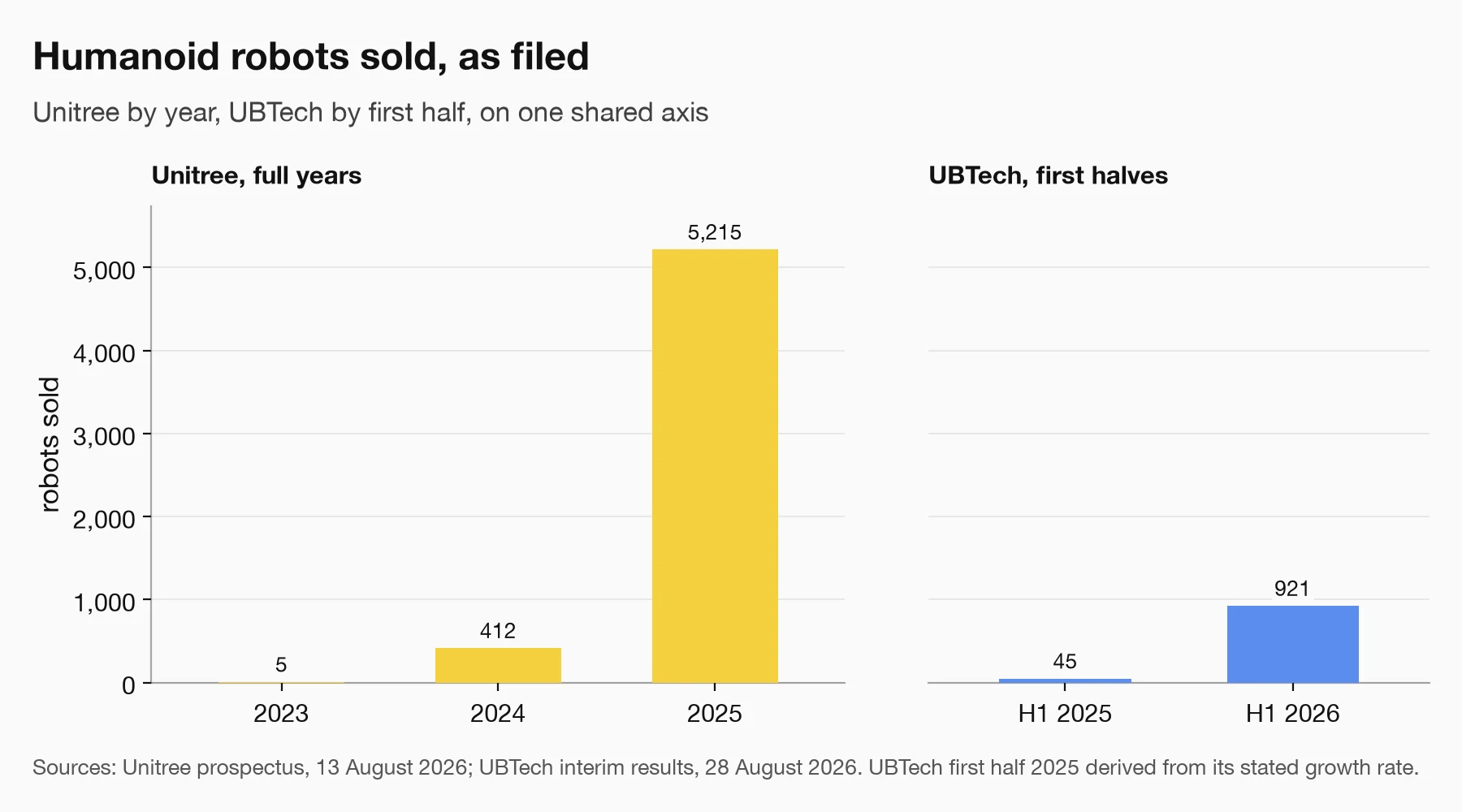
The only humanoid sales counts in stock exchange filings this year. UBTech’s first half of 2025 is our arithmetic from the growth rate it reports.
Two details in the filing change how the 921 should be read. UBTech’s full-size category includes the Cruzr Y1, which the company describes as a wheeled humanoid robot for manufacturing and warehousing, so not every one of those robots walks. And the revenue line covers products and services together, so dividing it by the units gives about 641,000 yuan per robot sold, services included, rather than a price.
The filing also sets the next marker. UBTech says its work on mass production supports “the achievement of annual production target of 10,000 units”. That is a target, and the filing presents it as one. The 921 is the number that happened.
What does Unitree’s 2026 prospectus say about humanoid sales?
Unitree filed its final prospectus on 14 August 2026, five days before its shares began trading in Shanghai. Its table of product sales gives humanoid robots sold as 5 in 2023, 412 in 2024 and 5,215 in 2025. A separate line says 2025 shipments exceeded 5,500, counting pure humanoids and excluding wheeled dual-arm robots. The production table puts shipments at 5,511, and the prospectus says the gap to 5,215 sold is robots delivered but not yet signed off by the customer, so not yet booked as revenue.
The same table shows the price falling as volume rose. Unitree’s average humanoid sold for 593,400 yuan in 2023, 260,400 yuan in 2024 and 166,400 yuan in 2025. Humanoids went from 1.88 per cent of main-business revenue to 51.78 per cent over the three years. Quadruped robots still sold in far larger numbers, 23,037 in 2025, so the four-legged machine remains the volume business and the two-legged one the revenue story.
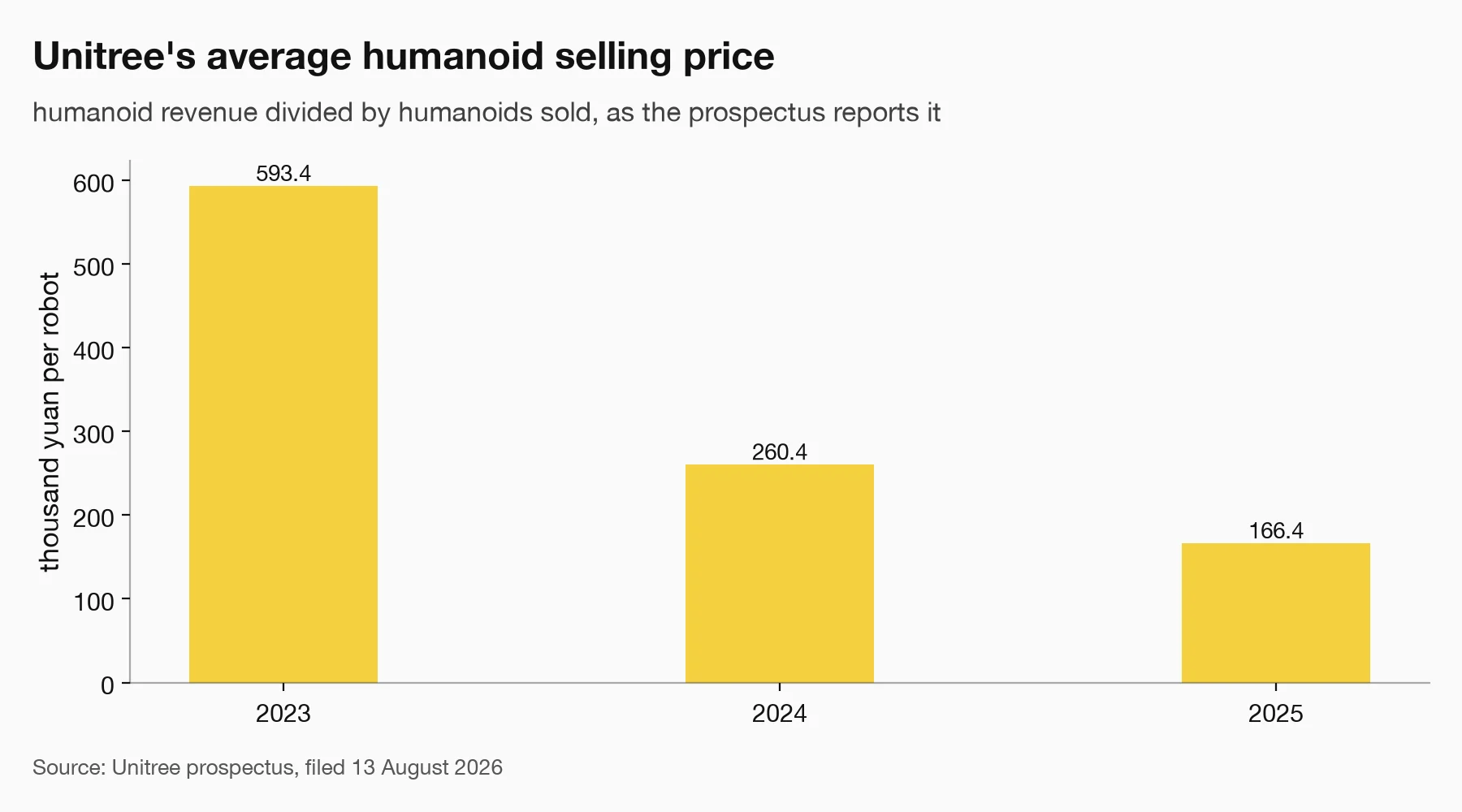
Unitree’s average humanoid price fell by almost three quarters in two years as sales went from 5 robots to 5,215.
The prospectus is also where the 2026 figures are. Reviewed accounts for the first quarter show revenue of 422.8 million yuan, up 68.49 per cent, against growth of 332.64 per cent the year before. Profit after non-recurring items fell 52.55 per cent. Unitree gives its own reasons, in our translation: a much larger revenue base, industry heat “gradually easing”, and competition “intensifying”. A risk section adds that if short-term demand such as robot rental cools, the effect could pass upstream into price competition.
We have not run any of these machines, so we have no verdict on them, and every figure here belongs to the company that filed it. Reading the document instead of the demonstration is the method we used when we read Graphify’s source rather than running it, and when we checked what every local AI tool actually sends home. It also means saying plainly when a company has published nothing, which is what we did when a vendor shipped a new quantisation format with no benchmark numbers attached.
What does Tesla’s 2026 filing say about Optimus production?
Tesla files a Form 8-K with its quarterly results, and the one dated 22 July 2026 is the plainest document in this piece. In its manufacturing table, under Robotics, two lines appear: California Optimus and Texas Optimus. Both carry the status “Construction”. The capacity column for both shows a dash where the other lines show a number.
The text says what has not happened yet. Tesla writes that it has decommissioned the Model S and Model X lines at its Fremont Factory and is installing the first-generation Optimus lines, where it expects “to start production soon”. The filing then says who the first robots are for: “The initial Optimus builds will be used in our Optimus Academy for training data collection and further functionality development.” In the same document Tesla reports Model 3 and Model Y production for the quarter as 442,936 units, counted exactly. Optimus gets a blank cell.
Unitree’s prospectus, describing its competitors, says Tesla has announced the start of small-batch trial production of Optimus Gen-3, in our translation. Tesla’s own filing, three weeks earlier, describes lines being installed. The competitor’s account is the more generous of the two.
How many humanoid robots shipped in 2026, by the filings
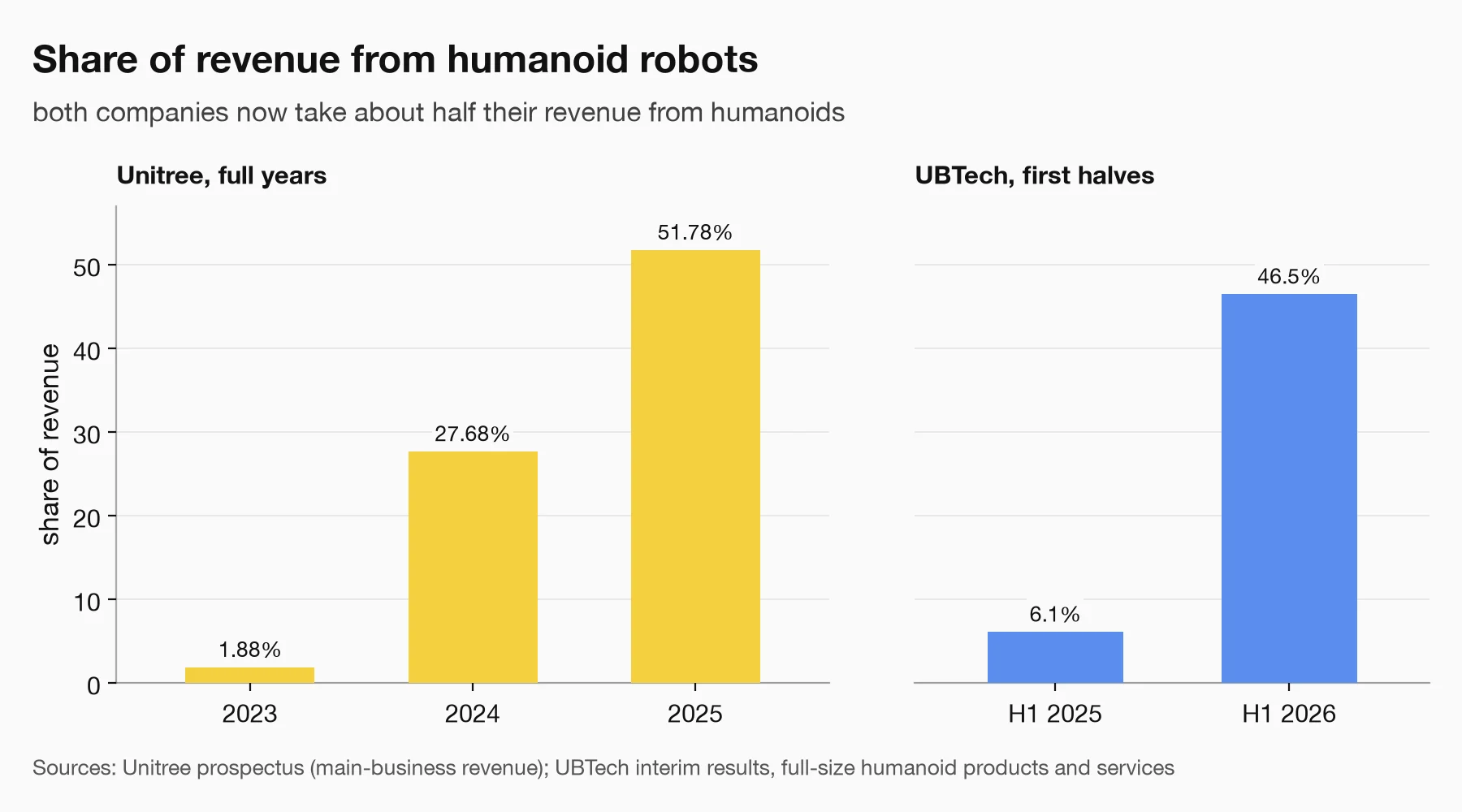
By 2026 both filing companies depend on humanoids for about half their revenue.
Read together, the filings describe a category that is real and still small. The two companies obliged to count sold 921 full-size humanoids in six months and 5,215 humanoids in a year, and each now takes about half its revenue from them. Unitree’s prices are falling fast, and Unitree, which says it shipped more humanoids than anyone in 2025, says in writing that the heat is easing. The best-known name in the category has filed a status, not a number.
The shipment count is one record among several, and this series reads the others the same way, from the documents the companies published: what a humanoid robot costs, how much a humanoid robot can lift, when you can buy a humanoid robot and what a home humanoid sends back to its maker.
Three records will test these numbers before the year ends. The International Federation of Robotics published World Robotics 2026 on 24 September, and its industrial count is the first outside check on the filed figures. Unitree’s first interim report as a listed company will show whether its humanoid volumes kept rising as growth slowed. And UBTech’s 10,000-unit target will either appear in its annual results or it will not. A category becomes real in the filings before it becomes common, and in 2026 the filings have started.