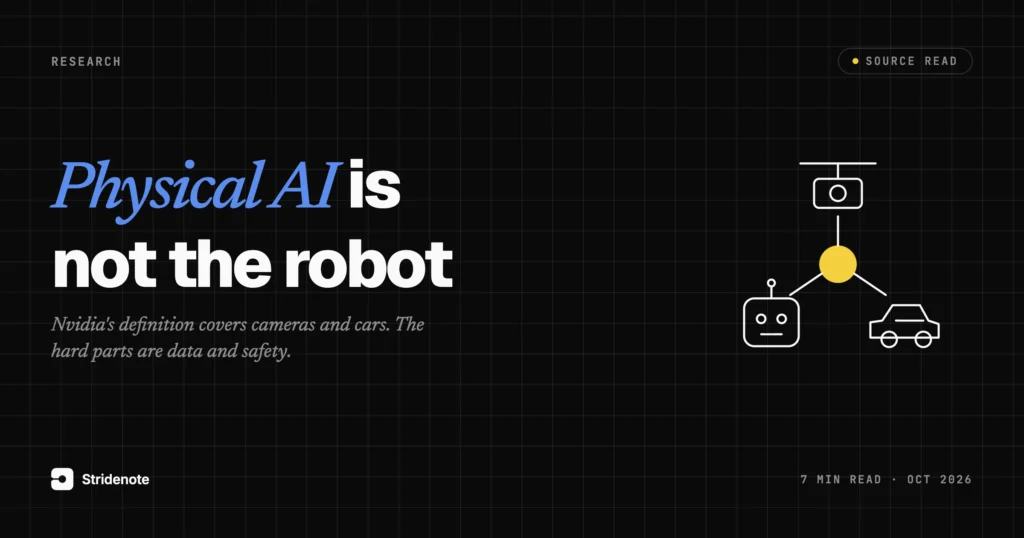
A security camera bolted to a warehouse ceiling has no arms and no wheels, and Nvidia counts it as physical AI all the same. The company’s glossary entry on physical AI lists cameras beside robots and self-driving cars as the autonomous systems the term covers, and says physical AI is what lets them perceive, understand, reason and act in the physical world. A robot is a machine. Physical AI is the intelligence put into it, and into several things nobody would call a robot.
What is physical AI, in Nvidia’s own definition?
Nvidia starts from what a text model lacks. Its glossary says generative models such as GPT and Llama are trained on text and image data gathered largely from the internet, and that they have a limited grasp of the physical world and its rules. Physical AI, in the same entry, extends generative AI with an understanding of spatial relationships and of how the 3D world behaves. It takes in images, video, text, speech or sensor data and turns them into insights or actions that a machine can carry out.
The examples on the page are wider than a humanoid. Under robots the glossary names warehouse mobile robots, robot arms, surgical robots and humanoids. Autonomous vehicles get their own heading. So do what Nvidia calls smart spaces: factories and warehouses watched by fixed cameras and computer vision models that track people, vehicles and robots.
The entry is also a catalogue. It describes building physical AI as a process across three computers and puts an Nvidia product on each. DGX trains the models. Omniverse with Cosmos, on RTX PRO Servers, builds the simulated environments and generates synthetic data. Jetson Thor runs the finished model inside the robot, and DRIVE AGX does the same job in a vehicle. That is Nvidia’s description of its own product line, and it should be read as one.
The GTC announcements followed the same map. In its press release of 16 March 2026, Nvidia announced Cosmos 3, which it calls the first world foundation model to unify synthetic world generation, vision reasoning and action simulation. A world model, in plain terms, is a system that predicts how an environment will behave before anything acts in it. The release also put Isaac Lab 3.0, a robot learning framework, into early access, and did the same for GR00T N1.7, a model for robot skills, with commercial licensing. Jensen Huang, Nvidia’s chief executive, is quoted in it saying “every industrial company will become a robotics company”. We have run none of these products, so we have no verdict on any of them.
Is physical AI the same thing as a robot?
No, and Nvidia’s own material shows the difference from both directions.
A robot can exist without physical AI. The glossary contrasts robots that do rigid automation with robots that can sense, reason and act in real time. The GTC release describes robotics as moving on from task-specific machines. It also says FANUC, ABB Robotics, YASKAWA and KUKA have a global install base exceeding 2 million robots, and that those four makers are now integrating Nvidia’s simulation software and Jetson modules. Two million machines were installed before that integration. The body came first.
Physical AI can also exist without a robot. The ceiling camera in a smart space moves nothing. A car is a vehicle before it is a robot. Both are on Nvidia’s list because the label describes what the software does with the physical world, and the shape of the machine does not enter into it. A related term, embodied AI, is narrower: AI that acts through a body, usually a robot.
The cleanest demonstration we have published came from Beijing in August. At the World Humanoid Robot Games, 21 scenario events scored robots on jobs such as hotel service and library shelving, and a remote-controlled run earned half the points of a run the robot completed alone. By our count of the final result sheets in our report on the 2026 Games results, a robot running on its own won 13 of those events and a remote-controlled robot won the other eight. The remote-controlled winners were robots in every mechanical sense. Their intelligence was a person holding a controller. Physical AI is the name for the thing that replaces that person.
Why is physical AI harder to build than a text model?
Two reasons stand out in the documents, and the first is data. A text model learns from writing that already exists. Nothing equivalent exists for the experience of gripping a box or crossing a wet floor, so it has to be recorded. Nvidia’s glossary says collecting that data in real-world settings can be “tedious, error-prone, dangerous, and expensive”. Nvidia sells the alternative, simulation, so the sentence is also a sales argument. A research body’s account points the same way.
Google DeepMind introduced AutoRT on 4 January 2024 as a system for gathering robot training data. Over seven months it directed as many as 20 robots at once, and 52 different robots in total, through office buildings. The result was 77,000 robotic trials across 6,650 unique tasks. Seven months of work by 52 robots is a great deal of effort for a dataset of that size.
The same shortage shows up in what we have read elsewhere. Tesla’s July filing says its first Optimus builds will go to its own training data collection, as we noted when we counted how many humanoid robots shipped. The organisers of the Games announced more than 2,500 hours of real-world robot data at the closing ceremony on 26 August. A month later we looked for it and found no download page, which we set out in our piece on the missing Games dataset.
Simulated experience is the cheap half. When we installed and ran MuJoCo on a Mac, our test machine stepped the standard humanoid model about 63,000 times a second on one core, and 3,014 times faster than real time across ten. That gap in cost is why so much of what is sold as physical AI is simulation software.
The second reason is the price of a wrong action. A text model that errs produces a bad paragraph. A robot that errs moves a motor. DeepMind’s post is frank about this. AutoRT gave its language model a Robot Constitution, a set of safety prompts, with rules that no robot should attempt tasks involving humans, animals, sharp objects or electrical appliances. DeepMind then says of that prompting: “this alone cannot guarantee safety”. So the robots were also programmed to stop if the force on their joints passed a threshold, and every active robot stayed in the line of sight of a human supervisor with a physical deactivation switch.
Our MuJoCo test shows the cheap version of the same failure. Unitree’s H1 model, loaded with no controller, collapsed within two seconds. Its pelvis dropped from 0.98 metres to 0.10. In a simulator that fall cost nothing, and we could run it again at once.
How much physical AI is there in 2026?
The public record counts bodies. UBTech’s interim results give 921 full-size humanoid robots sold in the first half of 2026. Unitree’s prospectus gives 5,215 humanoids sold in 2025. Neither filing says how many of those robots do useful work with nobody steering them, and no filing we have read tries to.
The Games came closer than any company document. A result sheet that records whether the winner ran alone or under remote control is a measurement of the intelligence, separate from the machine. Thirteen autonomous wins out of 21 is a small sample from one competition, and it is still the only figure of its kind we have found.
The third Games are due in Beijing in August 2027, with scenario events expected to take up more of the programme. The share of those events a robot wins on its own will say more about physical AI than the next shipment count, because a shipment count stays the same whether or not anyone is holding the controller.