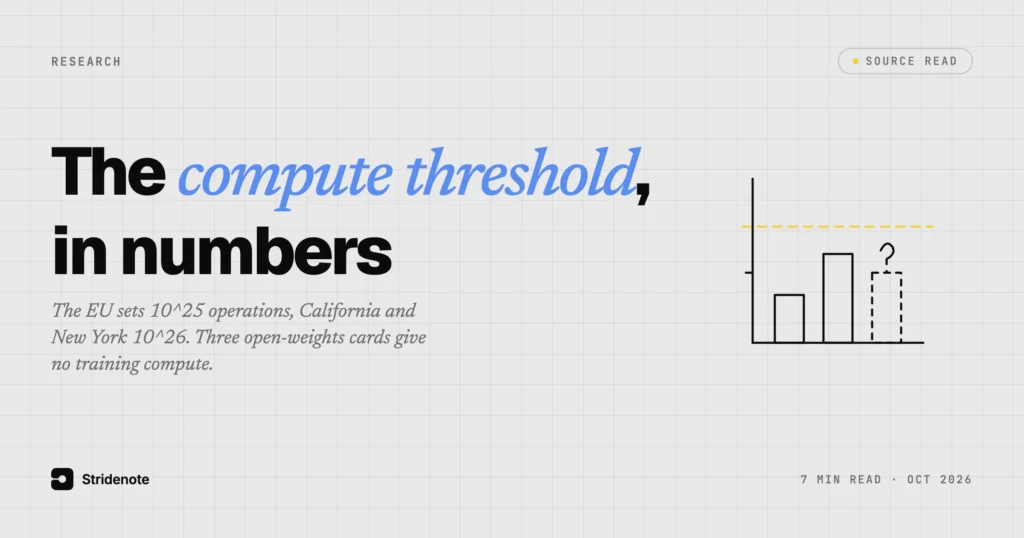
A weighbridge can tell you whether a lorry is over the limit for a bridge. Nothing of the kind exists for an AI model. The rules now being written for large models set their limit in a unit, the total arithmetic spent on training, that the finished model does not carry. In an essay dated June 2026, Policy on the AI Exponential, Dario Amodei, writing for Anthropic, proposed mandatory third-party testing above a compute threshold and gave no number for it. The laws already on the books do give one: 10^25 operations in the European Union, 10^26 in California and New York.
We read the legal texts on the official sites, then opened three open-weights model cards to see whether a reader could place a model on either side of those lines. None of the three cards states training compute at all.
What is a compute threshold in AI rules?
A compute threshold is a line drawn through the amount of computation used to train a model. Below it, a rule does not apply. Above it, the rule applies, or is presumed to. The unit in every text we opened is a count of operations, the individual additions and multiplications a training run performs, summed over the whole run.
The EU text gives a reason for the choice: the figure can be known early. A recital of the EU AI Act says training takes planning and an upfront allocation of compute, so a provider can tell whether a model will cross the line before training ends. Another recital calls compute one of the relevant approximations for capability, a stand-in.
Two details change the count. California’s SB 53 says the figure covers the original training run and any later fine-tuning, reinforcement learning or other material modification the developer applies to an earlier model. That second EU recital goes wider and counts synthetic data generation among the activities that add to the total. So the number is a running tally across a model’s history, kept by the developer.
What compute threshold does each law actually set?
Here are the clauses, with the number and unit as each text writes them.
| Law | Number as written | Unit as written | What crossing it does |
|---|---|---|---|
| EU AI Act, Article 51(2) | greater than 10^25 | floating point operations | Model is presumed to have high impact capabilities |
| California SB 53, section 22757.11(i) | greater than 10^26 | integer or floating-point operations | Model is a frontier model |
| New York RAISE Act as passed, S6953-B | greater than 10^26 | computational operations | Frontier model, if compute cost also exceeds one hundred million dollars |
| New York RAISE Act as amended, S8828 | greater than 10^26 | integer or floating-point operations | Model is a frontier model |
*Sources: EUR-Lex and the European Commission’s AI Act Service Desk; California Legislative Information; New York State Assembly. Read 2026-10-08.*
The European line is the lowest, ten times below the American ones. Article 51 of the AI Act makes it a presumption. A general-purpose model whose cumulative training computation is above the line is presumed to have high impact capabilities, which is one of two routes to being classed as a model with systemic risk. The other route is a Commission decision, and the criteria for that decision in Annex XIII list the number of parameters and the amount of training computation as separate items. Paragraph 3 of the same article lets the Commission amend the thresholds by delegated act.
California’s SB 53 became Chapter 138 when the Governor approved it on September 29, 2025. It defines a frontier model as a foundation model trained with computing power “greater than 10^26 integer or floating-point operations”. The duty to publish a frontier AI framework falls on a narrower group, the large frontier developer, which is a frontier developer whose annual gross revenues with affiliates passed $500,000,000 in the preceding calendar year.
New York is where the widely repeated version and the enacted version part. The RAISE Act signed as Chapter 699 on December 19, 2025 had a double test: more than 10^26 computational operations, and a compute cost above one hundred million dollars. That text no longer stands. Senate bill S8828, signed as Chapter 96 on March 27, 2026, repealed the article and wrote a new one. The new frontier model definition matches California’s word for word and has no compute cost test. The amendment also sets January 1, 2027 as the date the act takes effect.
One trap for anyone copying the figure: EUR-Lex prints the exponent as a superscript. The Service Desk’s article text and the New York Assembly’s bill text both flatten it, so the pages read 1025 and 1026. California types the caret.
What compute threshold does the Anthropic proposal name?
None. The essay describes the proposal in one sentence that begins “Models above a threshold of compute should undergo mandatory testing”, and the testing would be by a qualified third party across four risk areas: cybersecurity, biological weapons, loss of control of AI systems, and automated research and development that could speed up the other three. The government would have power to block or deter deployment on the strength of that assessment. The essay says Anthropic is releasing a legislative proposal on frontier model testing alongside it. The essay itself contains no operation count.
It does name the transparency laws Anthropic supported: SB 53, RAISE and Illinois SB 315. Its RAISE link goes to print A6453-A on the New York Senate site, an earlier print than the S6953-B that was signed, and one that predates the March 2026 rewrite. The Illinois link goes to a bill tracker. We could not open the official Illinois text, so SB 315 is left out of the table.
Anthropic’s is not the only proposal waiting on a text. When Senator Sanders and Representative Casar announced the Ban Artificial Superintelligence Act on September 3, the release described forthcoming legislation and gave no bill number. Until a text exists, there is no clause to read.
Can a model card tell you which side of the compute threshold a model sits on?
We read three cards from releases we have covered, on Hugging Face, on October 8.
Moonshot AI’s Kimi K3 card calls it a 2.8T-parameter model. It says quantization-aware training was applied from the SFT stage onward and that the model was trained in a preserved thinking history mode. It gives no training compute figure. The strings FLOP, floating, GPU hour and operations do not appear in it.
The card for Qwen3.8-2.4T-A95B, the open checkpoint of Alibaba’s Qwen3.8-Max, lists the training stage as pre-training and post-training and the parameter count as 2.4T in total with 95B activated. It gives no training compute figure either. The smaller Qwen3.8-27B card has the same layout, 27B parameters, and the same gap.
So the answer for all three is that the card does not say, and we will not guess. A parameter count is a different quantity from an operation count, and the Annex XIII list treats them as two criteria for that reason. This is the gap we described in what open weights leaves out: the file is the finished model, and the record of how it was made stays with the maker.
The EU text does require that record to exist. Annex XI lists “the computational resources used to train the model” among the technical documentation a provider must keep, with the number of floating point operations as its example. Article 53 sends that documentation to the AI Office and national authorities on request. It does not send it to the public. The same article excuses providers who release under a free and open-source licence with public weights from that duty, unless the model is one with systemic risk.
California has built a review into its own definition. Section 22757.14 tells the Department of Technology to recommend, on or before January 1, 2027 and every year after, whether and how to update the definition of a frontier model. That first deadline falls on the day New York’s act takes effect with the same sentence in it. If that review leads California to move its number, two states that now share one definition will have two again, and a model card will still be silent on both.