Two models sat loaded in the same copy of LM Studio this week, and one of them was a fifth the size of the other. The small one answered faster, held more context in reserve, and still got the hard questions right. On paper that should settle the argument. It does not, and the reason is the thing benchmarks rarely show: what each model does when you ask it to simply write. We ran Bonsai 27B, PrismML’s 1-bit build, head to head against Gemma 4 31B QAT, the model that already drives our daily work, on a single 48 GB M4 Pro test machine. Same prompts, same test setup, one loaded after the other where memory demanded it. For a business choosing one local model for its Macs, the result decides how much memory to buy and which jobs each model can be trusted with.
Both are dense models. Bonsai is a 3.80 GB file at 1.128 bits per weight, published under Apache 2.0 in the Bonsai-27B-gguf repository on Hugging Face. Gemma 4 31B QAT is an 18.85 GB quantization-aware-trained build that we run at a 64K context. We covered the Bonsai internals in our 1-bit teardown, and Gemma against its nearest rival in Gemma 4 31B vs Qwen 3.5 27B. This piece is about which one to reach for.
How much faster is Bonsai 27B than Gemma 4 31B?
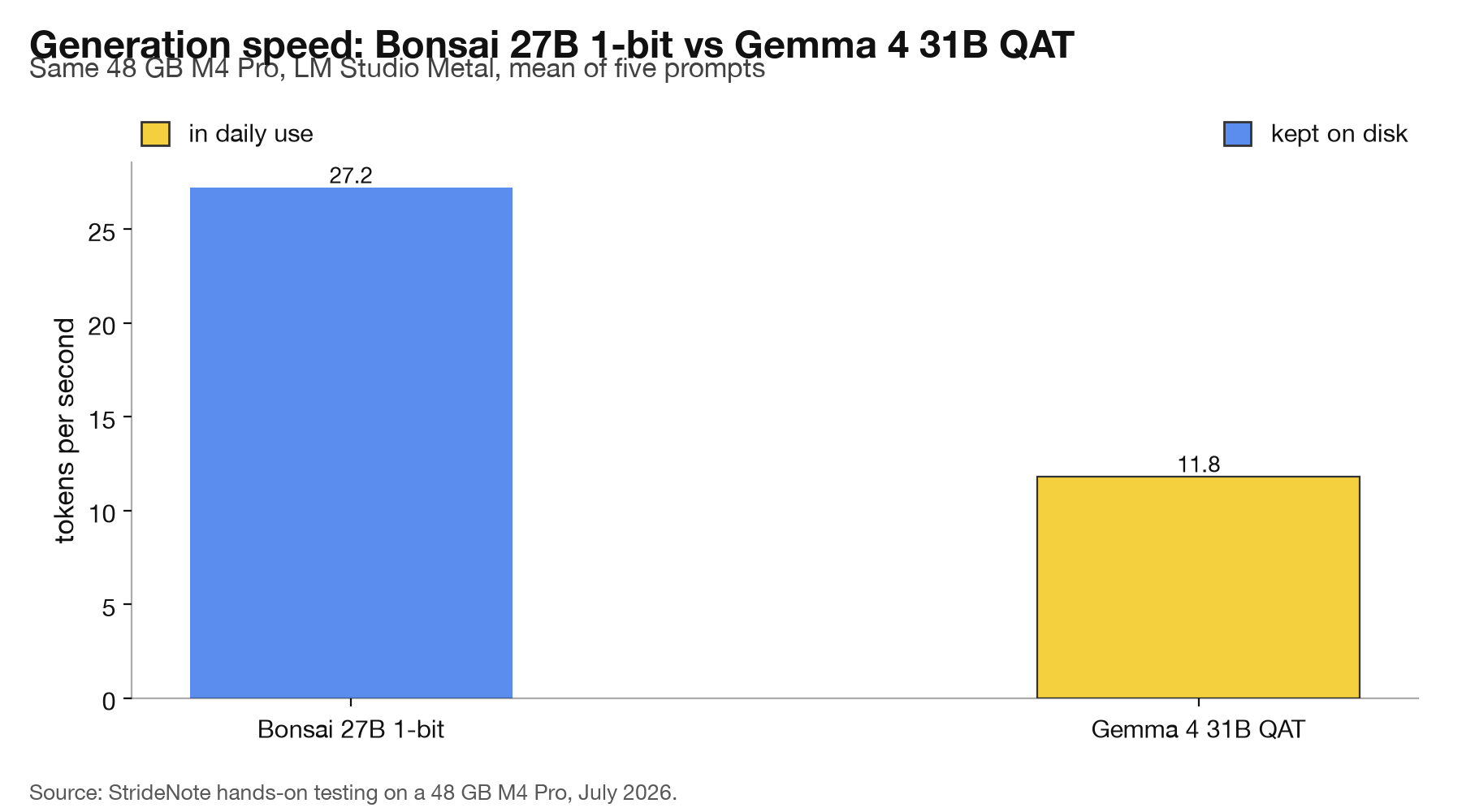
Speed is the cleanest result in the whole test. Across five prompts covering arithmetic, logic, instruction following, coding, and a short explanation, Bonsai generated at a mean of 27.2 tokens per second on the Metal path. Gemma managed 11.8. That is a 2.3x gap, and it held on every prompt rather than swinging around.
The memory story runs the same direction. Bonsai loads in 8.25 seconds and holds a 100K-token context inside about 11.6 GB. Gemma occupies 18.85 GB before you send it anything. On a 48 GB machine that difference decides how much room is left for everything else you have open. If raw throughput and a light footprint were the only axes, this article would end here with a one-word answer.
| Measurement | Bonsai 27B 1-bit | Gemma 4 31B QAT |
|---|---|---|
| Mean generation speed | 27.2 tok/s | 11.8 tok/s |
| File size on disk | 3.80 GB | 18.85 GB |
| Tool call accuracy (3 cases) | 3 of 3, valid JSON | 3 of 3, valid JSON |
| Time to emit a tool call | 4 to 7 s | 6 to 8 s |
| Timed 250-word draft | 251 words in 100 s | 245 words in 227 s |
| Reasoning share of output | 79 to 99% | 79 to 89% |
Source: StrideNote hands-on testing on a 48 GB M4 Pro, July 2026.
Which model is better for tool calling and agents?
We gave each model a single weather function and three requests: two that clearly needed the tool, and one that clearly did not. Both models went three for three. Each called the function with correct arguments when the question demanded it, produced valid JSON every time, and correctly declined to call anything on the question that asked for a direct answer. On tool-calling correctness there is nothing to separate them.
Latency gives Bonsai a small edge. It emitted a tool call in 4 to 7 seconds against Gemma’s 6 to 8. In an agent loop, where each step waits on the last, that difference compounds. Against that, Bonsai carries a real hazard for agent work. On one of our short prompts we capped the response at 1,600 tokens, and Bonsai spent the entire budget thinking and returned an empty answer, with a finish reason of “length”. The model had not failed in the usual sense. It simply had not stopped reasoning before the ceiling arrived. A step that silently returns nothing is worse for an agent than a slow step, because the loop has nothing to act on and no error to catch.
We then put Bonsai behind a real agent. In Bonsai 27B inside the Pi coding agent it found a seeded off-by-one bug in 32 seconds, read-only, and reported it on line 14 when the bug sits on line 17.
There is also the matter of context and fit. Our coding agents run against system prompts measured in tens of thousands of tokens, and Gemma already sits in that slot at 64K, wired into the stack we described in LM Studio vs Ollama on Mac. Bonsai can hold a far larger window in principle, but we tested it at 4K, and moving it up to agent-scale context erases part of the memory advantage that makes it attractive. For sustained agent work, Gemma is the safer default. Bonsai suits a narrow agent role: self-contained reasoning steps where you control the token budget and set it high.
Can a 1-bit model write as well as Gemma 4 31B?
This is where we expected Bonsai to fall apart, and where the test corrected us. We gave both models the same brief: a 220 to 260 word article opening for startup founders, with a concrete hook, varied sentence length, and no bullet points or em dashes.
Our first run capped output at 4,000 tokens, and both models returned empty. Each spent the whole budget on hidden reasoning before writing a word. That is the single most important operating fact about this class of model. Raising the ceiling to 12,000 tokens fixed it for both. Bonsai then produced 251 words in 100 seconds. It spent 2,249 tokens thinking before the first word landed. Gemma produced 245 words in 227 seconds after 2,281 reasoning tokens. Neither used a bullet or an em dash, so both followed the format.
On the prose itself the gap is narrow. Gemma opened on a live investor demo hitting a rate limit, with a clean narrative arc and a vivid beat when the room goes quiet. Bonsai opened on a two in the morning billing alert and wrote in punchier, more direct sentences. Gemma reads slightly more polished. Bonsai reads slightly more urgent. What separates them for our purposes is not craft but hygiene: Bonsai’s draft included a construction our own style rules ban, the “it is not about X, it is about Y” pivot, and leaned on a three-item list where one specific claim would do. Gemma’s draft carried fewer of those tells and needed less scrubbing. Both would still get an edit before publishing.
The headline correction is worth stating plainly. Given enough token budget, Bonsai writes at a quality close to Gemma and does it in under half the wall-clock time. Its earlier empty answer was a budget artifact, not a ceiling on what it can produce.
Bonsai 27B vs Gemma 4 31B for structured data extraction: which suits which Mac?
Pulling fields from invoices and forms into JSON is a common business job for a local model. We have not yet run Bonsai 27B on that task, so this section gives no extraction score for it.
The closest test in this piece is tool calling, where each model must return its arguments as valid JSON. Both did, three times out of three. Gemma 4 31B has since passed a stricter check: given a JSON schema with three required fields in our LM Studio structured output test, it returned schema-valid JSON in 3 of 3 requests. Asked for London’s population as an integer in our Gemma 4 31B MLX and GGUF comparison, the GGUF wrote 79. Valid JSON is not a correct extraction, so any trial needs documents whose right answers you already hold.
Memory decides the machine. Bonsai held a 100K-token context inside about 11.6 GB. Gemma’s weights alone take 18.85 GB, and our context window measurements on the same machine put the whole process at 21.97 GB at an 8K context. That rules Gemma out of a 16 GB Mac on the weights alone. Bonsai at 100K would leave about 4.4 GB of a 16 GB Mac for everything else (16 minus 11.6), which we have not tried. On a 32 GB Mac, Gemma at 8K would leave about 10 GB (32 minus 21.97). Both run on our 48 GB test machine, one at a time.
Speed sets the volume a single Mac can clear. At the 27.2 and 11.8 tokens a second we measured, every 100 tokens of output takes about 3.7 seconds on Bonsai and 8.5 on Gemma (100 divided by each rate). Most of those tokens are reasoning rather than JSON: 79 to 99 percent of Bonsai’s output and 79 to 89 percent of Gemma’s in our runs. Set a generous token cap for extraction, because Bonsai returned nothing when its budget ran out.
Until we have run both on the same set of documents, we make no pick. What the measurements above support is narrower. Gemma 4 31B is the one of the two with a schema-valid structured output result behind it, and by our memory figures it needs a 32 GB Mac or more. Bonsai is the one whose measured memory fits under 16 GB, by arithmetic we have not tried on such a machine. The test that would settle the extraction question is both models through LM Studio structured output on one set of business documents with known answers, with field accuracy, seconds per document and peak memory recorded, and it is on our list. Until then every output from either should be checked against the schema and a sample of known answers.
When should you run Bonsai instead of Gemma 4 31B?
The two models sort into clear roles. Gemma 4 31B is the reliable generalist. It writes visible prose on the first try, never returned an empty answer in our runs, and already anchors the daily stack, so nothing new has to be wired up. It is the model to keep loaded when you do not know what the next task will be.
Bonsai 27B is the fast specialist. It answers hard, self-contained questions at more than double Gemma’s speed from a fifth of the memory, which is exactly the profile you want when you are running a model on a laptop with other work open, or reaching for a quick reasoning pass rather than a long session. The condition attached to it is firm: give it a generous token budget, or it returns nothing. Cap it low and you get silence. Give it room and you get a strong answer, fast. Which model earns the RAM depends less on the leaderboard than on the job, a point we made in our guide to picking a local model for your RAM.
The wider signal is that a 3.80 GB file now trades blows with an 18.85 GB one across speed, tool calling, and even writing. It loses clearly only on the predictability that comes from an unbounded output channel. PrismML’s stealth-exit claim, reported when the lab first showed its 1-bit family, was that binarised weights could hold their own against conventional builds. On a single Mac, across a working week of tests, that claim mostly held.