Ask three humanoid robot makers how much their machine can lift and you get seven answers. Boston Dynamics’ Atlas spec sheet gives three: 50 kg instant, 30 kg sustained and 20 kg with one hand. 1X gives three more for NEO, and Agility Robotics gives one for Digit 5. Every humanoid robot lift figure among them is true on its own terms. None of them measures the same thing, and that difference is the most useful thing a buyer can take from the three makers’ current spec sheets.
How much can a humanoid robot lift, according to Atlas’s spec sheet?
Boston Dynamics’ Atlas spec sheet is dated 23 December 2025 and was posted to its site in January 2026. Its capability table splits weight capacity three ways: 50 kg (110 lbs) instant, 30 kg (66 lbs) sustained, and 20 kg (44 lbs) one-handed. The robot itself weighs 90 kg, stands 1.9 m tall, has 56 degrees of freedom and reaches 2.3 m.
The gap between the first two numbers is the one to notice. The sheet does not define its terms, but the ordinary reading is that instant is a brief peak and sustained is what the robot can hold. Sustained is 40 per cent lower. A buyer planning a shift of repeated work should read the 30, not the 50.
The same sheet is unusually open about what lifting costs in power. Battery life is 4 hours, and 2 hours with heavy lifting. Atlas swaps its own battery in 3 minutes, and the pack it takes out needs 1.5 hours on the charger. The swap means the halved runtime does not have to stop work: the robot changes batteries instead of waiting.
What do 1X NEO’s 154 lb lift and 18 lb arm payload mean?
1X lists three load figures for NEO on its specification page: a lift of 154 lbs, a carry of 55 lbs and an arm payload of 18 lbs. In metric that is about 70 kg, 25 kg and 8 kg. NEO itself weighs 66 lbs, about 30 kg, and stands 5 ft 6 in.
Taken literally, the lift figure is more than twice the robot’s own weight and the arm payload is less than a third of it. 1X does not say how each was measured, so the page alone cannot tell you whether 154 lbs is a load raised once with the whole body or something NEO can repeat through a chore. The three numbers only make sense read together. On their ordinary meaning, carry describes moving something across a room, and arm payload describes holding it out.
NEO is the home robot in this group, sold at the prices we set out in our piece on what a humanoid robot costs, so its figures are written for a household rather than a loading dock. The same page lists 842 Wh of battery, a run time of 4 hours and a quick charge of 6 minutes per hour of runtime.
Why is Digit 5’s 22.7 kg the most useful humanoid robot lift figure?
Agility Robotics used one word in its Digit 5 announcement that none of the other sheets use. Its new leg design, the company says, lets Digit 5 “repeatedly lift up to 50 lb. (22.7 kg) loads”. Repeatedly is a statement about a work cycle, which is what a warehouse or distribution buyer is paying for.
Digit 5 is the heaviest robot here at 129 kg. It stands 1.81 m and reaches up to 2.2 m. Its battery runs for 90 minutes and charges in 9, which Agility Robotics calls a 10:1 run-to-charge ratio, up from 2:1 on Digit 4, and says enables more than 20 hours of productive work in a 24-hour day. The robot is not yet on sale: early access begins in the first half of 2027, as we set out in our piece on when you can buy a humanoid robot.
Why humanoid robot specs cannot be compared line by line
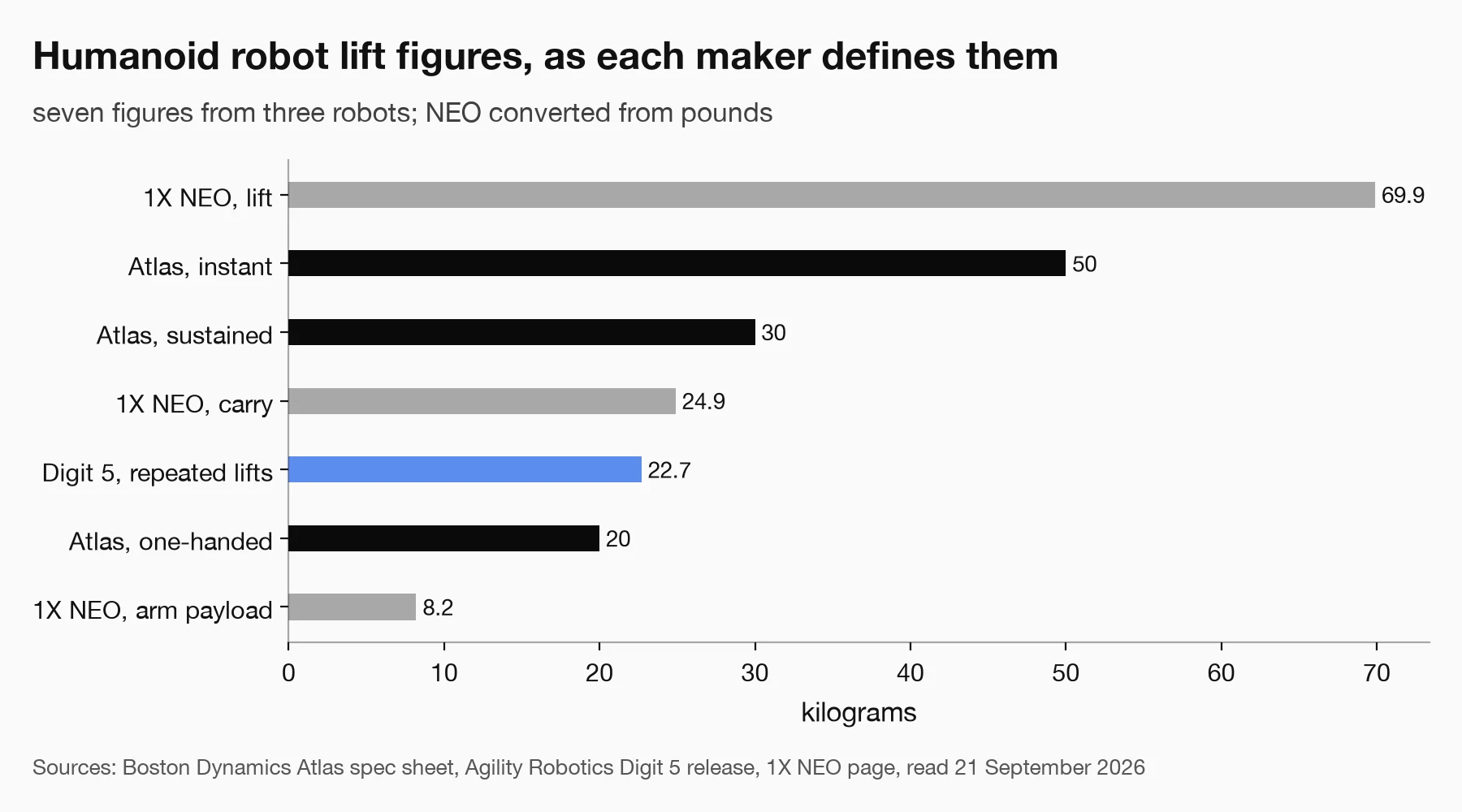
Seven lift figures from three robots. Black is Atlas, blue is Digit 5, grey is 1X NEO, converted from pounds. Only Digit 5’s figure says it holds across repeated lifts.
Put the seven lift figures on one axis and the problem shows at once. The largest number belongs to the lightest robot, measured in a way its maker does not define. The number most useful for planning work, Digit 5’s repeated lift, sits in the middle.
Runtime has the same trouble. Atlas and NEO both list 4 hours, but Atlas’s own sheet halves that under heavy lifting, and NEO’s page gives no equivalent figure. Digit 5’s 90 minutes looks short until the charge time is set beside it.
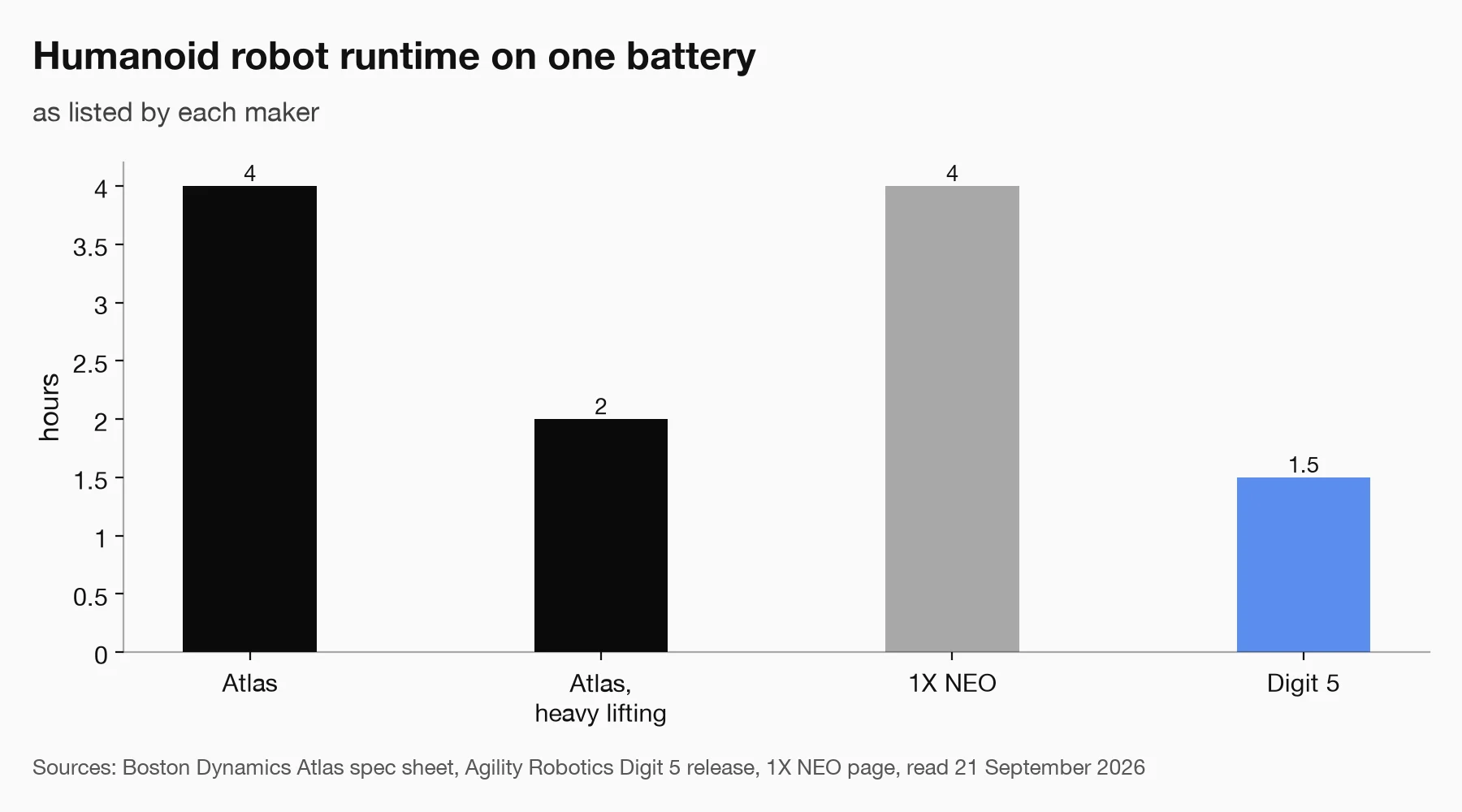
Runtime as each maker lists it. Only the Atlas spec sheet states what heavy lifting does to the battery.
Charging is where the two newer machines agree. Digit 5 charges for 9 minutes per 90 minutes of work, which is 6 minutes per hour of runtime. 1X states the same ratio for NEO directly. Atlas takes 1.5 hours to charge a 4-hour battery, 22.5 minutes per hour of runtime, but it does not have to wait for the charger, because it swaps.
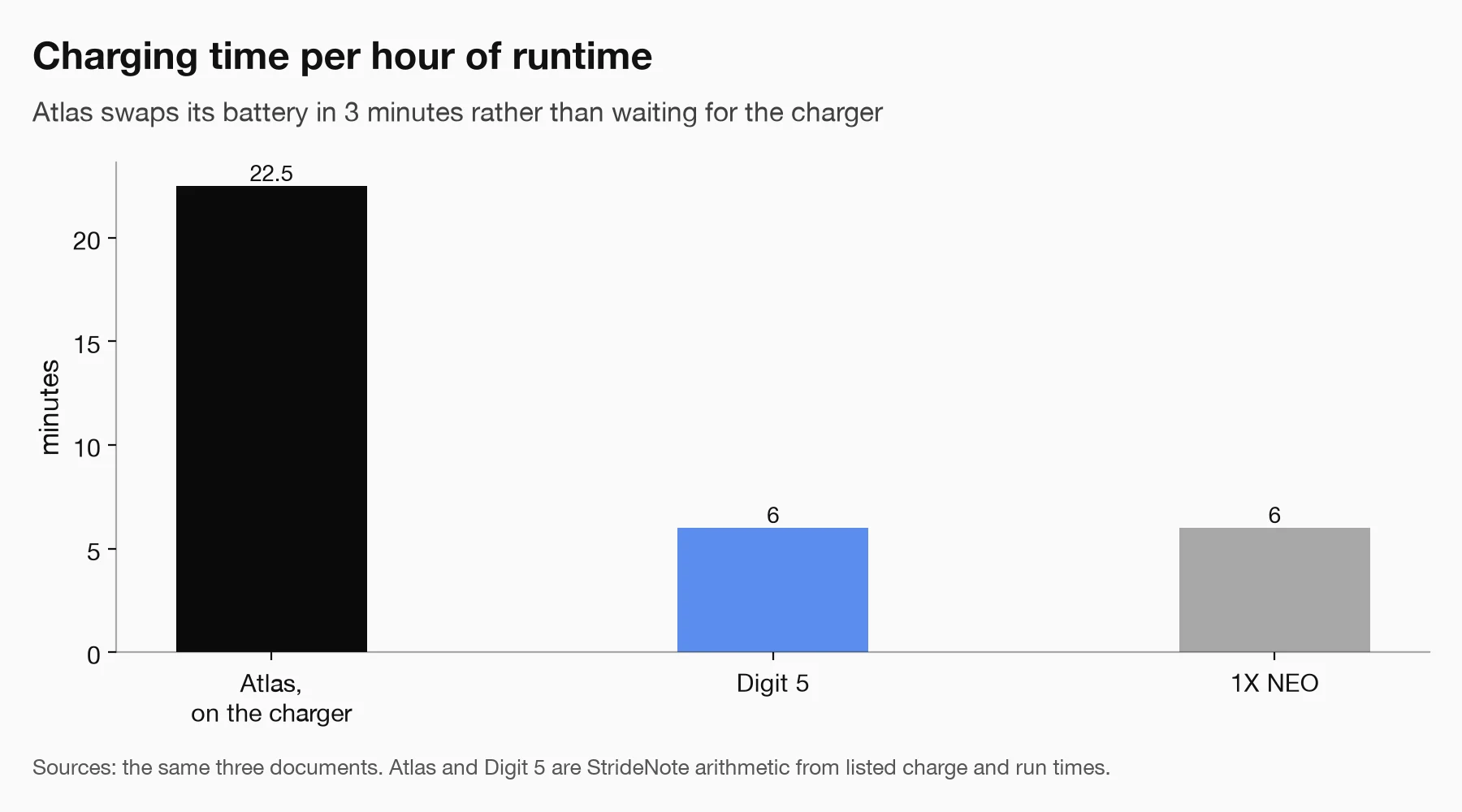
Digit 5 and NEO both come to six minutes of charging per hour of work. Atlas takes longer on the charger but swaps its battery in three minutes.
Divide each working load by the robot’s own weight and the order changes again. Atlas’s sustained 30 kg is a third of its 90 kg. Digit 5’s repeated 22.7 kg is less than a fifth of its 129 kg. NEO’s 55 lb carry is more than four fifths of its 66 lb. The lightest robot looks strongest for its size, and the heaviest looks weakest, but only one of the three says its figure holds across repeated lifts.
Each sheet is written for its buyer. A factory planning shifts needs sustained load and battery swaps, and the Atlas sheet gives both. A warehouse needs work cycles and charge ratios, and the Digit 5 release leads with them. A household is shown the largest thing the robot can pick up. Ranking the three without the definitions produces an order that does not exist.
The next spec sheet worth waiting for is one that states its test: the load, the number of repetitions, the time taken and the battery left at the end. Until a maker publishes that, the fairest humanoid robot lift figure on the record is the one with the word repeatedly in front of it.