
The fastest humanoid robot on the makers’ spec sheets we read is a home robot. 1X lists a “max run speed” of 6.2 metres per second for NEO, the robot it sells for household chores. The fastest humanoid robot in any official result ran nearly twice that: the winner of the 100 metres final at the World Humanoid Robot Games 2026 averaged 11.57 metres per second, a figure no maker’s spec sheet comes close to. How fast can a humanoid robot run? The honest answer in 2026 has two parts, and the gap between them is the story.
How fast can a humanoid robot run in 2026?
The best measured answer comes from a race. The organisers’ result sheet for the 100 metres final in Beijing on 26 August, for robots taller than 1.4 metres, gives the winner 8.64 seconds and the fifth-placed robot 8.87. Divided out, that is an average of 11.57 metres per second for the winner. Usain Bolt’s world record of 9.58 seconds works out at 10.44. The rules made the 100 metres fully autonomous, so no one steered those robots, as we set out in our investigation of the record claims.
Longer races tell the same story at lower speeds. The 400 metres final was won in 38.15 seconds, an average of 10.49 metres per second, and the 1,500 metres in 2 minutes 21.64 seconds, an average of 10.59. Those are official times, set out with the rest of the results in our piece on the 2026 Games. Over a much longer distance, Xinhua reported that a robot from Honor won Beijing’s humanoid half marathon on 19 April 2026 in 50 minutes and 26 seconds, running on its own. Over 21.0975 kilometres that is an average of 6.97 metres per second.
These are averages over a whole race, starts included. A robot’s top speed within a race is higher, and no organiser publishes it. What the sheets show is enough for the headline: in 2026 a humanoid robot covered 100 metres faster than any human has, and kept up more than 10 metres per second over 1,500 metres.
What top speeds do humanoid robot makers list?
Much lower ones, in more ways of saying it. We read the current spec pages of the best-known makers on 28 September. 1X lists NEO’s “max run speed” at 6.2 metres per second and its “walking speed” at 1.4. Unitree’s H1 page lists a “moving speed of 3.3m/s” and “potential mobility > 5m/s”. Booster lists a “walking speed” of 3 metres per second for its T2. EngineAI lists a “moving speed” of more than 2 metres per second for its PM01, marked “hardware supported”. Fourier lists 5.5 kilometres per hour, about 1.53 metres per second, as the walking speed of its GR-3. Figure lists a speed of 1.2 metres per second for Figure 03.
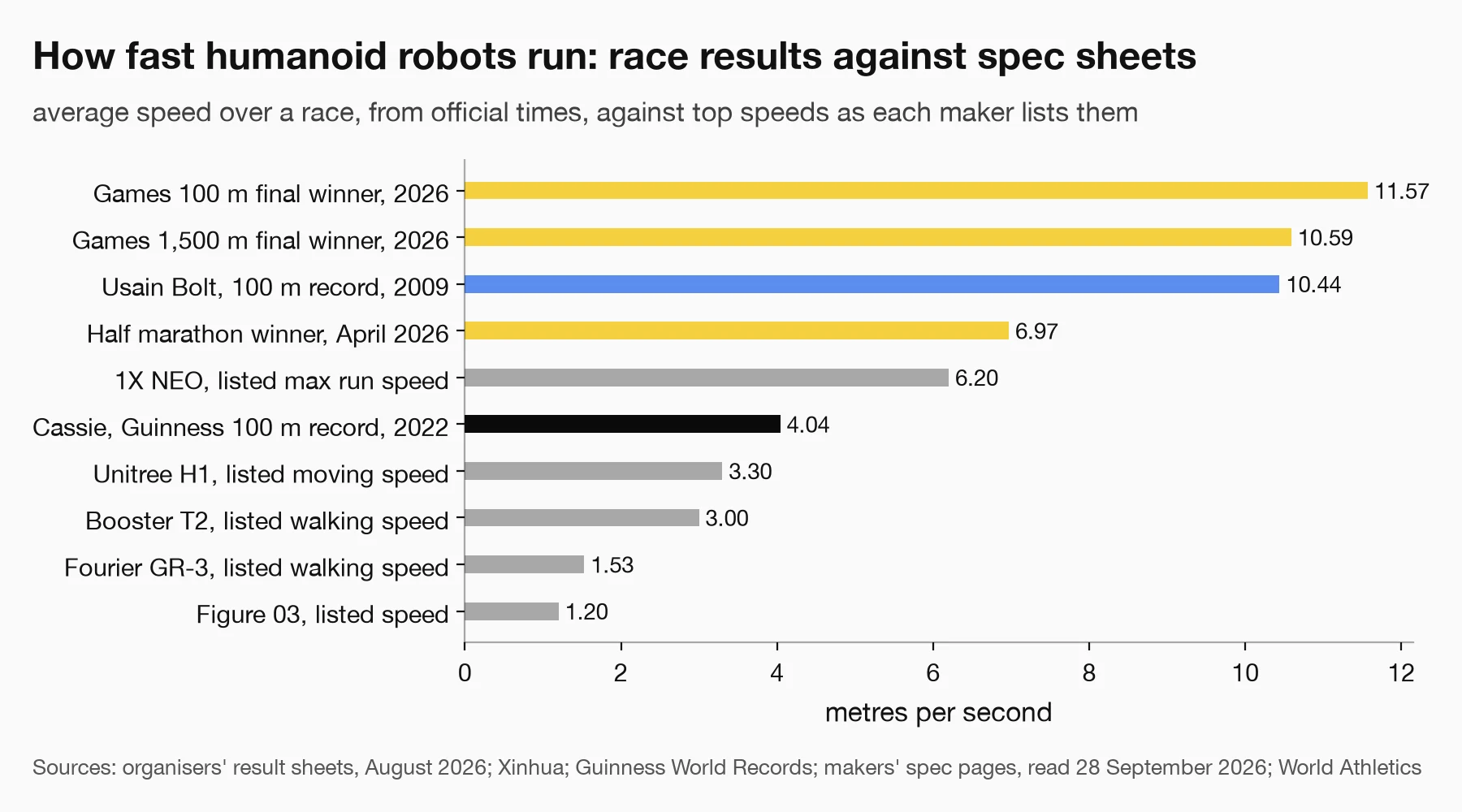
Race averages from official times in yellow, makers’ listed speeds in grey. The fastest robots on record publish no top speed; the spec sheets that do list lower figures, measured in ways they do not describe. Source: World Humanoid Robot Games 2026 result sheets, Xinhua, World Athletics, Guinness World Records and makers’ spec pages read 28 September 2026.
The wording matters as much as the numbers. A “max run speed”, a “moving speed”, a “walking speed” and a “potential mobility” are four different claims, and only Unitree’s second figure admits it is a potential rather than a speed the robot reaches. None of the pages says how or where the figure was measured, the same gap we found in lift figures in our piece on humanoid robot spec sheets.
The highest figure from any maker came in a post rather than on a spec sheet. On 17 August, days before the Games, Unitree previewed a new robot it calls Superman on its official account, claiming “top speed 12.66 m/s (0.85 m leg length)” and “surpassing the standing high jump and running speed records of all humans”. Unitree gave no test conditions. It is a claim made in a launch post, and it is the only maker figure above the Games’ measured averages.
Several makers list no speed at all. We found none on the current pages for Tesla’s Optimus, Agility’s Digit 5, the 2026 Atlas spec sheet from Boston Dynamics, UBTech’s Walker S2, or X-Humanoid’s Tiangong Ultra, the robot the company says won the 100 metres in Beijing.
Why do the fastest humanoid robots publish no top speed?
The one figure on the record for Tiangong Ultra’s top speed comes from a reporter, not the maker. Reuters wrote in September that “Ultra weighs 75kg and at top speed can exceed 17 metres per second”, and named braking as “one major challenge”: at the Games, a crash mat stood beyond a short run-off, and the sprinting robots slammed into it. The organisers publish times, not speeds, so the 17 metres per second cannot be checked against a sheet.
Honor’s sprinter has a peak speed on the record too, and two accounts of where it came from. The Associated Press reported that Honor’s robot ran 9.32 seconds in a trial before the Games “at a peak speed of 14.5 meters per second”, attributing both figures to the company. Reuters attributed a 14.5 metres per second peak to Chinese state media. Either way, the figure comes from a company or a state outlet, not from a result sheet.
The only independently certified record points further back. Guinness World Records still lists “the fastest 100 m by a bipedal robot” as 24.73 seconds, set by Oregon State University’s Dynamic Robotics Laboratory on 11 May 2022, an average of 4.04 metres per second. That robot, Cassie, is a pair of legs rather than a humanoid. Guinness certifies what is submitted to it, and none of the 2026 sprinters appears on its page.
So the fastest robots are measured by race organisers and described by reporters, while the spec sheets describe slower machines in their own terms, and the one maker figure above the race times comes without a test behind it. A buyer cannot set the two side by side, because no maker has published how its speed figure was taken.
Does humanoid robot top speed matter to a buyer?
For most jobs a humanoid robot is sold to do, top speed hardly matters. Figure’s 1.2 metres per second is a walking pace, a little below the 1.4 metres per second 1X lists as NEO’s walking speed, and it is enough for a factory aisle or a kitchen. What matters more is whether the robot can stop, which is exactly what Reuters found the Beijing sprinters could not do gracefully.
Speed also costs battery. None of the pages above says how long a robot can hold its listed speed, and the runtimes the makers publish are for ordinary work, as we compared in the same piece on spec sheets. A buyer paying the list prices in our piece on what a humanoid robot costs is paying for hours of ordinary work, not a sprint. A sprint record set in a stadium, with a crash mat at the end and a team to carry the robot off, says little about a robot walking a warehouse floor for four hours.
The useful number would be a sustained speed with a stopping distance, measured the way the Games measure a race, on a published sheet. Until a maker prints that, the answer to how fast a humanoid robot can run is 8.64 seconds for 100 metres on a race track, and whatever the brochure says everywhere else.