A high jump with no bar sounds like a riddle. In the rulebook of the World Humanoid Robot Games 2026 it is simply how the event is scored, and it is the event X-Humanoid, the Beijing Humanoid Robot Innovation Center, used when it said on 23 August that its Tiangong Ultra had beaten the human high jump record. Most of the humanoid robot world record claims made in Beijing that week can be checked against two documents: the organisers’ own rules and the world records list kept by World Athletics. In three of the four events, the organisers’ final sheets carry times faster than the human record. The fourth event does not measure what a human high jump measures.
Which human world records did humanoid robots claim at the 2026 Games?
X-Humanoid, whose robots set most of the marks, made the claims in its own posts. Its post of 23 August leads with a 100 metres time, “9.32s!! Faster than Bolt’s 9.58s”, and adds that “within just 2 hours Tiangong Ultra broke the human record three times and won first in the preliminaries”. The same post says that Tiangong Ultra, “performing as the opening-ceremony curtain-raiser demonstration, leapt to 2.88 m, beating the human high jump record”, and that it then won a 400 metres preliminary in 39.70 seconds, “again breaking the human 400m record”. The quotations are our translation of the Chinese.
X-Humanoid’s later posts added the 1,500 metres, and the claims that travelled furthest covered four events: the 100 metres, the 400 metres, the 1,500 metres and the high jump. By the close of the Games most of the numbers it cited came from finals, which the organisers do publish. The 9.32 seconds did not. The organisers’ announcements page carries result sheets for the 100 metres finals only, so no official sheet stands behind any heat time, including 9.32. Reuters and the Associated Press attribute a 9.32-second run to a different robot, from the phone maker Honor, in a test before the Games, so both the time and its owner are in dispute.
The four claims are of two kinds. Three are times over a set distance, which a clock settles. The fourth is a height, and the way the organisers measure that height is the whole story.
How is the humanoid robot standing high jump measured?
The organisers’ athletics regulations, published on 2 July, set out the event the robots call a high jump. Its Chinese name means a jump from a standing position. Each robot gets three attempts inside a 3 metre by 3 metre area. It must take off from both feet without moving them first, with “run-ups, stutter steps and repeated jumps” banned, and it must land steadily back inside the area. Then comes the scoring rule: “The high jump result is the vertical distance from the lowest point of any part of the robot’s body to the ground when the robot reaches the highest point of its jump.”
There is no bar. The robot’s score is how high its lowest point rises, which means a 3.40 metre result puts every part of the robot at least 3.40 metres above the floor at the top of the jump. A human high jump is scored on a bar that the athlete clears after a run-up, and the record World Athletics lists is Javier Sotomayor’s 2.45 metres, set in Salamanca in 1993. The World Athletics world records list has no standing high jump at all. The robot event is a standing jump measured without a bar. It is a different event from the human high jump, not a harder or easier version of it.
The 2.88 metres in X-Humanoid’s post was not a competition result either. The company’s post of 23 August calls it an opening-ceremony demonstration, as does China News Service’s report of the opening, although a poster X-Humanoid published the next day labels the same jump a high jump competition. The organisers’ result sheets include no 2.88 metre jump. The competition final came three days later, on 25 August, and was won with 3.40 metres, one of the results we set out in our piece on the 2026 results. The winning robot in the event of the same name at the first Games, in 2025, reached 0.96 metres.
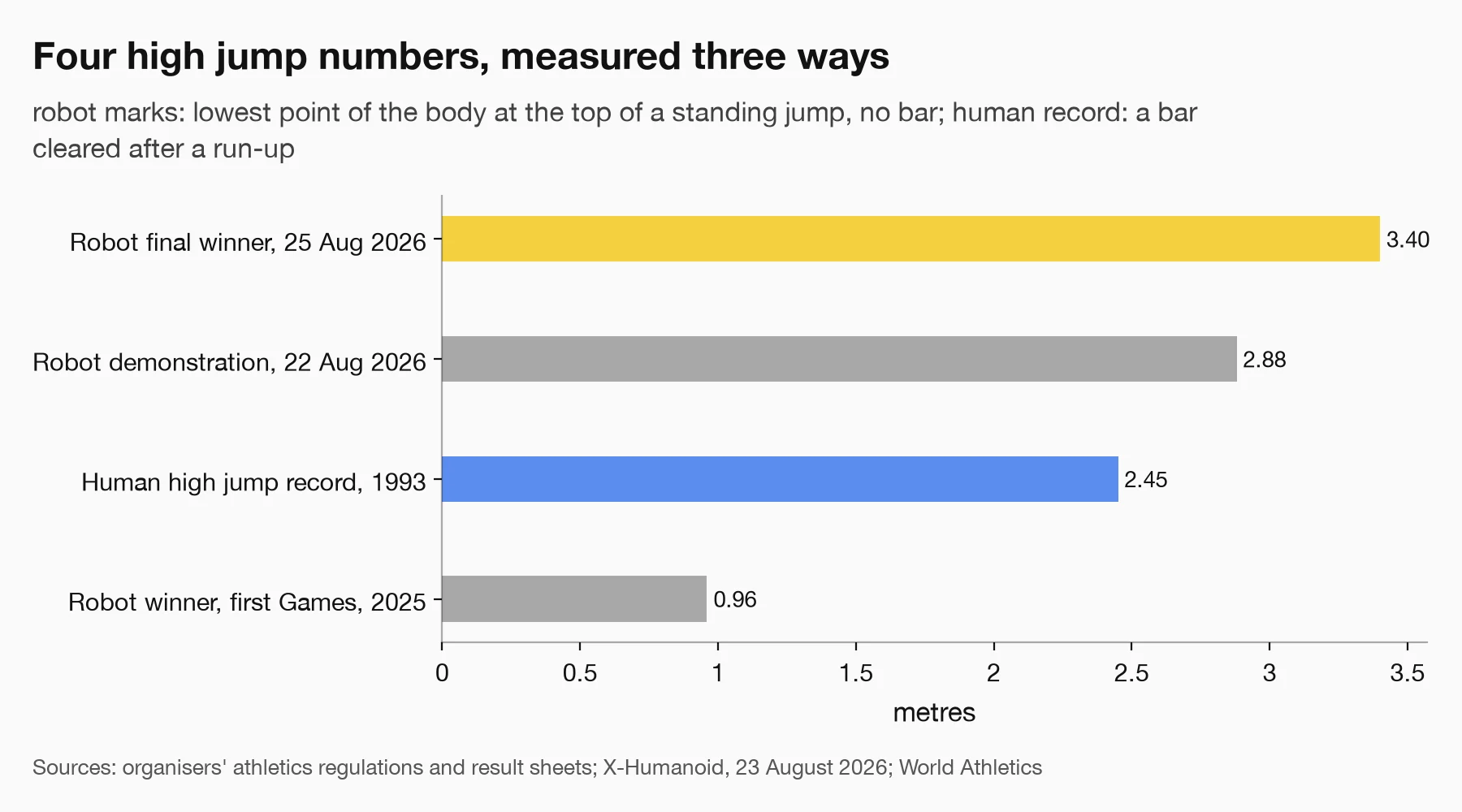
Four numbers, three ways of measuring: the robot marks are the height of the robot’s lowest point at the top of a standing jump, and the human record is a bar cleared after a run-up.
Set side by side, the high jump numbers look like a sequence. They are not. Only the 3.40 metres is a competition result under the organisers’ rule. The 2.88 metres was an exhibition, and the 2.45 metres belongs to a different event.
Did humanoid robots beat Usain Bolt’s 100 metres world record?
On the clock, yes, and under rules that make the comparison fair as far as a clock can. The same regulations list the 100, 400 and 1,500 metres and the 4 by 100 metres relay as fully autonomous events. During a race a team may send only a start command and a stop command, from a designated area. For the 400 and 1,500 metres the rules add that an operator may pick up a remote control in the finish area only after the robot has finished. Only the 100 and 400 metres obstacle races, which the organisers’ English summaries call hurdles, allow remote control. For the 100 and 400 metres, robots are split by height into a small class, 1.4 metres and under, and a large class above that.
The large-class 100 metres final on 26 August was won in 8.64 seconds, and all five finishers were inside Bolt’s 9.58, set in Berlin in 2009. The 400 metres was won in 38.15 seconds, against Wayde van Niekerk’s 43.03. The 1,500 metres was won in 2 minutes 21.64 seconds, against Hicham El Guerrouj’s 3 minutes 26.00. The human records are all as World Athletics lists them today. The robot marks come from the organisers’ final sheets and the host broadcaster, as set out in our results piece.
Those are real times over real distances. They are also times set by machines, in a class of their own, the way a cycling record over 1,500 metres is real and is not a running record. The rule that matters is autonomy. A robot steered by a person at 8.64 seconds would be a remote-control record. A robot running itself at 8.64 seconds set what the host broadcaster calls a Games record, and on the published rules no one steered it. No body ratifies humanoid robot world records, so a Games record is the most any robot time can claim. How far autonomy reaches in other events is the subject of our piece on remote control at the Games.
What a humanoid robot world record means after Beijing
Lay the four claims against the records they were compared with and the pattern is plain.
| Event | Robot best, 2026 | Human record |
|---|---|---|
| 100 metres | 8.64 s, run on its own | 9.58 s, 2009 |
| 400 metres | 38.15 s, run on its own | 43.03 s, 2016 |
| 1,500 metres | 2:21.64, run on its own | 3:26.00, 1998 |
| High jump | 3.40 m final, 2.88 m demo; lowest body point, no bar | 2.45 m over a bar, 1993 |
Three rows compare like with like in what is measured. The fourth compares a standing jump scored from the robot’s lowest point with a running jump over a bar. The 2.88 metres in that row was also an exhibition, not a result.
The difference matters beyond the arena. Humanoid robot makers sell on numbers, and the numbers they choose are the ones a buyer remembers. We found the same habit on spec sheets, where three makers gave seven different answers to one question in our piece on how much a humanoid robot can lift. A record is only as useful as its definition, and the definition sits in the rulebook, not in the post that announces it.
The fastest route to a record nobody can argue with runs through the organisers: heat results, reaction times and the robot’s model on every sprint sheet, and for the jump, a bar. The 2026 sheets left the reaction-time column blank, named no robots and published no sprint heats.