For most of the history of robotics, the price of a humanoid robot was a sales conversation. In September 2026 it is a shopping cart. Unitree lists its R1 from $4,900, its G1 from $13,500 and its H2 at $29,900 on its humanoid store page, and 1X takes orders for its NEO home robot at $20,000 or $499 a month. Those numbers, plus the $4,290 Unitree asks for its smaller R1-D, are the whole public answer to what a humanoid robot costs this year. The makers who publish no price at all say nearly as much as the ones who do.
What does a humanoid robot cost from Unitree?
Unitree’s store shows six humanoid products. Three carry a price a buyer can act on: the R1 from $4,900, the G1 from $13,500 and the H2 at $29,900. A fourth, the R1-D, starts at $4,290. The word “From” matters on the R1 and the G1. It is the price of the base configuration, and the store sells other editions of the same robots above it.
The remaining two listings need reading with care. The H1 shows $90,000 beside the words “Contact us for the real price”, so the store itself tells you not to take that number at face value. The H2 Plus is listed at exactly $100,000.00, the same round figure the store shows against four other products, including its B2 quadruped. We leave both out of the comparison below. One is flagged by Unitree as not the real price, and the other matches a figure the store repeats across unrelated models.
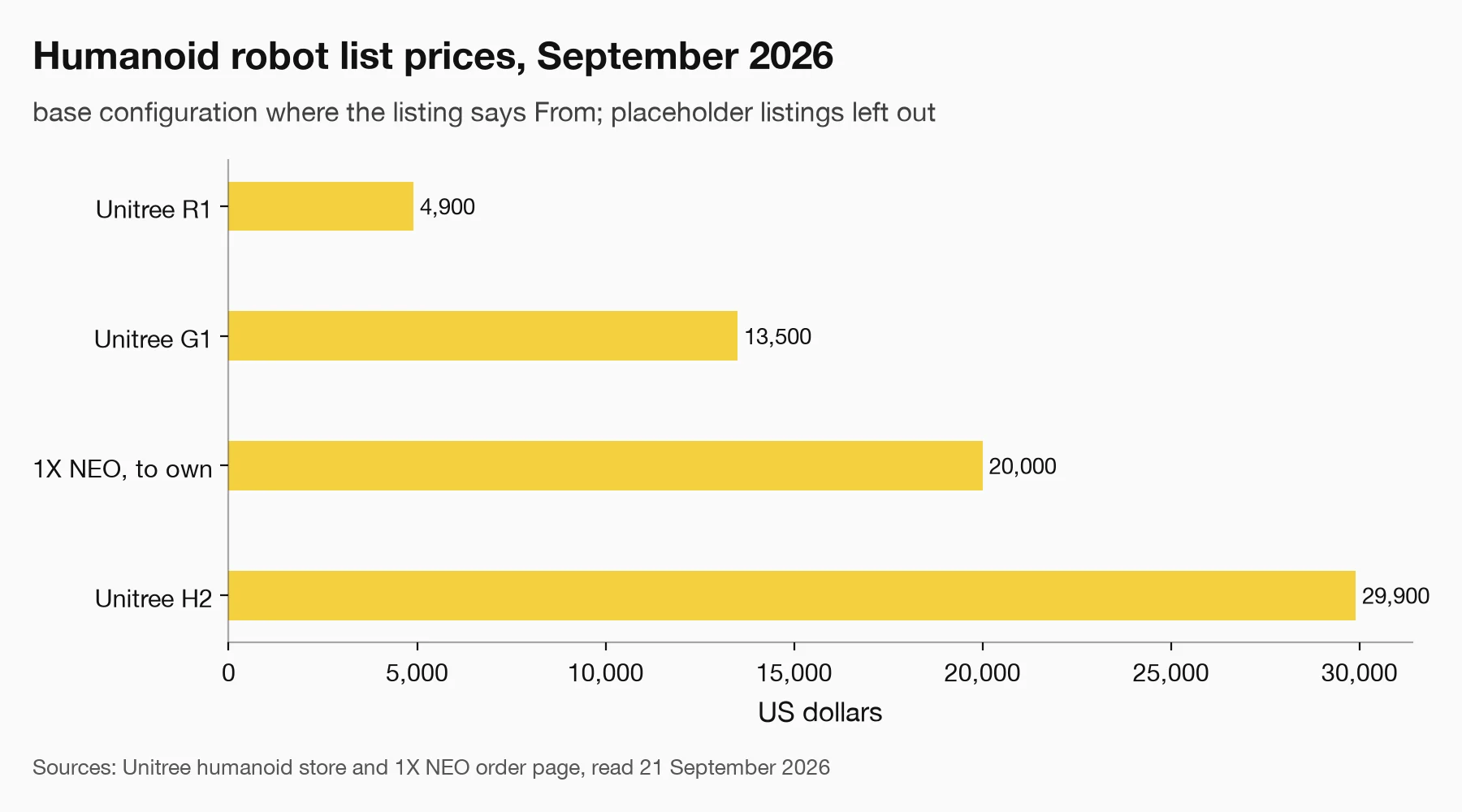
Every humanoid robot with a usable public price in September 2026. Unitree listings that say From are base configurations; the H1 and H2 Plus listings are left out as placeholders.
What the usable numbers show is a spread of about six times between the cheapest humanoid on sale and the most expensive one with a real price: the R1 costs less than a sixth of the H2. Every one of them is below $30,000. Unitree is also one of two humanoid makers, with UBTech, whose sales figures are in stock exchange filings this year, which we read in our piece on how many humanoid robots shipped, so its list prices sit on top of a sales record rather than a promise.
What does 1X NEO cost to buy or to rent?
1X sells NEO two ways on its order page. Ownership costs $20,000 and comes with a three-year warranty, under the heading Early Access. The subscription costs $499 a month and includes what 1X calls a “Starter Productivity Package”. Either route starts with a $200 deposit, which the page’s FAQ says is fully refundable up to the point the robot is ready for delivery, and the page says US deliveries start in 2026.
The FAQ on the same page describes the subscription in two sentences: “You pay monthly for having and using a NEO at home. At the end of your subscription, you may extend it or return NEO.” It states no minimum term.
Two more details on the page narrow who these prices apply to. Deliveries are listed for the US only, so a buyer anywhere else has no NEO price at all. And the FAQ says NEO is manufactured in California. The $200 deposit is a reservation rather than a purchase, since it is refundable until the robot is ready to ship.
The page also gives the only running cost any humanoid maker publishes: on standard retail electricity rates, 1X says it expects NEO to “run for under $1 a day”.
The arithmetic decides between buying and renting. Forty months of subscription comes to $19,960, and the forty-first payment takes the total to $20,459, past the purchase price. Anyone who expects to keep NEO for more than three years and five months pays less by buying it. Anyone who wants to stop after a year pays $5,988 and hands it back. It is the same trade we set out for AI models in our piece on ownership versus cognitive rental, with a body attached.
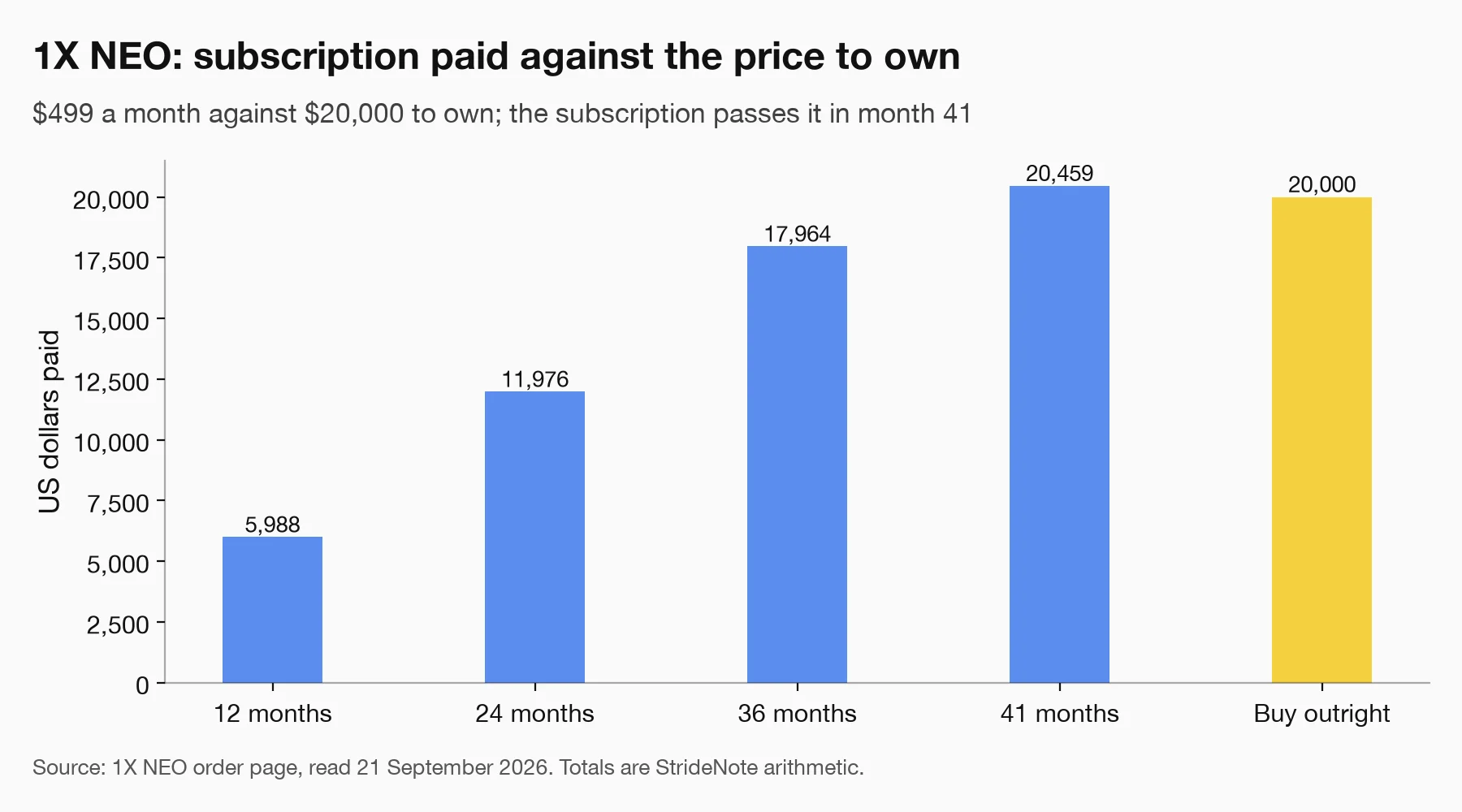
The subscription passes the purchase price in month 41. Totals are our arithmetic from the prices on 1X’s order page.
Buying NEO also buys into how it handles data, which is a question the price does not answer. We read what 1X has written about that in our piece on 1X NEO privacy, and the answer is in a less binding place than a buyer might expect.
Why Figure, Boston Dynamics and Tesla publish no humanoid robot price
Figure’s product page for Figure 03 lists the robot at 5 ft 8 in, 61 kg, a 20 kg payload, five hours of runtime and a speed of 1.2 metres a second. It does not list a price. Boston Dynamics has committed all of its 2026 Atlas deployments to Hyundai and Google DeepMind without publishing a number, which we cover in our piece on when you can buy a humanoid robot. Tesla’s quarterly filing gives Optimus a production status and no price. Agility Robotics announced Digit 5 in September with availability dates and no price.
None of these companies explains why it publishes no price, so we will not guess. What the record does show is who the robots go to. The robots with list prices are sold to anyone with a card: households in the case of NEO, and whoever checks out on Unitree’s store. The robots without prices are going, where their makers say at all, to industrial customers, research partners or the maker’s own factories.
That is why the published prices are not a fair comparison with the unpublished ones. A $13,500 G1 and an Atlas working in a Hyundai plant are not two points on one price curve. They are different products sold on different terms to different buyers, and one of those terms is whether the price is public at all.
It also means the question most people ask, what the best humanoid robot costs, has no answer yet. The machines most often shown lifting boxes in factories are the ones whose prices are not on the record. The machines whose prices are on the record are aimed at research, development and the home. How much each of them can actually lift is its own tangle of definitions, which we unpick in our piece on how much a humanoid robot can lift.
A price is a figure a company can be held to. In September 2026 five humanoid robots have one, and the most talked-about robots in the category still do not.