A better model will not give your AI agents a brand voice, and without one they sound like every other AI agent. An AI agent clears its throat the way a nervous writer does, except it does it in every draft. Ours kept reaching for the same phrase, “I have been sitting with this,” until we stopped reading the sentence and started reading the tell. That one habit, multiplied across a studio’s worth of output, is the line between writing that sounds like us and writing that sounds like everyone else’s model. The fix was not a bigger model. It was a rule, written down in the one place the agent actually reads. The format for those agent rules, AGENTS.md, is now used by more than 60,000 open-source projects and is stewarded by the Linux Foundation’s Agentic AI Foundation, according to the AGENTS.md specification. This piece is about what we put inside that file, and why the voice you write for an agent is the most important thing you will build for it.
What is a voice for an AI agent?
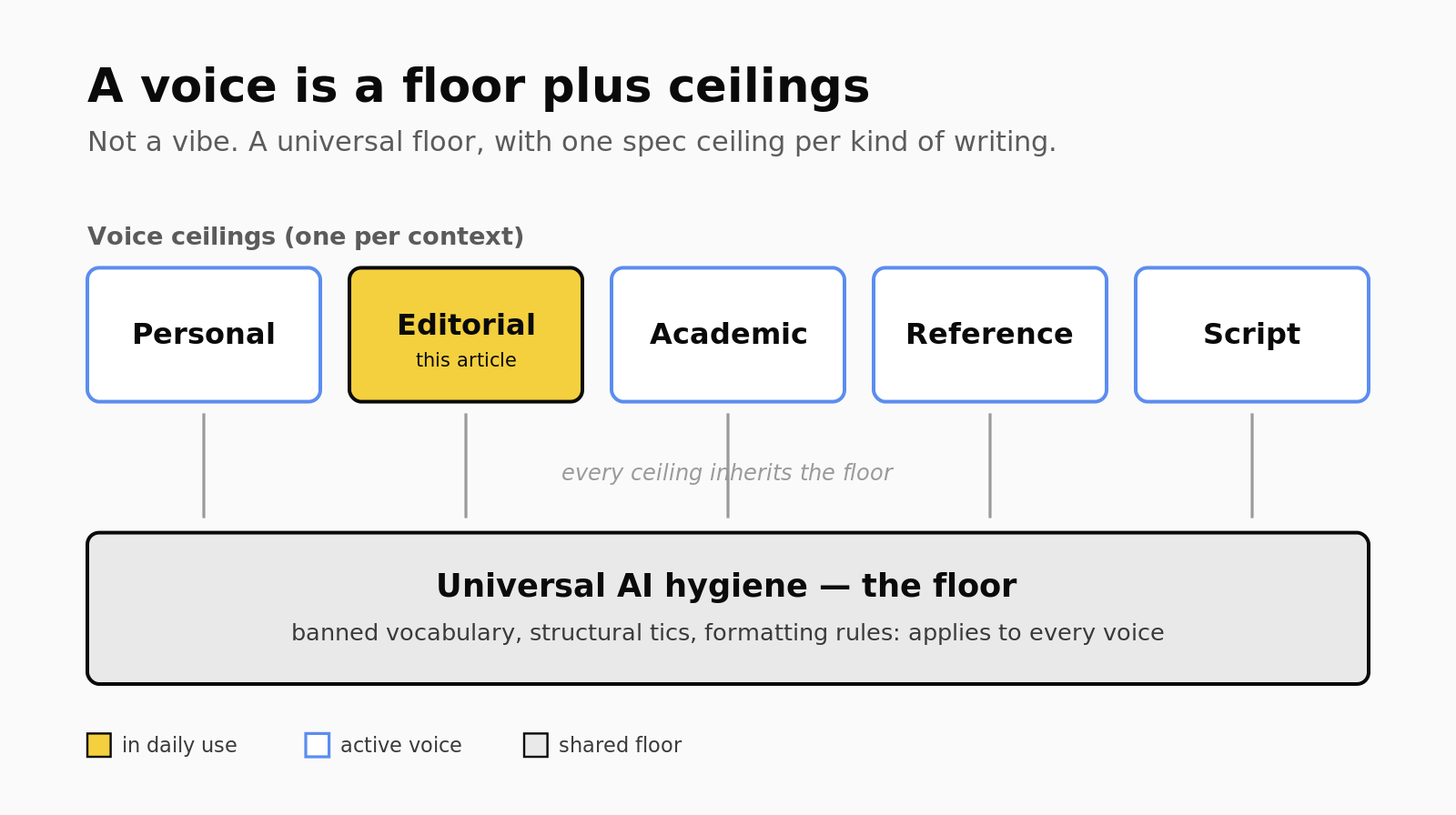
A voice is not a mood or a tone setting. It is a spec, and it has parts you can point at. Ours has four: a point of view, a banned-vocabulary list, a structure, and a pass or fail checklist the output has to clear before it counts as done. Written that way, “voice” stops being a taste argument and becomes something an agent can be graded against.
We keep it in two layers. A universal floor sits under everything and every voice inherits it: the words that read as machine-generated, the structural tics, the formatting habits. On top of the floor sit context-specific ceilings, one per kind of writing we do, articles, essays, reference entries, scripts. The floor is the same for all of them; the ceiling changes with the job. The whole thing is a handful of plain markdown files, not a personality.
Why a brand voice matters more than the model
The model and the tools are converging on everyone at once. The same open format we use, AGENTS.md, already works across more than twenty coding agents and tools, from Codex to Cursor to OpenCode, per the AGENTS.md project. When the runtime, the tool loop, and even the instruction file are shared infrastructure, they stop being where you differ from the next studio. We wrote about the underlying shift in what agentic changed for local AI: once the plumbing is common, the output is the product.
The output is exactly what a voice governs. Google added a fourth letter to its quality framework in December 2022, turning E-A-T into E-E-A-T, where the first E is Experience: content produced with real, first-hand use, according to Google Search Central. A generic model cannot fake that. A voice that forces first-hand specifics and strips the marketing gloss is how experience actually reaches the page. Two studios can run the same model on the same hardware, as we did in how we built our local AI stack, and the reader can still tell their work apart. The thing that tells them apart is the voice, and almost nobody writes one down.
How do you build a voice your agents can follow?
Start from your own writing, not from a template. Pull ten pieces you are proud of and read them for patterns: how you open, how you cite, the sentence rhythm, the words you never use. That reading is the raw material for the rules.
Then ban the tells. Large language models default to a small set of words and shapes that trained reviewers and detectors recognise on sight. Our floor names them: 38 high-alert single words like “delve,” “pivotal,” and “robust,” and 25 filler phrases like “it is important to note that” and “in today’s world.” Each one ships with a plain replacement, so the rule is a swap, not just a prohibition.
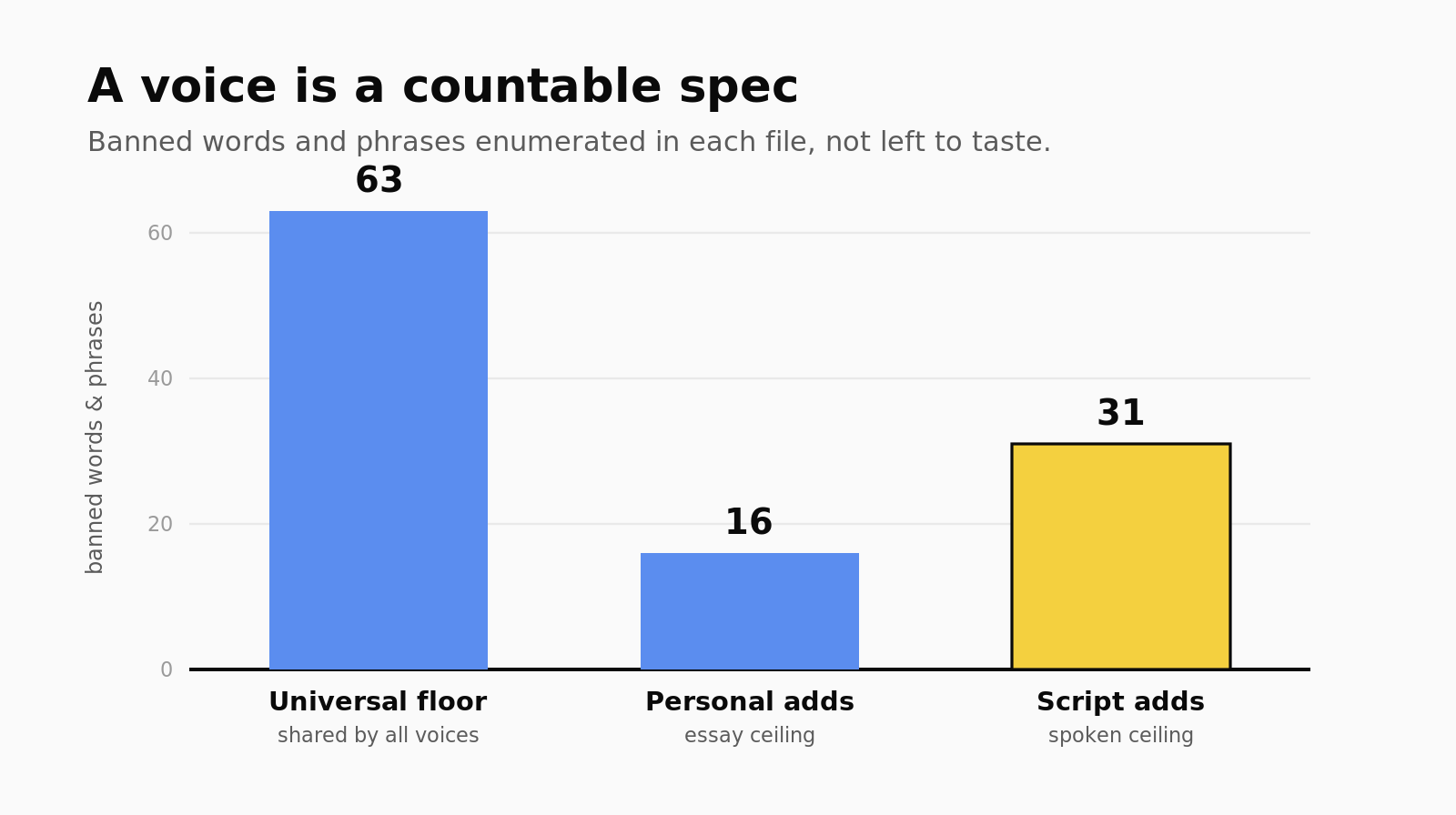
After the floor, split off the ceilings. A point of view that fits an article does not fit a spoken script. Our articles are written as “we,” first person plural, with the writer mostly off the page. Our scripts drop the first person almost entirely and swap formal contractions for natural speech, because they are read aloud. Same floor, different ceilings. Last, write the checklist. Every rule that matters becomes a line the output has to pass: banned words absent, sources named, headings in sentence case, no em dashes. The checklist is what turns the voice from advice into a test.
How do you make an agent obey its voice?
A voice document that lives in a folder the agent never opens is decoration. It becomes real the moment it is codified where the agent loads its rules. For OpenCode, Hermes, and Pi, the three agents we run, that place is the AGENTS.md file. We point it at the voice files with one standing instruction: read the relevant rules before writing, do not write from memory. The step-by-step wiring for each agent is its own piece, set up a brand voice across OpenCode, Hermes, and Pi. The agents that read a nearest-file-wins format then pick it up automatically, and an explicit chat instruction still overrides everything, as the format defines.
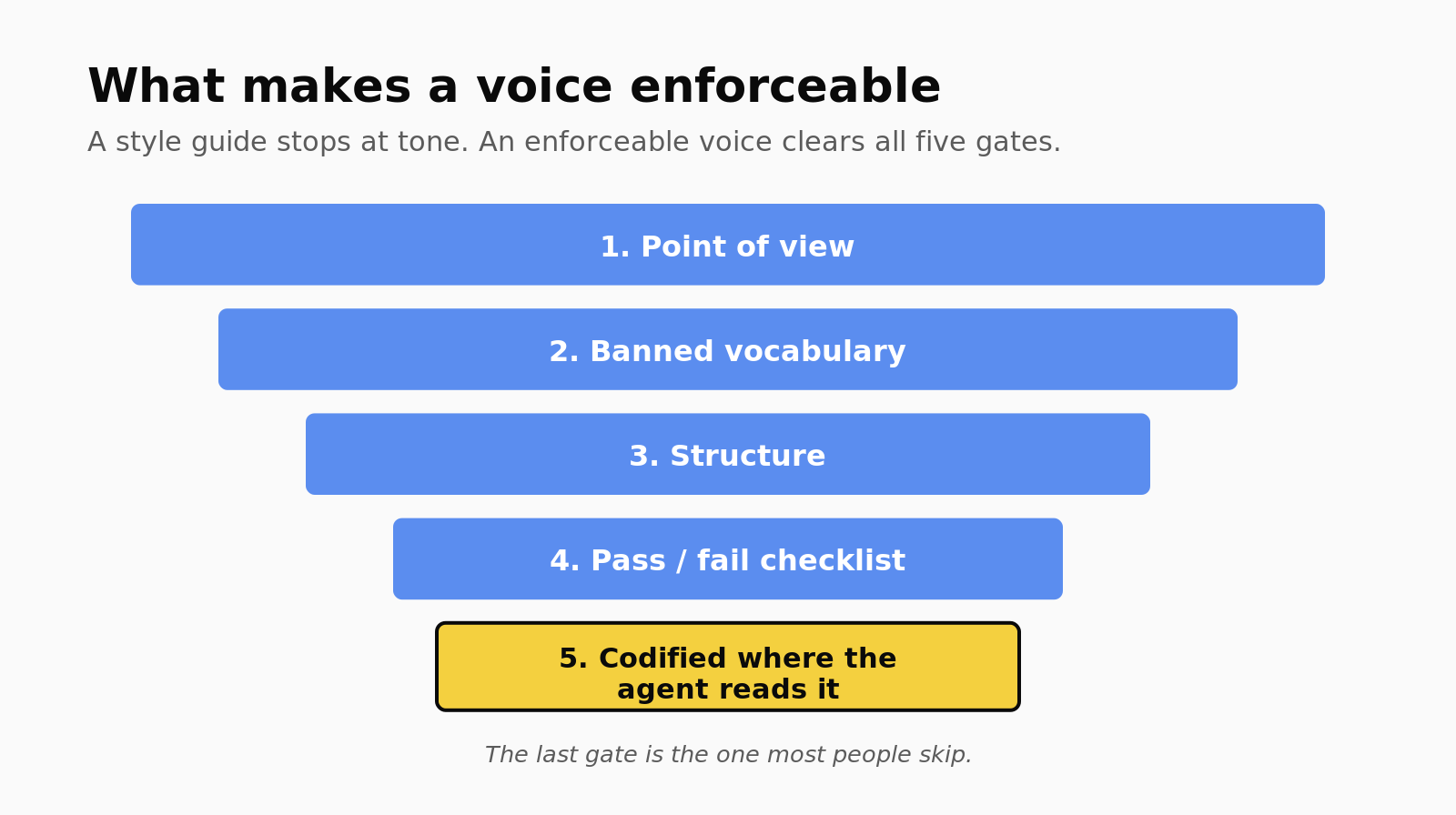
The last gate is the whole game. We saw the same lesson from the other side when we tested local tool calling across our agents: a capability the model cannot reliably emit is a capability it does not have. A voice the agent does not read is a voice it does not have either. Gating the output on the checklist closes that gap. The agent is not done when the draft exists; it is done when the draft passes.
What breaks a voice system?
Two things, in our experience. The first is banning a word that was doing real work. “Sitting with this” was our signature move in personal essays for a year before we retired it, and cutting it meant rebuilding the move it anchored, not just deleting a phrase. A voice is a system, and pulling one rule tugs the others.
The second is drift. We keep the voice files in more than one place, and the copies fell out of sync, one carrying a rule the other had already replaced. An agent reading the stale copy writes to the old spec and looks like it ignored you, when the truth is you gave it two answers. The fix is boring and non-negotiable: one canonical source, and a check that the copies match. A voice only holds if every agent reads the same version of it.
The models will keep getting better and cheaper, and the tools will keep converging, which is the honest reason voice is worth the work. The next thing we want is the moment an agent catches its own tell before we do, flags “I have been sitting with this” against its own banned list, and rewrites the line without being asked. That is when the voice has stopped being a document and started being how the agent thinks.