Most creators currently rent their intelligence. When we use a cloud-based LLM, we are not using a tool so much as we are leasing a cognitive process. We send our ideas to a server, a proprietary model processes them through a filter designed for a global average, and we receive an answer that is technically correct but stylistically vacant. This is the reality of cognitive rental.
The shift toward a sovereign AI stack is not about a preference for open source. It is about the preservation of the creative voice. When the model lives on a server owned by a corporation, the boundaries of what that model can think, say, or style are decided by a safety team in a boardroom. For the professional creator, this is a critical failure point.
We have spent the last few months testing different local configurations in our studio. The results suggest that the gap between cloud-convenience and local-sovereignty is closing. Ownership is no longer a compromise on quality. It is a prerequisite for distinctness.
Why move LLMs from cloud to local?
The primary driver for moving to a local stack is the removal of the “average” filter. Cloud models are tuned using Reinforcement Learning from Human Feedback (RLHF) to be helpful, harmless, and honest. While these goals are necessary for a general-purpose chatbot, they create a gravitational pull toward the center.
Every response from a cloud model is pushed toward a corporate-approved median. This results in a specific kind of prose: polite, structured, and utterly predictable. If you ask a cloud model to write a poem or a technical analysis, it will likely follow a standard three-act structure with a generic positive conclusion. It cannot be truly edgy, truly weird, or truly precise because those things deviate from the safety-tuned average.
Local ownership allows us to use models that have not been neutered by global RLHF. By running a raw base model or a fine-tuned version tailored to a specific domain, we regain control over the output. We can choose models that prioritize raw reasoning over politeness, or models that have been trained on a specific corpus of literature that informs a unique style.
Beyond the stylistic concerns, there is the issue of data volatility. In a cloud environment, your prompts and the resulting outputs are data points for the provider. Even with “privacy” settings, the relationship is asymmetrical. A local stack ensures that the most sensitive part of the creative process-the iterative, messy stage of ideation-remains entirely private.
What is the cost of cognitive rental in AI?
Cognitive rental is the hidden tax on creative work. It manifests as a loss of agency over the tools of thought. When you rely on an API, you are vulnerable to “model drift.” A provider may update the weights of a model to improve safety or efficiency, and in doing so, they may accidentally destroy the specific nuance you relied on for your workflow.
We have observed this in our own studio work. A prompt that produced a sharp, cynical tone in one version of a cloud model might produce a bland, apologetic response after a silent update. When you rent your intelligence, you do not own your process. You are subject to the whims of a deployment cycle you cannot see and cannot influence.
There is also a financial cost to this rental. While a single subscription seems negligible, the cumulative cost of multiple API keys and monthly seats adds up. More importantly, the dependency creates a fragility. If an account is flagged or a service goes down, the creative pipeline stops.
A sovereign stack replaces this volatility with stability. Once a model is downloaded to local storage, it is a frozen asset. It will never drift. It will never be updated without your consent. It will never stop working because a credit card expired.
How does a sovereign AI stack preserve creative voice?
The creative voice is found in the deviations. It is the specific way a writer breaks a rule or the unusual connection a designer makes between two unrelated concepts. Cloud models are designed to minimize these deviations.
A sovereign stack preserves voice through three specific mechanisms: system prompt control, model selection, and local fine-tuning.
First, local models allow for absolute system prompt control. In a cloud environment, the system prompt is often a suggestion that the model can ignore if it conflicts with its core safety training. Locally, the system prompt is the law. We can force a model to adopt a specific persona or a rigid structural constraint without the model trying to “helpfully” steer the conversation back to a generic center.
Second, the ability to switch models instantly is a creative superpower. We can use a massive model for structural planning and then switch to a smaller, more specialized model for stylistic polishing. This is a modular approach to thinking that is impossible when you are locked into a single provider’s ecosystem.
Third, local fine-tuning allows us to inject a specific aesthetic into the model’s weights. By training a small adapter on a curated set of personal writing or a specific library of texts, we can create a model that understands a particular voice not as a persona it is pretending to be, but as its natural state of being.
How to build a sovereign AI stack for creative work?
Building a sovereign stack does not require a server farm. The hardware requirements have dropped significantly due to advancements in quantization.
For our evaluations, we used a studio work/test stack consisting of an Apple M4 Pro with 64GB of unified memory. This configuration is the current sweet spot for local LLMs because the unified memory allows the GPU to access the entire RAM pool, making it possible to run models that would typically require multiple expensive A100 GPUs.
The software layer of our stack is built on three pillars:
- The model engine. We use Ollama for its simplicity and efficiency. It handles the complexity of model loading and memory management, providing a clean API that other tools can hook into.
- The model library. We prioritize models from the Llama and Qwen families, specifically those that have been quantized to 4-bit or 8-bit. These provide a high ratio of intelligence to memory usage without significant loss in reasoning capability.
- The interface. We use a combination of custom scripts and local UI wrappers to interact with the models. This ensures that our prompts and histories are stored in local Markdown files rather than a cloud database.
To start building a sovereign stack, the first step is to identify the “cognitive load” of your work. If you primarily need a brainstorming partner, a 7B or 8B parameter model is sufficient. If you are doing complex system design or deep research, you will need to move toward 30B or 70B models, which requires a machine with at least 64GB of RAM.
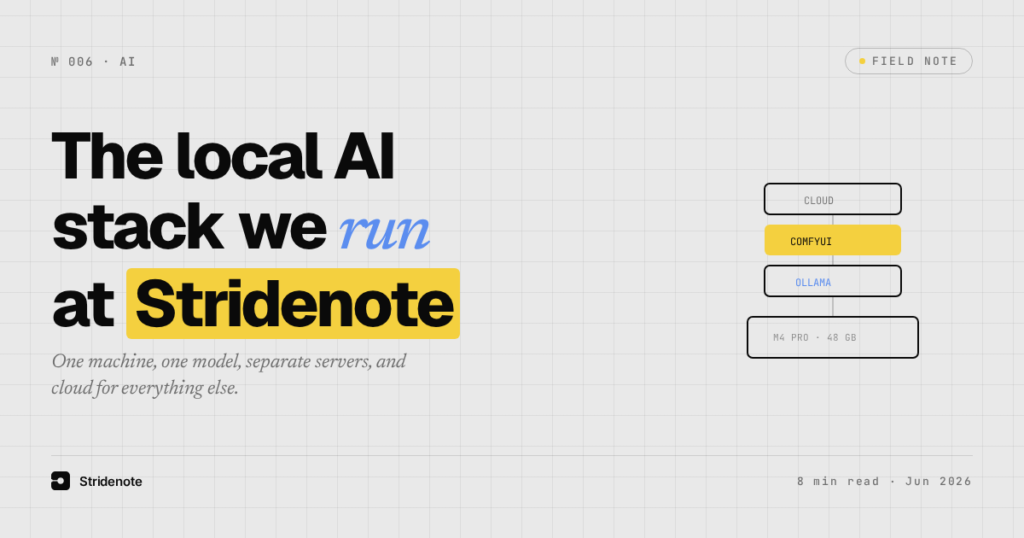
We maintain a detailed directory of these tools in our Open Source AI Atlas, which is a map for those moving away from cognitive rental. The case for that move is in own your AI stack instead of renting it.
The transition to local AI is not a return to the stone age of computing. It is an upgrade in agency. By moving the intelligence from the cloud to the desk, we stop renting our thoughts and start owning them. The sovereign stack is the only way to ensure that the AI we use is an extension of our voice, not a replacement for it.
For those starting their own local setup, we recommend beginning with how we built our local AI stack to understand the memory constraints and model selection process.