The ARC-AGI-3 human baseline for ls20 is a list of seven integers in a JSON file on your own disk: [22, 123, 73, 84, 96, 192, 186]. Across the 25 public games there are 183 such numbers, one per level, and every score the benchmark ever reports is a division by one of them.
Most descriptions get the baseline wrong in the same way, so here is what it is, where it comes from, and what the 183 numbers actually look like. For anyone judging an agent supplier’s claim to human-level play, they are also the yardstick, and they are free to check.
Where the ARC-AGI-3 human baseline comes from
Each level’s baseline is a count of actions taken by real people who had never seen the game. The technical report gives the sample: “486 unique participants across 414 candidate environments”, 2,893 attempts in all, with participants drawn from the general public and “not selected for any special training, abilities, or skill sets”. The median attempt lasted 7.4 minutes.
Candidate games had to earn their place. Each was tried by ten people, and a game was only admitted if at least two of them solved every level on first sight. Many were solved by six or more. The ones that failed the threshold went back to their designers.
The numbers that survive all of that ship with the game. Install the toolkit, download any public environment, and metadata.json in its directory contains baseline_actions, an ordered list with one entry per level. No API call is needed to read it, and in offline mode no API call is made.
Why the ARC-AGI-3 human baseline is not the best human
This is the part that gets mangled. The baseline is not the fastest player. It is not the average player either. The methodology page defines it as the upper median human by fewest actions, and spells out the arithmetic: “For an even number of players, the upper of the two middle entries is selected. For example, if four players complete a level, third place is the baseline; if five players complete it, third place is still the baseline.”
Third place out of four or five. The report calls it “the upper-median best human” and gives the reason: a baseline chosen this way is “resistant to outlier performance while reflecting strong but representative human efficiency.” One lucky or expert run cannot drag the target down, and one confused run cannot push it up.
The consequence for agents is that beating the baseline is meant to be achievable. An agent that plays as well as a decent, ordinary first time human scores 100 on a level. The scorer even pays a small bonus, up to 115, for being modestly better than that person. What it will not pay for is being ten times worse.
The report gives its own worked example of why the bonus is capped: “suppose the human baseline shows 20 actions needed to complete a level, but an AI discovers a 2-action exploit, the ratio (20/2 = 10x) would overwhelm the environment average.” So the baseline is a floor for full credit and a soft ceiling for extra credit at once. Beat the third best of five humans by a little and you gain; beat them by a mile and the metric stops counting.
How many actions a first time human needs, level by level
Reading all 183 baselines off disk gives the shape of the public set as a person experiences it. The smallest baseline anywhere is 6 actions. The largest is 578, on the sixth level of dc22. The median level takes 60.
First levels are short by design: across the 25 games, level one takes between 7 actions (vc33) and 78 (g50t), with a median of 30. The medians then climb with the level number, 54 at level two, 51 at three, 54 at four, 96 at five, 80 at six, and keep rising through the games long enough to have more: 86 at seven across 16 games, 92 at eight across 11, 163 at nine across 5, and 225 for the single tenth level in the set, in lf52.
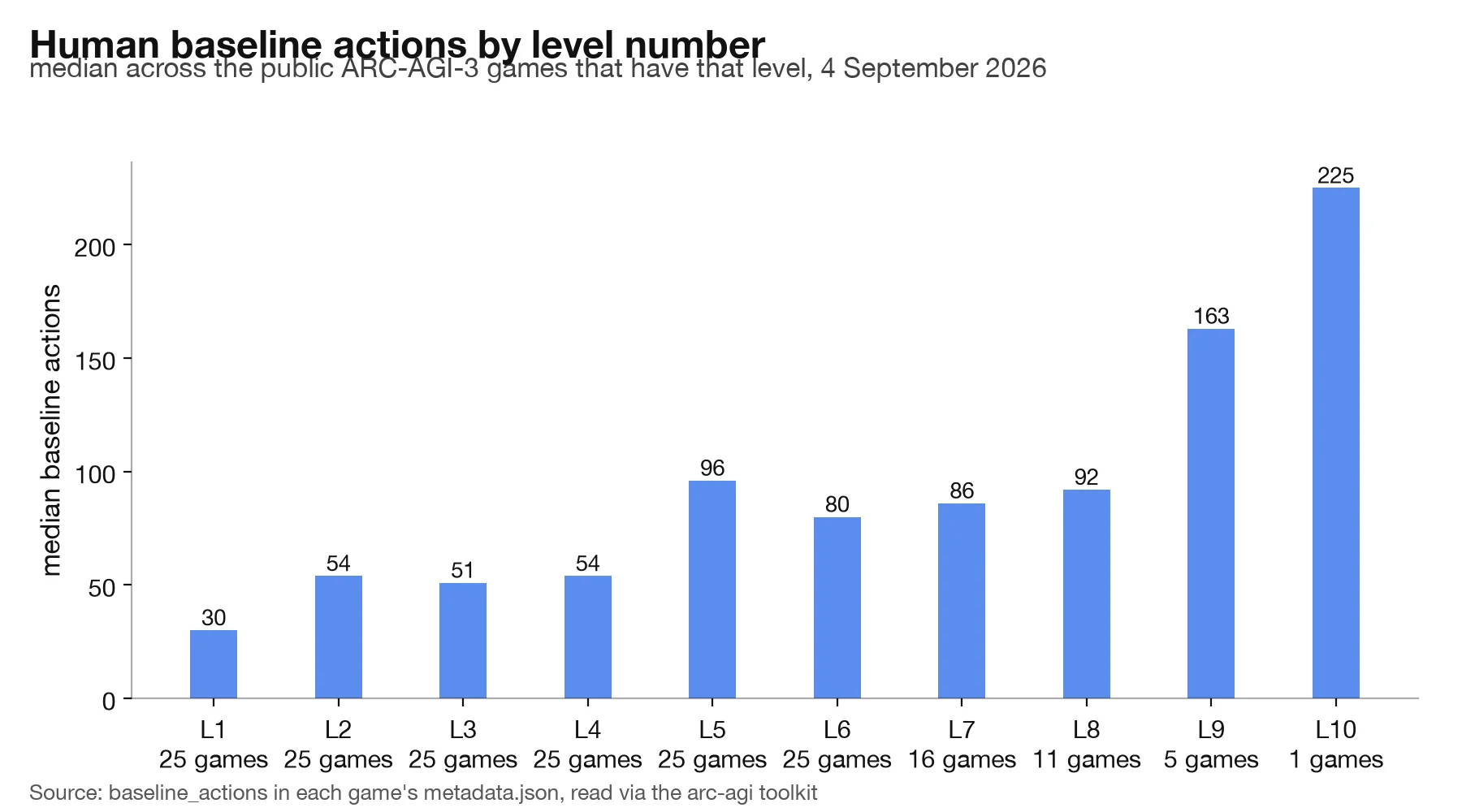
Median human baseline by level number, with the number of public games that have that level. Later levels are longer, and RHAE weights them more.
That climb matters for scoring more than it looks, because RHAE weights each level by its number. Level five counts five times as much as level one. So the levels that take humans longest are also the levels that decide the score, and an agent that is efficient on the short opening levels and wasteful on the long later ones will be scored mostly on the waste.
Which ARC-AGI-3 games are the longest for a person
Summing each game’s baselines gives a rough measure of how much play a game holds. The shortest public game by that measure is cd82, whose six levels total 171 actions for a first time human. The longest is wa30, nine levels totalling 1,843. The median game is 638 actions end to end.
Those totals are the cheapest available estimate of what a full playthrough costs an agent. At 100 on every level, an agent needs exactly the human total. At half human efficiency, it needs double and keeps a quarter of the score. For a local model that spends minutes on a single move, a game like wa30 is a working day at parity, before any of the moves are wrong.
How to use the ARC-AGI-3 human baseline to check an agent supplier’s claim
“Human level” in a pitch for an agent has a precise meaning on this benchmark, and it is a modest one. A level score of 100 means the agent matched the upper median of a handful of ordinary first-time players, third place out of four or five, not an expert. So the first question for any supplier quoting ARC-AGI-3 is how many actions their agent spent per level, set against the baseline_actions list. Because the baselines for the 25 public games sit in plain JSON on anyone’s disk, a buyer can check that arithmetic without trusting anyone’s summary of it.
The second question is what parity costs. The baselines turn straight into a machine time estimate. The median public game is 638 actions end to end for a first-time human. On our test machine, a 31B model needed about 95 seconds a move on a 16 by 16 board with a JSON schema, so one game played at exact human efficiency, one model call per move, is 638 times 95 seconds, about 60,600 seconds or close to 17 hours. The longest public game, wa30 at 1,843 actions, would be about 48.6 hours at the same rate. An agent that needs twice the human’s actions keeps a quarter of the score and doubles the time.
The third question is which games the claim is about. The baselines in your metadata.json cover only the 25 public games, the development set that ships as source. A score measured there tells you how an agent does on games its builders could read. Which set and which scaffold a published number comes from, and why that decides whether it compares one system with another, is the subject of ARC-AGI-3 is not saturated: which number to believe. The baseline answers a narrower question that a buyer can settle alone: how much less efficient than an ordinary person the agent was, level by level.
How to read baseline_actions from metadata.json
Two lines, after a game is on disk:
meta = json.load(open("environment_files/ls20/9607627b/metadata.json"))
print(meta["baseline_actions"])   # [22, 123, 73, 84, 96, 192, 186]
The list is indexed by level in order, so baseline_actions[0] is level one. The same file carries the version hash, the download date and the game’s tags, so a scored run can record exactly which baselines it was scored against. The toolkit’s own scorecard reads the same list; feed it your action counts and it returns the per level and per game numbers the leaderboard would.
The survey of all 25 public games that produced the figures above read every one of these files in a few seconds. The numbers are not hidden, not estimated and not proprietary. They are the one part of ARC-AGI-3 that is entirely public, and they are the part an agent is measured against. The whole series starts from what a local model does with an ARC-AGI-3 board.
In this series: ARC-AGI-3 scores