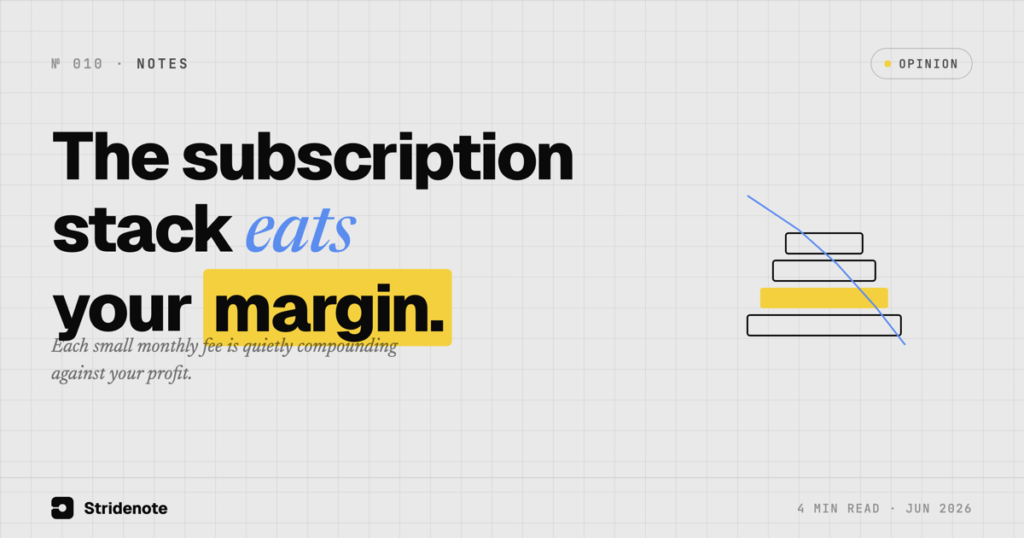
A personal AI subscription is a line item you notice and shrug at. A business AI subscription is something else. It does not stay one line item. It multiplies along two axes at once, and both of them grow exactly when the business is doing well.
This is not about your own bill. It is about the math of running a company on rented AI, where the cost does not scale with value delivered. It scales with headcount and tool count, and that is a different and worse thing.
Per-seat pricing compounds, by design
Most business AI tools charge per seat. That sounds fair until you see what it does over time. The cost of a tool is not its sticker price. It is its sticker price times every person who needs it, and the people who need it tend to be the people you are hiring.
So the moment you succeed, the bill grows. Hire a team and every per-seat tool they touch is now multiplied by the size of that team. Add a second tool and the multiplication starts again from scratch. The structure is built so that growth, the thing you are working toward, automatically increases your fixed cost. Per-seat pricing is not a fee. It is a tax on scaling, and it is collected before you see a dollar of margin.
Two axes, both pointing up
Watch where the growth actually comes from, because it is sneaky.
The first axis is people. Each new hire inherits the standard tool set, and each tool on that set is another per-seat charge. The second axis is tools. The studio adopts one more capability, a transcription service, an image tool, a coding assistant, and that new tool is itself multiplied across the whole team. Multiply the two axes together and you get a cost that grows faster than either one alone. Nobody decides to spend that much. It accrues, one reasonable approval at a time, until it is a number large enough to matter and old enough that nobody questions it.
Margin is the part nobody is watching
Here is why this is a business problem and not just a spending problem.
Revenue gets attention. Margin is what is left after the costs nobody is watching, and rented AI is exactly that kind of cost. It does not show up as a crisis. It shows up as a slow, structural drag, a slice of every project that quietly goes to vendors instead of to the business. The work gets done, the clients are happy, and a growing piece of what you earned never reaches the bottom line, because it was already promised to a stack of monthly invoices that scale with your success.
The local alternative breaks the multiplication
The reason this matters to a studio that runs local AI is that local cost does not multiply the same way.
A model on hardware you own is paid for once, and it does not charge per seat. Add a person and the marginal cost is close to nothing. Add a use and the marginal cost is close to nothing. The cost is tied to the hardware, not to your headcount or your ambitions, which means growth stops being the thing that inflates the bill. You move the cost from a per-seat tax that compounds to a fixed asset that does not. That is the whole structural difference.
The honest counterpoint
Not every per-seat tool should be torn out, and pretending otherwise would be dishonest. Some tools genuinely earn their multiplied cost, because they do work nothing local can match, and the managed handoff is worth real money for the team’s time and sanity. Local AI also carries costs that do not appear on an invoice: setup, maintenance, the hours someone spends keeping it running. The point is not that subscriptions are evil. It is that they should be a deliberate choice, not a default that compounds in the dark.
So do the thing almost no growing business does. Add up your AI subscriptions, then multiply by the people and the tools you expect to have a year from now. Look at where that number is heading before it gets there. Curious about these things. You should be too.
Harness your curiosity.
— Stridenote · № 010