An ARC-AGI-3 random agent, pressing legal keys with no memory and no goal, cleared level one in 12 of the 25 public games. It reached level two in exactly two. It scored, in total, about two points out of a possible 2,500.
That took 1.5 million actions across 25 games, six minutes of our test machine’s time, and it is the floor every real agent has to be measured above. For a team deciding whether an agent project is worth paying model time for, it is also the cheapest result it will get. Here is the floor in detail.
How the ARC-AGI-3 random agent was run
One script, one seed. For each of the 25 public games the agent sent RESET, then chose uniformly from whatever available_actions the frame reported, 60,000 times. Click actions got a random cell, since ACTION6 without coordinates crashes the game. After every GAME_OVER it sent RESET again and kept counting. It recorded the action index at which each level was first completed and how many times it died.
Speed is the first result. The median game took 14.0 seconds for 60,000 actions, all of it local Python, which is why a random baseline is worth running before anything else: it is nearly free, and it tells you what “doing nothing clever” already achieves.
Which ARC-AGI-3 games a random agent clears, and at what cost
Twelve games gave up their first level. The human baseline for that level, from each game’s own metadata, sits beside the random cost:
| Game | Human, level 1 | Random actions to clear | Level score |
|---|---|---|---|
| sp80 | 39 | 288 | 1.83 |
| r11l | 22 | 383 | 0.33 |
| ft09 | 43 | 2,960 | 0.021 |
| lp85 | 17 | 3,821 | 0.0020 |
| m0r0 | 30 | 3,905 | 0.0059 |
| ar25 | 32 | 6,128 | 0.0027 |
| cd82 | 55 | 10,600 | 0.0027 |
| cn04 | 29 | 10,678 | 0.00074 |
| tu93 | 19 | 17,951 | 0.00011 |
| sk48 | 61 | 33,978 | 0.00032 |
| ls20 | 22 | 40,699 | 0.000029 |
| tr87 | 54 | 59,536 | 0.000082 |
The other thirteen games never showed random play a second level.
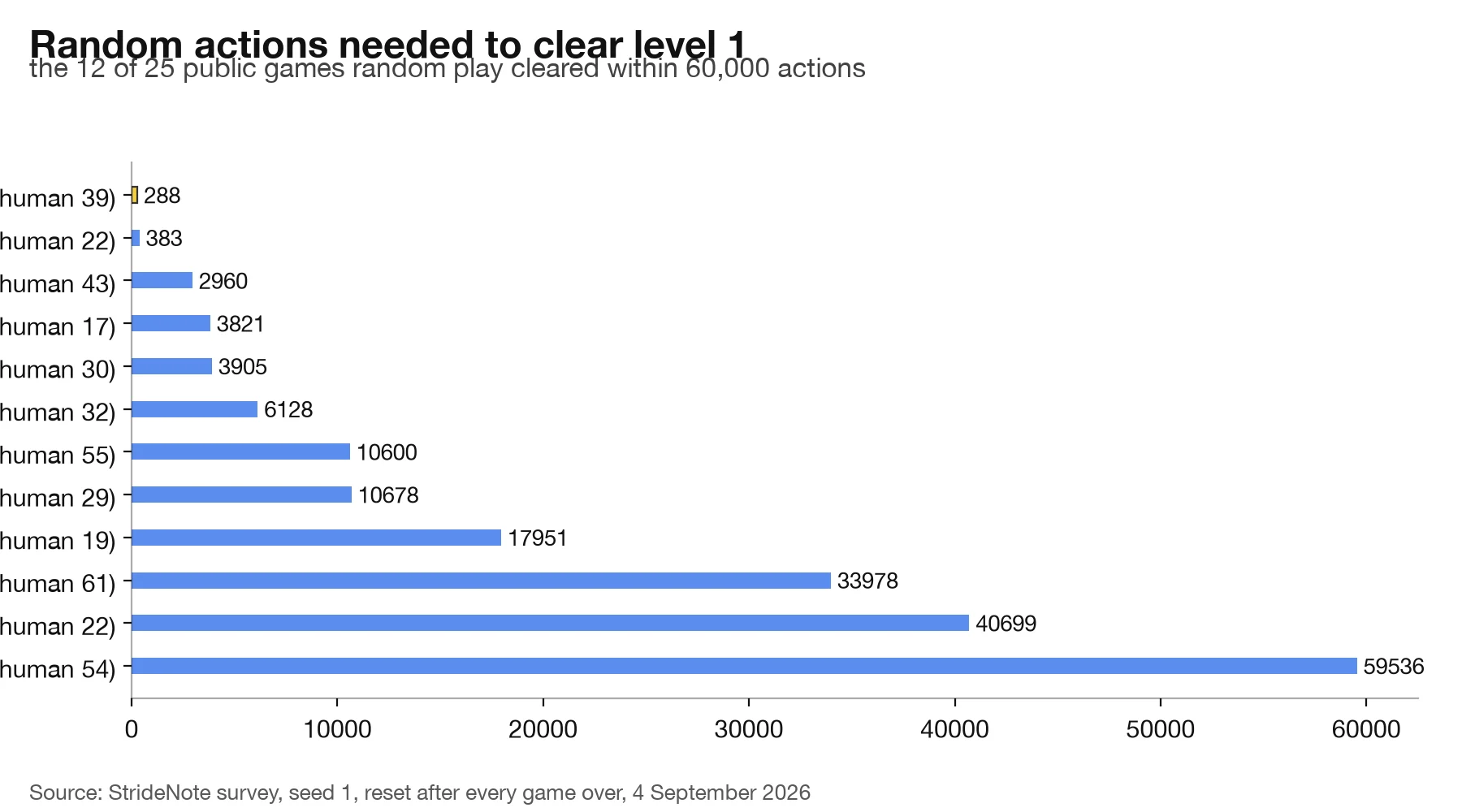
Random actions to the first clear of level 1, seed 1, 60,000 action budget, 4 September 2026. Yellow: the cheapest game for chance. Two of the twelve went further: tu93 cleared level two at action 27,384, against a human 16, and ar25 at action 25,069, against a human 50. Nothing reached level three.
The spread is the interesting part. sp80 and r11l fall to chance in a few hundred moves; whatever their first level asks for, a wandering agent stumbles into it. tr87 took 59,536, and on a different seed might not have made it at all. Three seeds on ls20 gave 40,699, 23,136 and a third that never cleared it in 60,000. A random baseline is a distribution, and one seed is one draw from it.
Sixty thousand is also a large number by the only yardstick that matters. The median public game takes a first time human 638 actions to finish end to end, every level included. Random play had roughly 94 complete human playthroughs’ worth of moves per game, and in 23 of the 25 games it never found the second level. Whatever the second levels ask for, it is not something that happens by accident.
How often random play dies in each ARC-AGI-3 game
The death counts vary by more than a hundred to one. Random play hit GAME_OVER 20 times in 60,000 actions on lp85, once every three thousand moves, and 3,330 times on r11l, once every eighteen. The median across all 25 games was 594.
This is a property of the game, not the agent, and it is worth knowing before you spend a model call on a move. Some games have almost no failure state and will let an agent explore for thousands of actions. Some kill it constantly, and an agent that does not check state after every step and send RESET will spend its entire budget pressing keys at an empty grid. That is the exact silent failure the engine is designed to produce: after a game over, every action except RESET is accepted and ignored.
The technical report happens to have computed one of these numbers analytically. Its graph of ls20 level one notes the “three-life mechanic of the level” and states that the probability of a random win “is exactly 1 in 355”. Our seed one run died 598 times on ls20 before its single clear, which is within a factor of two of what that figure predicts for one lucky attempt in six hundred.
Why 12 cleared levels score almost nothing under RHAE
Add the twelve level scores in the table and you get roughly 2.2. The maximum for twelve first levels would be 1,200, or 2,500 for the 25 games. The best single result, sp80 at 1.83, comes from a level a human finishes in 39 moves that random play finished in 288, and the metric squares that ratio, so seven times the moves becomes a fiftieth of the score.
Ten of the twelve clears score below 0.01. ls20, cleared at 40,699 moves against 22, scores 0.000029. It is a completed level, honestly earned, and it counts for nothing, which is the design working. The scoring methodology exists to make sure that a system which finishes by brute force cannot look like a system that understood the game, and a random agent is the purest brute force there is.
Why run an ARC-AGI-3 random agent before paying for model time?
Because it sets the bar that any spend on a model has to clear, and it costs almost nothing to get. The run above took six minutes of our test machine’s time for 1.5 million actions across 25 games, with no model and no GPU work. A model move is a different order of cost. On the same machine, ARC-AGI-3 on a Mac measured a 31B model at 66.9 seconds a move on an 8 by 8 board and 442.7 seconds on the full 64 by 64 board. Six minutes is 360 seconds, so the whole random survey costs about the same machine time as five model moves at the fastest of those settings (360 divided by 66.9 is 5.4).
That makes the random baseline a gate for a budget decision. Before an agent project asks for hours of model time, or before a supplier’s agent result is accepted, the table above answers the first questions. Compare any claimed clear against the random cost for that game: an agent that needs more than 288 actions on sp80 has done worse than chance on that level, however it was built, and its RHAE score will say so. Ask for the death count beside the clear count. An agent that dies far less often than random play on r11l, which killed the random agent 3,330 times in 60,000 actions, is reading the board; one that dies at the same rate is not.
Then ask whether the scaffold was ever run without a model. Our own first version reported zero levels on every game because it never reset after a game over, and a team that skips the random run can spend model hours finding the same bug. The Mac piece covers what this hardware can and cannot run. This piece covers the step before it: what doing nothing clever already achieves, so a team knows exactly what it is paying a model to beat. On the public set that is two points out of 2,500, for six minutes on our test machine.
What a random baseline is actually for
Not for scoring. For three things it does better than any model run.
It tells you which games are cheap. If random play clears sp80 in 288 moves, an agent that needs 2,000 has learned nothing, and that comparison is available before the first model call.
It tells you the death rate, which sets how much exploration a game tolerates and how much reset handling an agent needs before it can reason at all.
And it catches harness bugs. The first version of this script reported 352,000 actions a second and zero levels on every game, because it never reset after a game over. A random agent that scores zero everywhere is not evidence about the games; it is evidence about your loop. Run it first, read the deaths and the clears, and only then decide what the model is for. On the 25 public games it costs six minutes, and the two points it earns are the two points every agent you build has to beat.
In this series: ARC-AGI-3 on a Mac